
It starts at 11 p.m. with a restlessness you have never seen: your Shepherd pacing, drooling, dropping into a play bow that ends halfway, then standing again as if sitting hurts. He tries to vomit — heaves twice, three times — and nothing comes out. His left flank is beginning to look like a drum. This is the textbook opening scene of german shepherd bloat, the emergency vets call GDV, and it is the one condition in this breed where the difference between 11 p.m. and 1 a.m. can literally be the difference between a dog who comes home and one who does not.
This guide is written for the moment you hope never arrives: what GDV actually does inside the body, the nine signs that demand an immediate drive to the emergency hospital, the risk factors research has actually validated, what treatment costs in 2026 (roughly $3,000–6,000 for emergency surgery), and the prevention plan that lowers the odds. German Shepherds are not the most bloat-prone breed, but they are badly overrepresented — one 2025 clinical review of 130 surgically treated GDV cases found German Shepherds made up 25.4 percent of all patients, more than any other breed in the sample. Know this condition before you need to know it (PMC11851494).
For the breed’s wider health picture, our German Shepherd health problems guide places this emergency alongside every other condition owners should screen for.
What Is German Shepherd Bloat?
The household word for german shepherd bloat hides two escalating problems. Gastric dilatation is the first: the stomach fills rapidly with gas or fluid and balloons like a party balloon in a closed room. In some dogs it stops there — uncomfortable but survivable with treatment. In the worst case the distended stomach rotates on its long axis (volvulus), twisting the entry and exit points shut, sealing the gas inside, and pinching off the blood vessels that feed the stomach wall and the spleen. That twisted state is gastric dilatation-volvulus, GDV, and it is a true five-alarm emergency.
Once the stomach flips, the clock starts running in minutes. Gas has nowhere to go, pressure climbs, and the stomach wall begins to die from lack of blood. Circulation to the back half of the body collapses; toxins pour into the bloodstream; shock follows even though the dog may still be standing and breathing. Untreated, GDV is uniformly fatal — not “often,” but essentially always — and even with excellent surgical care the 2025 review above still lost roughly one dog in seven, a survival rate of 86.4 percent. Speed is the single biggest controllable factor in which side of the german shepherd bloat survival curve your dog lands on.
Two clarifications prevent common mistakes. First, german shepherd bloat is not caused by “a big drink” or a single greedy meal in the simple sense — those can trigger dilatation, but GDV is a mechanical catastrophe in a predisposed anatomy, which is why prevention (below) is about meal structure and gut dynamics, not just portion size. Second, no amount of walking, burping, home remedies, or waiting reliably untwists a stomach; every competent veterinary source treats suspected german shepherd bloat as a drive-now, phone-ahead situation, including Cornell’s emergency guide to GDV. Home management is for preventing the gas buildup — never for treating the twist.
Why German Shepherds Rank High in Bloat Cases
German shepherd bloat risk starts with anatomy — the dice are loaded from birth. German Shepherds are a deep-chested breed: the chest is tall and narrow, which lets the stomach hang with more room to swing, and the ligaments anchoring it are comparatively slack in affected lines. When a full, gas-filled stomach gets the wrong combination of motion and gut contractions, that suspension allows the rotation that defines GDV. Great Danes and other giant breeds top the risk charts, but the Shepherd’s size, chest depth, and eager working-dog eating style place it firmly in the elevated-risk tier — and the 2025 Italian hospital data put the breed at the top of its own 130-case tally at 25.4 percent.
The breed’s psychology adds its own twist. Shepherds eat with purpose, drink like it’s a job, and — crucially — are prone to arousal and anxiety, both of which change how the stomach and gut behave around meals. A genetics study funded by Morris Animal Foundation is currently searching for the inherited components of GDV in German Shepherds specifically, an acknowledgment that the breed’s risk is not just about chest shape but about inherited gut and temperament traits as well. Age concentrates risk in the prime years: in the same 130-case series, dogs aged 5–10 years made up more than half of all cases, and males outnumbered females — intact males most of all.
None of this means your Shepherd is a lottery ticket with a countdown running. It means the breed profile earns you a prevention mindset that owners of Beagles can skip: structured meals, managed water, a fast-eating fix, and a plan for the night it happens anyway. Every one of those is covered below, and none of them costs what one night of german shepherd bloat treatment costs.
The 9 Warning Signs of German Shepherd Bloat
The warning signs of german shepherd bloat follow a recognizable escalation, and the first three usually appear together. Print this list mentally, because on the night it matters you will be running on adrenaline, not research. The unifying theme is a dog trying — and failing — to relieve a stomach that cannot relieve itself:
- Unproductive retching — forceful heaving motions that bring up only foam, saliva, or nothing at all. This is the signature sign, present in the vast majority of GDV cases.
- Distending abdomen — the belly behind the ribs tightens and drums, usually more on the left flank; it can look visibly rounder within an hour.
- Restlessness and pacing — the dog cannot settle, lies down and springs up repeatedly, paces the hallway as if looking for a position that doesn’t exist.
- The failed play bow or half-sit — dogs repeatedly start to lie down or bow and abort the motion; pain and pressure make every position wrong.
- Heavy drooling — thick, ropey saliva from nausea and from being unable to swallow comfortably.
- Rapid, shallow breathing — the ballooning stomach pushes the diaphragm; breathing turns fast and labored long before collapse.
- Pale or grey gums — circulation is failing; gums blanch when pressed and refill slowly. Check this on the night: it is a shock indicator.
- Weakness and wobbliness — the dog staggers, lies flat, or seems suddenly old; this signals shock has arrived, not that the crisis is resolving.
- Collapse or unresponsiveness — the end stage; the dog may still be saved, but minutes now count in single digits.
| Sign | What it looks like in real time | Urgency |
|---|---|---|
| Unproductive retching | Heaves, arches neck, produces foam only | Go now — treat as GDV until proven otherwise |
| Drum-tight belly | Left flank rounds and sounds hollow when flicked | Go now |
| Restless pacing | Cannot settle for more than a minute | Go now if combined with retching or belly |
| Drooling + fast breathing | Ropey saliva, shallow rapid chest movement | Go now |
| Pale gums, staggering | White/grey gums, slow refill, wobbly rear | Emergency — shock is underway |
| Collapse | Flat out, barely responsive | Seconds count — call en route |
One practical note on checking a Shepherd: their thick double coat hides early abdominal distension from the eye, so learn to feel your dog’s normal belly shape today — a flat, soft curve behind the last rib. German shepherd bloat hides behind a double coat; fingers beat eyes every time. On a suspicious night, fingers beat eyes. And when in doubt, go: emergency hospitals would far rather X-ray a false alarm than explain a delay to a grieving family, and simple dilatation caught early is treated with far less trauma than a full twist.
Bloat or Something Else? The Lookalike Problem
Not every swollen belly or vomiting episode is german shepherd bloat, and knowing the impostors keeps you calm enough to judge speed correctly. Simple gastric dilatation — gas without twist — produces discomfort and a rounded belly but usually with productive vomiting and less dramatic restlessness; it still warrants a same-night visit, but the stakes are lower. Gastroenteritis brings repeated vomiting and diarrhea, with a soft (not drum-tight) belly. Spleen problems, pancreatic flares, and heatstroke can each mimic parts of the picture. The table below sorts the signals at a glance:
| Condition | Belly feel | Vomiting | Behavior | Action |
|---|---|---|---|---|
| GDV (twist) | Drum-tight, left flank rounder | Unproductive retching | Pacing, can’t settle, shock signs | ER immediately |
| Simple dilatation (gas) | Rounded but softer | Often productive | Uncomfortable, still settles | ER same night |
| Gastroenteritis | Soft | Repeated, productive | Depressed but restable | Vet today / ER if blood |
| Splenic mass bleed | Swollen, pale gums | Rare | Weak, collapsing spells | ER immediately |
The trap to avoid is the reverse error: convincing yourself it’s “just gas” without evidence. If two of the four GDV hallmarks are present — unproductive retching, tight belly, pacing, drooling — the lookalike debate is over, because the cost of an unnecessary ER trip is a few hundred dollars and the cost of a wrong guess is the 13.6 percent of the survival curve you handed to hesitation. Vets resolve the ambiguity with a single lateral X-ray in under five minutes; that film is the only legitimate tiebreaker between lookalikes and true german shepherd bloat, and it only exists at the hospital.
The First 60 Minutes: What To Do If You Suspect Bloat
Suspected german shepherd bloat rewrites every normal rule of “wait and see.” Your job in the first hour is not diagnosis — it is buying the surgeon time. Move through this sequence without debating yourself: first, stop all food and water immediately (a stomach already filling does not need more material); second, call the emergency hospital while someone else starts the car if you can — phone-ahead matters because the team prepares decompression and anesthesia the moment they hang up.
Third, drive. Do not walk the dog to “help him pass gas,” do not massage the belly, do not attempt to induce vomiting, and do not wait to see if it settles: every one of those delays converts treatable dilatation into twisting, and twisting into shock. German shepherd bloat punishes hesitation more than any other mistake.
On the way, keep the car cool and quiet, let the dog stand or lie however he chooses (forcing a position adds pain without benefit), and have someone sit with him for reassurance without crowding. If you do not know where your 24-hour hospital is, you are reading this at the right time: tonight, before you need it, find the nearest one, confirm they do GDV surgery in-house, and save the address in your phone. The difference between the ER that can operate and the one that must refer you is often 45 minutes — roughly the margin the german shepherd bloat survival statistics care about.
At the hospital, expect a triage tech to take your dog immediately, a quick history (what happened, when it started, last meal), and a single lateral X-ray that settles the diagnosis in minutes. Bloodwork — especially lactate, the chemical fingerprint of oxygen starvation — follows, and then either decompression (a tube or needle that releases the gas) with continued stabilization, or straight to surgery. Ask one question and accept the answer: “Does my dog need surgery tonight?” In confirmed german shepherd bloat the answer is effectively always yes, because even a successfully decompressed stomach that stays twisted will keep strangling its own blood supply.
Risk Factors Backed by Research
Bloat research spans five decades and several continents, and the factors that survive scrutiny as drivers of german shepherd bloat cluster around meal mechanics, anatomy, and temperament. The largest classic studies — Purdue University’s multi-year investigations of large and giant breeds — plus the recent 130-case hospital review converge on a practical picture. Here is what actually raises risk, ranked roughly by how actionable each item is:
- One large meal per day — the single most cited german shepherd bloat dietary risk factor; dogs fed once daily bloat far more often than dogs fed twice. Volume per meal stretches the stomach ligaments that are supposed to hold it in place.
- Fast eating — gulping air with food (aerophagia) is strongly associated with GDV; speed-eaters are overrepresented in case series, which is why slow feeders exist.
- Dry food as the entire diet — all-dry feeding shows higher association in several studies; adding moisture or canned food appears protective in some analyses, though the mechanism is debated.
- Deep, narrow chest — the anatomy you cannot change; deep-chested breeds dominate every risk table, and within breeds, the leaner, taller dogs measure higher risk than chunky ones.
- Temperament and stress — fearful, high-strung, or recently stressed dogs bloat more; hospital data repeatedly note the breed-typical anxious arousal pattern. Our guide to german shepherd separation anxiety covers the arousal side of that equation.
- Family history — first-degree relatives of GDV victims carry sharply elevated risk; if a sibling or parent of your dog twisted, your prevention bar should rise a notch.
- Age and sex — risk climbs through middle age (5–10 years dominates case series), and males — especially intact males — twist more often than females.
- Exercise around meals — vigorous activity within an hour of a full meal is repeatedly flagged; the full stomach swings in that slack suspension.
One “tip” from older internet lore deserves its autopsy: elevated feeding bowls are not protective. The Purdue work actually associated raised bowls with increased risk in large breeds, a finding that reversed conventional wisdom and that modern guidelines reflect. Floor-level feeding, smaller more frequent meals, and slower intake are the evidence-based german shepherd bloat prevention triad; chrome feeders are furniture, not medicine. Cornell’s GDV overview reaches the same practical conclusions for owners.
GDV Surgery: What Actually Happens at the Hospital
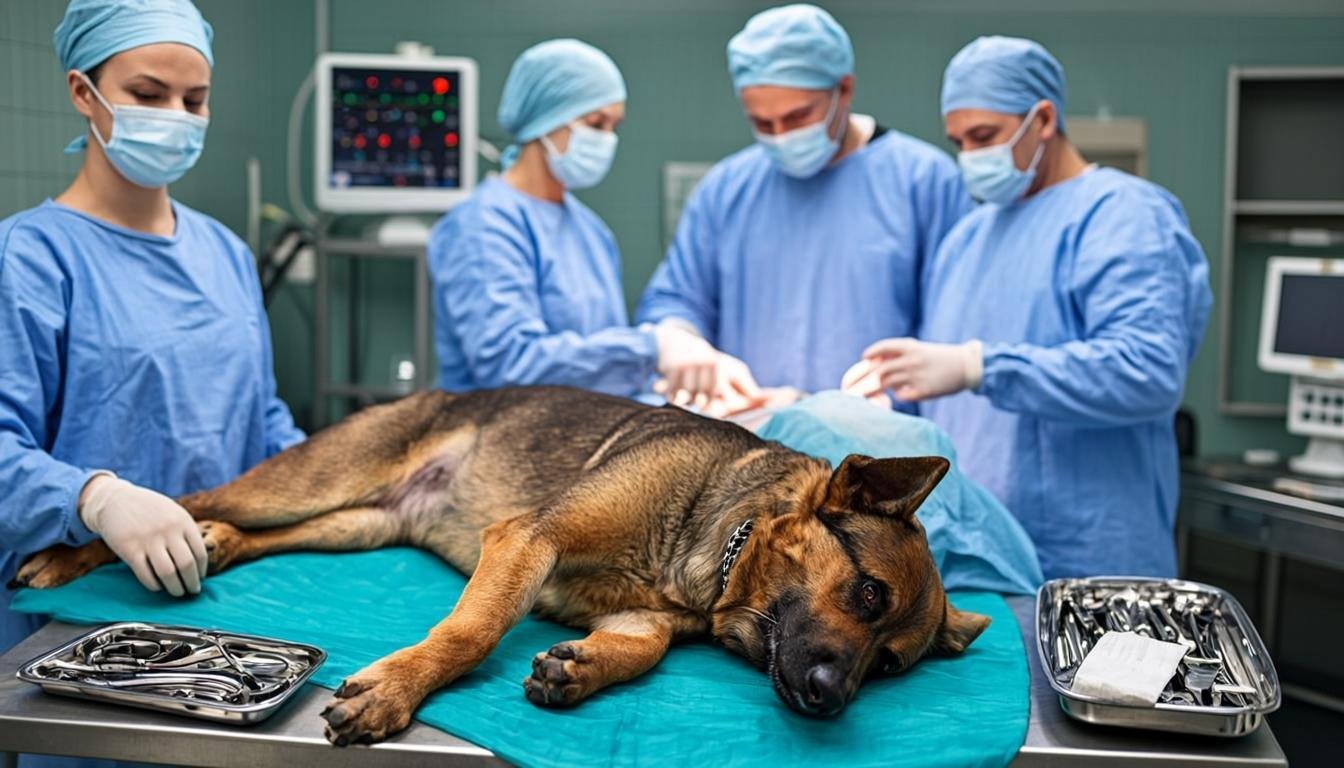
Understanding the hospital sequence helps you answer the consent questions and the bill questions in one breath. Stabilization comes first: IV catheters, shock-fluid boluses, pain control, sometimes decompression through the body wall with a large-bore needle if pressure is severe. Bloodwork measures lactate and organ values; arrhythmias — common as the reperfusing stomach releases its toxins — get monitored and treated. A dog that arrives in shock may need one to two hours of stabilization before anesthesia is safe, which is precisely the time your phone-ahead call bought.
Surgery itself follows a fixed script: the surgeon opens the abdomen, deflates the stomach, rotates it back to anatomical position, and assesses the wall for dead tissue — regions that have lost blood supply must be resected, and if the spleen is damaged, it comes out too (the 2025 series reported splenectomy in a meaningful minority of cases).
Then comes the part that matters for the future: a gastropexy, where the stomach’s outer edge is tacked permanently to the abdominal wall so the organ can never fully twist again — the anchor that ends the deadly german shepherd bloat mechanism permanently. The incisional gastropexy has replaced the older “belt-loop” technique in most hospitals, per the same review. Gastropexy prevents volvulus with high reliability — it does not prevent future gas dilatation, so the feeding rules still apply afterward.
Recovery from german shepherd bloat surgery runs two to five days of hospitalization for uncomplicated cases: continued IV fluids, heart-rhythm monitoring, gut-quiet medications, and staged refeeding. Survival for surgically treated german shepherd bloat was 86.4 percent across the 130-case series, with death concentrated in dogs that arrived in advanced shock or needed stomach-wall resection. The sobering corollary: survival was best when surgery happened early, which is the entire argument of the nine signs above. A dog that walks into the hospital on his own feet has odds no hospital can offer a dog that arrives flat.
GDV Surgery and Treatment Cost in 2026
German shepherd bloat is one of the most expensive emergencies in small-animal medicine, and honest numbers help you prepare for it in advance rather than mid-crisis. Contemporary US pricing puts emergency GDV surgery — decompression, stabilization, derotation with gastropexy — at $3,000 to $6,000, with complicated cases (stomach resection, splenectomy, multi-day ICU, arrhythmia treatment) pushing well past that range. Consumer health pricing guides place the typical emergency gastropexy bill in exactly that window (GreatPetCare’s bloat surgery cost breakdown).
| Item | Typical range (US, 2026) | Notes |
|---|---|---|
| ER exam + triage | $150–350 | Often due up front at emergency hospitals |
| Diagnostics (X-ray, bloodwork, lactate) | $400–900 | The lateral film that confirms GDV |
| Stabilization (IV fluids, meds, monitoring) | $800–2,000 | Longer in shock cases |
| GDV surgery + anesthesia | $2,000–4,000 | Core derotation + gastropexy for german shepherd bloat |
| Hospitalization 2–5 days | $1,000–2,500 | ICU rates apply in complicated cases |
| Typical emergency total | $3,000–6,000+ | Resection/splenectomy/ICU push higher |
| Preventive gastropexy (elective) | $800–2,500 | Laparoscopic at the lower end; often bundled with spay/neuter |
Run the german shepherd bloat prevention math honestly: a $1,500 elective gastropexy at neutering age versus a $4,500 emergency with a 14 percent failure rate and a dog in shock is not a hard equation. Pet insurance changes the picture further — GDV is covered under accident-and-illness policies precisely because it is not pre-existing, and our best pet insurance for German Shepherds review shows which insurers handle emergency surgery claims smoothly. Whatever you choose, choose it before the 11 p.m. pacing starts; insurance bought at the ER door does not exist.
Prevention: 7 Changes That Cut Your Shepherd’s Risk
You cannot shorten a German Shepherd’s chest, but you control the mechanics that fill and swing the stomach, and that is where german shepherd bloat prevention lives. These seven changes cost little, demand no heroics, and together attack the validated german shepherd bloat risk factors from the research section. Apply them from adulthood onward, and apply them strictly if your dog has any family history of GDV:
- Split the daily food into two or three meals. Single-meal feeding is the most repeated dietary risk factor in GDV research; two smaller meals halve the stomach load that stretches the anchoring ligaments.
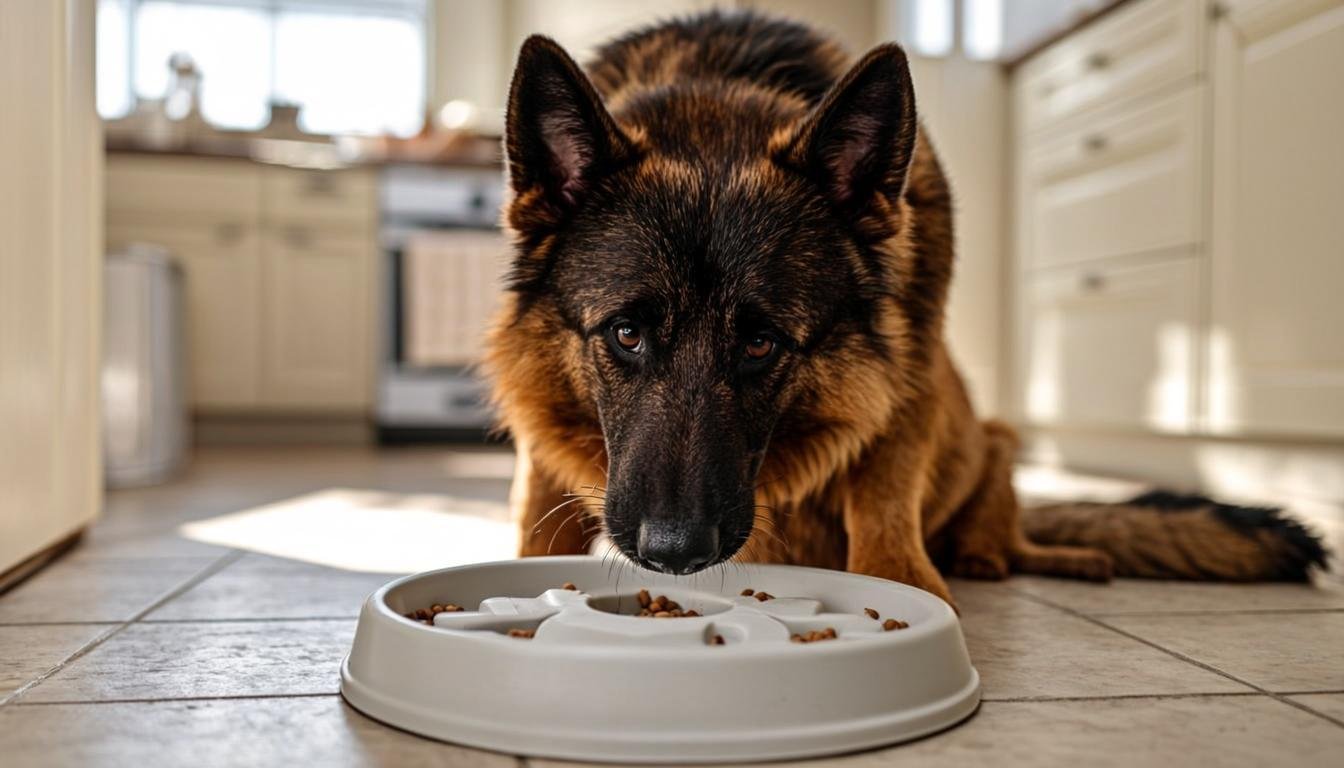
- Slow the eating down. A slow-feeder bowl or muffin-tin game turns a two-minute gulp into a ten-minute forage, cutting the air-swallowing that inflates the stomach — the mechanical engine of german shepherd bloat. Our treats and calorie budgeting guide shows how to fund the extra enrichment without overfeeding.
- Guard the hour around every meal. No fetch sprints, no rough play, no long car rides on a full stomach; a calm hour before and after lets the stomach empty before it moves.
- Feed at floor level. Elevated bowls lost their reputation when the Purdue data associated them with higher risk; the floor is the evidence-based height.
- Manage water strategically. Moderate drinking with meals is normal, but discourage tank-drinking sessions right after exercise — a stomach full of water and food is the loaded version of the organ.
- Lower the arousal baseline. Chronically stressed, sleep-poor dogs bloat more; a predictable day with real rest is medical advice here, not lifestyle garnish. Our german shepherd daily routine blueprint builds exactly that structure.
- Know your emergency plan cold. Nearest 24-hour hospital that does GDV surgery in-house, saved in your phone, discussed with your household. Rehearse who drives, who calls, who holds the leash.
Recommended gear for this stage:
- Slow-feeder bowls for large dogs (Amazon) — the single most practical anti-gulping tool for a breed that inhales meals.
- Interactive puzzle feeders (Amazon) — turns meals into ten minutes of brain work while slowing intake to research-approved speeds.
- Pet first aid kits (Amazon) — for the glovebox: emergency contacts, muzzle, and basics while you drive to the ER.
None of these steps guarantees immunity — a genetically unlucky stomach can twist despite perfect management — but stack them and you have removed most of the controllable load. Owners who follow this german shepherd bloat list are also the ones who recognize the nine signs fastest, because structured feeding makes any deviation from the routine obvious within minutes instead of hours.
Preventive Gastropexy: Is It Right for Your Shepherd?
The same gastropexy that anchors the stomach during emergency surgery can be done electively, before any bloat has ever happened, and for high-risk dogs it is the strongest single german shepherd bloat prevention measure available. The procedure tacks the stomach’s outer edge to the body wall — a permanent anchor that does not change digestion, appetite, or temperament — and studies report volvulus recurrence after properly performed gastropexy to be rare. Modern technique favors laparoscopy: two or three small ports, less pain, faster recovery, and it is routinely bundled with spay or neuter anesthesia to avoid a second visit (PetMD’s gastropexy overview covers indications and recovery in detail).
Who should seriously consider german shepherd bloat prophylaxis? Shepherds with a first-degree relative who bloated, dogs already treated for simple dilatation episodes, males in the 5-plus age band with the deep-chested anatomy, and any owner whose distance from a surgical ER is measured in hours rather than minutes. The decision is a conversation between your vet and your budget — elective pricing runs $800–2,500 depending on approach and region — but the calculus tilts strongly in favor when risk factors stack. A working-line male with an anxious temperament and a GDV uncle is a different proposition from a placid, chunky female from a clean pedigree.
Two honest limits close the topic. Gastropexy prevents the twist, not the gas: slow feeding and meal structure remain mandatory afterward. And it is not a license to ignore the signs — a gastropexied stomach can still dilate painfully, which merits a same-night vet visit even though full GDV is now off the table. Think of the procedure as a seatbelt against the worst german shepherd bloat outcome: it does not remove the need to drive carefully, but it changes what a crash costs.
German Shepherd Bloat FAQ
Can german shepherd bloat resolve on its own?
Simple gas dilatation occasionally improves with burping and calm — but true german shepherd bloat never does. The problem is that you cannot reliably tell them apart at home, and waiting is the one variable that reliably worsens outcomes. Treat any unproductive retching with a tight belly as a drive-now emergency; if it turns out to be gas, you have bought peace of mind for a few hundred dollars.
How fast does GDV progress?
Faster than almost any other canine emergency: german shepherd bloat can go from first restlessness to shock within one to two hours, and the literature documents death within a few hours of onset in untreated cases. This is why the guide repeats one message — the signs section exists to compress the time between “something’s wrong” and “wheels rolling toward the hospital.”
Are elevated feeding bowls good for large dogs?
The old advice said yes; the Purdue research said the opposite, associating raised bowls with increased GDV risk in large breeds. Unless your veterinarian prescribes elevation for a specific medical reason (megaesophagus, severe arthritis), floor-level feeding is the evidence-based german shepherd bloat prevention default for German Shepherds.
Can a German Shepherd puppy bloat?
German shepherd bloat in young puppies is rare but documented, especially in fast-growing adolescents who gulp meals and sprint afterward. The prevention rules apply at every age, and puppy owners should treat unproductive retching with the same urgency as adult-dog owners — small stomachs twist too.
Does gastropexy guarantee no bloat ever again?
Gastropexy prevents the deadly german shepherd bloat twist with high reliability, which is why surgeons do it. The stomach can still dilate with gas, so slow-feeding and meal management remain part of life. What disappears is the catastrophic scenario: a stomach that cannot twist cannot strangle its own blood supply.
Is bloat more common at certain times of day?
Case series show german shepherd bloat peaking in the evening hours — the interval after the main meal of the day, when the stomach is full and the household winds down. It is a strong argument for splitting dinner into two servings and for knowing your emergency hospital’s location before the lights go out.
Your next step: tonight, not someday — save the address and phone number of the nearest 24-hour hospital that performs GDV surgery, feel your dog’s normal belly so you know what “not normal” feels like, and if your Shepherd matches the high-risk profile, ask your vet about elective gastropexy at the next visit. Preparation is the only part of german shepherd bloat you fully control, and it takes one evening.
Sources and Limits
Affiliate disclosure: As an Amazon Associate, German Shepherd Haven earns from qualifying purchases made through marked links on this page, at no extra cost to you.
The references below informed this german shepherd bloat guide. This article is educational and is not a substitute for emergency veterinary care; if you suspect bloat, go to the nearest hospital now and read later. Key references consulted: the 2025 clinical review of 130 surgically treated GDV cases (linked above; breed distribution, survival rate, surgical technique trends); Cornell University’s owner guide to GDV; the AKC’s bloat signs overview; PetMD’s gastropexy procedure guide (linked above); and GreatPetCare’s cost breakdown for emergency and preventive surgery.
Cost figures are 2026 US market estimates and vary by region, hospital, and case severity. Risk-factor research (Purdue University dietary and non-dietary studies) is summarized in plain language; individual risk assessment belongs with your veterinarian, who knows your dog’s history, conformation, and temperament.