
A realistic german shepherd daily routine is the difference between a calm office companion and a dog that invents chaos during your 2 p.m. call. German Shepherds thrive on predictability: anchored meals, exercise, enrichment, and rest make the workday manageable for both of you. This guide builds a german shepherd daily routine around a remote-work calendar, with sample schedules, interruption plans, and the training cues that hold everything together when meetings run long.
Affiliate disclosure: As an Amazon Associate, German Shepherd Haven earns from qualifying purchases made through marked links on this page, at no extra cost to you. See our full Affiliate Disclosure.
Understand your German Shepherd’s core needs
Before you create a schedule, remind yourself of the basic building blocks of a healthy day for a German Shepherd: sufficient physical exercise, mental stimulation, social interaction, and predictable downtime. Age, health status, and past training all change how much of each your dog needs. Puppies and adolescents often need more frequent interaction and short bursts of activity, while mature adults have steadier energy patterns. Age shapes energy, but a german shepherd daily routine shapes behavior.
Use reputable resources to shape your approach to training and welfare. The American Veterinary Society of Animal Behavior offers position statements and behavior guidance to support humane, evidence-based methods, especially around training and management. The RSPCA provides practical, reward-focused training advice that is suitable for people working on routines at home. Borrow their structure and adapt it to a german shepherd daily routine that fits your calendar.
Designing a realistic german shepherd daily routine
A routine should be realistic for both your work demands and your dog’s needs. Below is a framework you can adapt depending on meeting schedules, time zones, childcare, and other household responsibilities. A german shepherd daily routine survives busy weeks when it is built from anchors, not exact times.
Morning (before work)
- Active walk or play session (20–45 minutes): Start with brisk walking, a game of fetch, or a short run if your dog is fit. This helps dissipate morning energy and primes your dog for calmer periods.
- Breakfast + short calm time (10–20 minutes): Feed and give a quiet opportunity to settle before you start work. Consider putting a chew or a food-dispensing toy in a safe space to encourage independent activity.
- Short training session (5–10 minutes): Practicing a few basic cues like sit, wait, and settle reinforces good habits and puts the dog in a learning mindset.
Midday (work-blocks)
Plan for at least one to two short breaks during the core workday. These are essential for both you and your dog. Protect these breaks like meetings; a german shepherd daily routine collapses when midday disappears.
- Midday walk or play (15–30 minutes): A brisk walk or focused play helps break up the day and relieves restlessness.
- Enrichment time (10–20 minutes): Puzzle feeders, scent games, or supervised interaction with long-lasting chews provide mental work while you return to your desk.
Afternoon and evening (after work)
- Longer exercise session (30–60 minutes): Evening is often the best time for a more relaxed, social walk or training class visit.
- Family time and social interactions: Dogs are social animals; time with household members reinforces bonds and reduces separation-related stress at night.
- Calm wind-down and bedtime routine (30–60 minutes before sleep): Low-key activities and a consistent bedtime help your dog distinguish work hours from rest hours.
Exercise and enrichment strategies that fit a home-based workday
German Shepherds need both physical outlets and brain work. Balancing these two areas improves behavior and makes long stretches of calm more likely. Balance is what turns a schedule into a genuine german shepherd daily routine rather than a wishlist.
Physical exercise examples
- Brisk walks or jogs: Good for cardiovascular fitness and scent exploration.
- Fetch and tug in a safe space: Short, focused bursts help burn energy quickly.
- Structured games: Agility basics, obedience sequences, or safe backyard games provide both movement and discipline.
Mental enrichment examples
- Food puzzles and snuffle mats to slow feeding and engage the nose.
- Scenting games—hide treats or toys around the house for the dog to find.
- Obedience or trick training in short bursts to keep the mind active.
- Rotating toys to keep novelty without needing to buy new items constantly.
Rotate activities across days to prevent boredom. Even ten minutes of focused enrichment can be more valuable than a longer period of unstructured time. Stack enrichment right before your deep-work blocks and your german shepherd daily routine starts working for you.
Crate, rest, and creating safe downtime
Many dogs benefit from a predictable rest area. A crate, gated corner, or quiet room can become a positive den when introduced correctly. The goal is a calm, comfortable place the dog chooses for rest—never used for punishment. Downtime is a skill, and a german shepherd daily routine teaches it faster than any single command.
Recommended gear for this stage:
- Programmable automatic feeders (Amazon) — keeps meal times exact even mid-meeting.
- Large-capacity water fountains (Amazon) — fresh water through long work blocks.
- Lick mats for calm downtime (Amazon) — a repetitive calming activity for post-walk rest.
- Introduce gradually: Pair the space with high-value treats or a long-lasting chew during short, pleasant sessions.
- Keep the area comfortable: Bedding, toys, and water (if appropriate) help the dog settle for longer periods.
- Respect limits: If your dog becomes anxious about confinement, work with a qualified, reward-based behavior professional to develop a plan. The American Veterinary Society of Animal Behavior lists resources and position statements that can guide humane approaches.
Managing work interruptions and maintaining focus
Remote work often brings unpredictable interruptions. Planning reduces stress for both you and your dog. Buffer time is the secret ingredient in a german shepherd daily routine built around meetings.
- Use scheduled breaks: Align your core focused work blocks with your dog’s nap times after exercise and enrichment.
- Visual cues: Use a physical barrier, a pet gate, or a mat to indicate when you are not available for petting or play.
- Pre-arranged signals: Teach a ‘settle’ cue and reward calm behavior. Over time, your dog will learn that when you are at your desk, quiet behavior earns reinforcement later.
- Backup plans for busy days: If an intense meeting day falls ahead, arrange a midday dog walker, pet sitter, or friend to provide extra activity and social time.
Training basics that support your german shepherd daily routine
Consistent, positive methods accelerate progress and maintain a trusting relationship. Avoid punitive techniques; they risk stress and setbacks. Use brief, frequent sessions and clear expectations. Short daily reps turn cues into the quiet machinery of a german shepherd daily routine.
Reward-based approaches
Positive reinforcement—rewarding behaviors you want to see—builds habits efficiently. The RSPCA and AVSAB both endorse humane, reward-focused strategies for teaching and problem prevention. Keep training sessions short (5–10 minutes), focus on one cue at a time, and end on a successful note. Ten trained minutes inside a german shepherd daily routine outperform an hour of weekend drilling.
Practical cues that help a workday
- Settle/Place: Teach your dog to lie down on a mat and relax on cue for short periods.
- Wait/Stay: Useful for meal times, doorways, and when interruptions arise.
- Quiet: Reward a lack of barking with calm attention or a treat when the dog stops on cue.
For more structured guidance on humane training methods, consult the RSPCA’s training advice and the AVSAB resources for behavior professionals and owners. Bookmark both; they pair well with any german shepherd daily routine you design.
Handling common routine and management challenges
Even well-planned days run into problems. If your German Shepherd becomes overly vocal, destructive, or anxious, look at three areas: exercise quantity and quality, enrichment variety, and consistency in rules. Some common issues and practical responses: Most of these fade within weeks once a german shepherd daily routine stabilizes sleep, meals, and exercise.
- Boredom-driven chewing: Rotate safe chew toys and introduce puzzle feeders at mealtimes.
- Excess barking: Increase nose work and short, frequent training sessions; teach a reliable quiet cue.
- Separation-like anxiety when you move around the house: Build short, supervised departures and returns so the dog learns being alone is temporary and safe.
If behaviors are persistent or escalate, consult a qualified, reward-based behavior professional. For a summary of typical difficulties and management strategies, see this article on common routine and management challenges for German Shepherds. Use it as a checklist whenever your german shepherd daily routine drifts off track.
Socialization and outside-the-home interactions
A work-from-home life can reduce incidental social exposure. Intentionally schedule social interactions to maintain your dog’s comfort around people and other dogs. Social slots belong in a german shepherd daily routine the way meetings belong in yours.
- Dog parks and group classes: Use these opportunities selectively based on your dog’s temperament and vaccination status.
- Safe, supervised playdates: Short, calm visits with a well-matched friend can be valuable.
- Professional classes: If you want structured progress, look for reward-based trainers or group classes recommended by reputable animal welfare organizations.
Always manage risk: ensure vaccinations and parasite control are up to date and monitor interactions closely. If you’re unsure which environments suit your dog, a local trainer or veterinarian can advise based on your dog’s history.
Sample german shepherd daily routine: a full week
Below is one adaptable example for a typical workweek. Adjust times and durations to fit your hours and your dog’s energy level. This is what a realistic german shepherd daily routine looks like on paper: anchor times matter more than perfect minutes.
Sample weekday
- 6:30–7:15 a.m.: Brisk walk or play session (20–40 minutes), breakfast, restroom break.
- 8:30 a.m.: Short training session (5 minutes) — practice settle and wait.
- 10:30 a.m.: 15-minute enrichment break — food puzzle or sniffing game.
- 12:30–1:00 p.m.: Midday walk or active play (20–30 minutes).
- 3:00 p.m.: Brief grooming/check or another enrichment toy while you handle a work task.
- 5:30–6:30 p.m.: Longer exercise session — social walk, training class, or structured play.
- 7:00 p.m.: Dinner and calm family time; short, gentle training/reinforcement of quiet behavior.
- 9:30–10:00 p.m.: Short potty break and bedtime routine.
Weekend adjustments
Use weekends for longer outings, variety, and deeper training sessions. Plan novel enrichment (new scent trails, supervised off-leash parks where allowed) and social opportunities. Weekend flexibility keeps a german shepherd daily routine from becoming brittle.
Quick practical tips
- Batch plan enrichment toys (rotate three sets) so novelty is ready each day.
- Use smartphone alarms or calendar blocks to schedule short activity breaks.
- Document what works: a brief journal entry noting energy levels and behaviors helps you adapt the plan week to week.
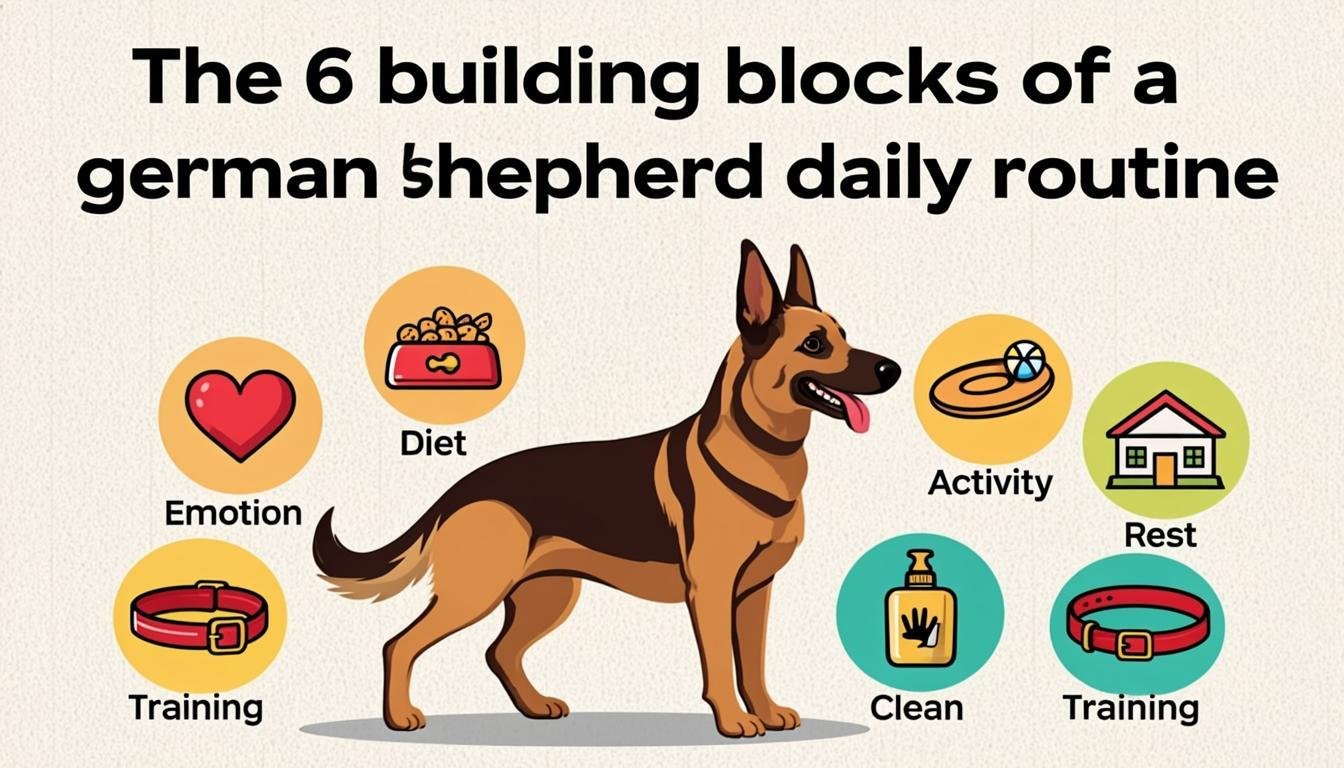
The 6 building blocks of a german shepherd daily routine
Every sustainable german shepherd daily routine is assembled from the same six components, arranged around your work calendar. Understanding the blocks matters more than copying any single schedule, because your meetings, timezone, and household are unique while your dog’s needs are not. When something breaks during a chaotic week, you will know exactly which block failed and how to patch it without dismantling the whole day.
| Block | Daily amount | Best timing | Purpose |
|---|---|---|---|
| Structured exercise | 60–90 min total | Before work + after work | Physical release that prevents indoor restlessness |
| Sniffing / decompression walks | 15–30 min | Midday or evening | Lowers arousal better than high-speed play |
| Training sessions | 2 × 5–10 min | Before meetings | Mental fatigue and clear communication |
| Enrichment / chewing | 1–2 items | During long work blocks | Occupies the mouth and brain productively |
| Rest / settled downtime | 12–14 hrs (incl. night) | Between blocks | Where actual growth and calm happen |
| Social contact | Family time + planned outings | Evenings / weekends | Keeps the breed’s people-focus healthy |
Notice the proportions: rest dominates, exercise is substantial but not endless, and training is small but daily. Owners sometimes assume a working breed needs constant activity, yet a well-designed german shepherd daily routine teaches the opposite — that off-switches are trained, expected, and rewarding. Rotate enrichment rather than escalating it; a snuffle mat on Tuesday stays more valuable than a fourth walk on Wednesday. The blocks also tell you what to protect when life interferes: if you must cut something during a deadline crunch, trim social outings before you ever trim the pre-work exercise block.
Finally, sequence matters. Exercise before training lowers arousal so learning sticks; enrichment before deep work buys you ninety quiet minutes; decompression after conflict or commotion resets the nervous system. A german shepherd daily routine is not a timetable to obey but a set of cause-and-effect tools — once you feel the sequencing logic, you can improvise any day without your dog noticing the difference.
A shift-worker routine: when your hours move
Remote work is not always nine to five. Support shifts, client timezones, and split days all challenge a fixed schedule, and Shepherds cope better than most breeds with variation — provided the variation is rhythmic rather than random. The trick for a nonstandard german shepherd daily routine is keeping the order of blocks identical even when clock times move: exercise always precedes your focus hours, training always precedes your longest meetings, and the last block before sleep is always calm and low-light.
Anchor events are your stabilizers. Dogs cannot read clocks, but they read sequences brilliantly, so a german shepherd daily routine for shift workers relies on ritual markers: the same mat for settling, the same phrase before focus hours, the same pre-break stretch routine. When your Tuesday starts at noon, the sequence still says workday to your dog, and behavior holds. Aim to keep at least two anchors constant every single day regardless of shifts — typically meal times and the final wind-down — because those two carry most of the predictability weight.
Night shifts deserve one extra caution. A german shepherd daily routine that keeps a dog awake through your nocturnal work hours should still end with a real dawn-time sleep block in a darkened room, and exercise should avoid the hottest hours. If shift patterns rotate weekly, hold the sequence constant and let the times flex; if your schedule is simply chaotic, outsource one exercise block to a walker so at least one anchor never moves. Our German Shepherd as a house dog guide“>house dog guide has more on adapting breed needs to indoor life.
Rainy days, sick days, and travel: the flexible version
Every german shepherd daily routine needs a degraded mode for days when walks are impossible or you are bedridden with flu. Planning the fallback in advance turns a broken schedule from a behavior crisis into a mild inconvenience. The flexible version keeps three things fixed — meal anchors, one ten-minute training touchpoint, and one real enrichment session — while compressing everything else into whatever the day allows.
For weather days, indoor blocks carry the load: hallway recall drills, hide-and-seek with a favorite toy, stair sprints for able adults, and a longer chewing session. For sick days, pre-portioned puzzle feeders and a frozen stuffed Kong buy rest while the routine’s skeleton stays visible to your dog. For travel days, a german shepherd daily routine travels surprisingly well: replicate the morning exercise block in a new location before you start work, and your dog settles as if nothing happened. If absences during travel trigger distress at home, our separation anxiety training plan“>separation anxiety plan is the companion read.
The deeper lesson is that consistency of pattern beats consistency of clock time. Dogs do not mind that Tuesday looked different; they mind that nothing made sense. A german shepherd daily routine with a known fallback mode communicates continuity even when the day collapses, and that communication — more than any single walk — is what keeps a working-breed housemate calm through imperfect weeks. Adjust feeding amounts slightly on low-activity days; our feeding and nutrition guide“>nutrition guide covers the calorie math.

FAQ: german shepherd daily routine questions
How much exercise does a german shepherd daily routine need on workdays?
Most healthy adults do well with 60–90 minutes spread across the day, plus mental work. A german shepherd daily routine built around two substantial blocks — before and after work — with a midday top-up covers the need without exhausting the dog into stress.
Can a german shepherd daily routine reduce barking during calls?
Yes, dramatically. Barking at home office life is usually arousal without an outlet. When a german shepherd daily routine places enrichment and exercise before long meeting blocks, most call-time barking fades within two to three weeks of consistency.
Should I wake my dog to keep the schedule on time?
No. Sleep is a block in its own right. Anchor the activities around rest; a german shepherd daily routine that sacrifices naps for punctuality produces a tired, reactive dog and misses the point of scheduling entirely.
What if my partner’s schedule breaks the routine?
Share the block map, not the timetable. Two people can run one german shepherd daily routine from different calendars as long as everyone respects the sequence and the same house rules. Consistency of expectations matters more than who holds the leash.
When should a routine change to fit aging?
Revisit blocks at every life stage: puppies need micro-blocks and naps, adolescents need more structure, seniors need shorter but more frequent gentle outings. A german shepherd daily routine is a living document — review it seasonally the way you review your own calendar.
The tools that keep the routine on track
A german shepherd daily routine lives or dies on friction: the fewer taps, prep steps, and decisions each block requires, the more days you actually run it. The toolkit below costs little and saves the plan on the days motivation is low. None of it is clever; all of it works, because consistency is an infrastructure problem as much as a discipline problem.
Visual scheduling for the household. A whiteboard or printed block chart on the fridge does two jobs at once: it tells family members whose turn the evening walk is, and it shows the dog’s day as a sequence everyone can see. Mark blocks with magnets or dry-erase checks. Households that can see the plan skip it measurably less, because a skipped block is visible instead of invisible. Sync a shared phone calendar if your family runs digital — the format matters less than the shared visibility.
Automated anchors. Phone alarms labeled by block — morning walk, midday enrichment, evening training — remove the remembering entirely. Smart plugs and feeders help with meal anchors on unpredictable days, though food-dispensing gadgets are aids, not replacements for the social ritual of meals. For dogs who notice your meeting schedule, a visual cue like a specific mat or a baby gate helps them predict focus hours; over a few weeks the cue alone triggers settling, which is exactly what a german shepherd daily routine needs from its equipment.
The enrichment rotation bin. Boredom with the same three toys is routine erosion in disguise. Keep seven enrichment items — puzzles, snuffle mats, stuffed Kongs, chews — in a closed bin, and rotate two per day so novelty never depends on shopping. Pre-stuff and freeze Kongs in batches on Sunday evenings; the thirty seconds of weekly prep is what makes the during-meeting enrichment block actually happen on Wednesday when you are slammed. Our best treats guide“>treat guide has stuffing recipes that survive freezing well.
The fifteen-minute contingency. Every household eventually hits the impossible day. Decide now what the compressed version of your german shepherd daily routine looks like — one fifteen-minute combined walk-and-training block plus a frozen Kong — and write it on the whiteboard as the official fallback. A planned bad day is just a different day; an unplanned one becomes guilt and skipped everything. If impossible days cluster because your schedule is genuinely overloaded, that is a dog-walker conversation, not a willpower conversation, and our dog walker hiring guide“>dog walker hiring guide covers what to look for. The AKC socialization guide also has good ideas for turning short urban breaks into confidence-building micro-adventures.
Review the whole system monthly in ten minutes: which blocks ran, which got skipped, what the dog’s behavior says about the gaps. A german shepherd daily routine is a garden, not a monument — it stays alive through small, regular tending, and the tools above are just the watering can and the shears. Keep them by the door.
A closing word about tracking results, because the data quietly improves everything else. Keep a one-line daily note for the first month: energy level, any problem behavior, and which blocks ran. Patterns emerge faster than owners expect — barking that tracks skipped morning walks, restlessness that follows late dinners, Sunday chaos that mirrors Saturday schedule drift. Adjusting your german shepherd daily routine from your own data beats adjusting it from internet advice, because your dog is the dataset that matters.
After the first month you can relax the logging to a weekly glance; by then the routine will have taught you to read the feedback live, in the moment, which is the real skill this whole guide has been building toward.
Checklist / Takeaway
- Match daily exercise to age and health: short frequent bursts for young dogs, steady routines for adults.
- Schedule 2–3 focused breaks per workday for walks, play, or enrichment.
- Use reward-based training to teach useful cues like settle, wait, and quiet.
- Create a comfortable, positively introduced rest area for unsupervised downtime.
- Rotate enrichment items and include nose work to tire the brain as well as the body.
- Arrange backup help for high-workload days: dog walkers or trusted friends.
- Track what reduces unwanted behaviors and adjust weekly.
Sources and Limits
For humane training and behavior resources, consult the American Veterinary Society of Animal Behavior (AVSAB) position statements and resources and the RSPCA’s advice on dog training. These organizations promote evidence-based, reward-focused methods and provide additional reading and referrals. A german shepherd daily routine is management, not medicine — keep professionals in the loop for health questions.
Internal reading on realistic expectations and common management topics can help you plan: see this overview of German Shepherd home-life expectations and this article on common routine and management challenges for German Shepherds.
Limits: this article provides general guidance and practical examples, not individualized medical or behavioral diagnoses. If your German Shepherd has health concerns, sudden changes in behavior, or severe anxiety or aggression, contact a qualified veterinarian and a certified, reward-based behavior professional. They can assess medical issues, underlying causes, and create an individualized plan. Professional input can rebuild a german shepherd daily routine around medical or behavioral limits.
Useful links: