
Explore 9 German Shepherd challenges, from high energy to training needs. Learn why this breed requires dedicated ownership and how to succeed.
Table of Contents
- Introduction
- 9 German Shepherd Challenges at a Glance
- 1. German Shepherd Challenge #1: The Need for Strong Leadership
- 2. German Shepherd Challenge #2: Managing High Energy Levels
- 3. German Shepherd Challenge #3: Time Commitment and Separation Anxiety
- 4. German Shepherd Challenge #4: Their Innate Need for a “Job”
- 5. German Shepherd Challenge #5: Managing a Strong Prey Drive
- 6. German Shepherd Challenge #6: Balancing Protective Instincts
- 7. German Shepherd Challenge #7: Lifelong Training Requirements
- 8. German Shepherd Challenge #8: Risk of Aggression Due to Poor Breeding
- 9. German Shepherd Challenge #9: Health and Grooming Demands
- German Shepherd Challenges FAQ
- German Shepherd Challenges: Key Takeaways
- Conclusion: Are German Shepherd Challenges Worth It?
Introduction
German Shepherds are celebrated for their intelligence, loyalty, and versatility, but their demanding nature often makes them a poor fit for unprepared owners. While they excel as working dogs, therapy animals, and family protectors, German Shepherd challenges like high energy, training demands, and strong instincts can overwhelm even experienced dog lovers. This article explores the nine most common hurdles of owning this breed, offering actionable insights to help prospective owners decide if they’re ready for the commitment.
9 German Shepherd Challenges at a Glance
| Challenge | Why It Is Demanding | How to Succeed |
|---|---|---|
| 1. Strong leadership | Tests boundaries when guidance is unclear | Confident, consistent rules and obedience classes |
| 2. High energy | Destructive when under-exercised | 1-2 hours of daily exercise plus mental work |
| 3. Time alone | Separation anxiety and howling | Gradual alone-time training, walker or daycare |
| 4. Need for a job | Boredom without purpose | Daily tasks, dog sports, advanced obedience |
| 5. Prey drive | Chasing cats, squirrels, joggers | Leash management and a solid “leave it” |
| 6. Protective instincts | Wariness can tip into reactivity | Early socialization and calm-guest training |
| 7. Lifelong training | Skills regress without practice | Ten minutes of refreshers every day |
| 8. Breeding quality | Poor lines risk health and temperament | Vetted breeders with health clearances |
| 9. Health and grooming | Shedding, joints, sensitive stomach | Regular brushing, vet checks, quality diet |
1. German Shepherd Challenge #1: The Need for Strong Leadership
German Shepherds thrive under confident, consistent leadership. Their intelligence and independence mean they quickly detect uncertainty, which can lead to stubbornness or dominance. Without a leader who exudes calm authority, these dogs may ignore commands or test boundaries.
Actionable Tips:
- Enroll in obedience classes to establish trust and hierarchy.
- Use positive reinforcement, such as treats and praise, to reward compliance.
- Avoid punitive methods, which can trigger fear-based aggression.
Expert Insight:
According to the American Kennel Club (AKC), German Shepherds rank among the top three most intelligent breeds, requiring mental stimulation and structured guidance.
Leadership with this breed is not about domination – it is about predictability. Short daily sessions where your dog earns rewards by following through keep the hierarchy clear. Owners who set fair rules early avoid the power struggles that make adolescence the first real challenge most German Shepherd owners face.
2. German Shepherd Challenge #2: Managing High Energy Levels
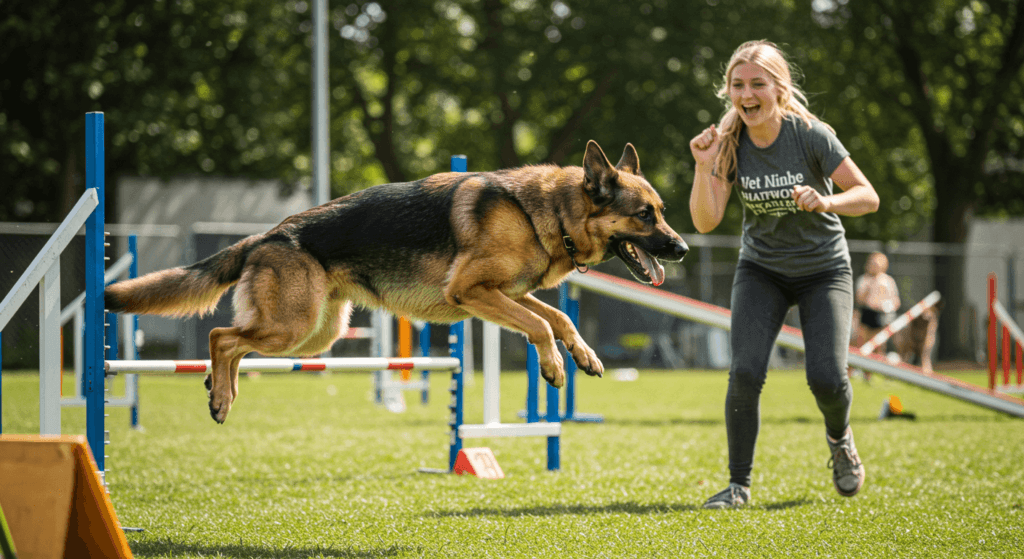
Bred for herding and police work, German Shepherds possess boundless energy. Without daily exercise, they become restless, leading to destructive behaviors like chewing or excessive barking.
Solutions:
- Provide 1–2 hours of vigorous exercise daily (e.g., running, agility training).
- Engage in mentally stimulating activities like puzzle toys or scent work.
- Consider dog sports like Schutzhund or flyball to channel their drive.
Case Study: A 2022 study by PubMed found that dogs with unmet exercise needs are 60% more likely to develop anxiety-related behaviors.
Plan the exercise before the dog arrives, not after problems appear. A tired German Shepherd is calm indoors; a bored one redesigns your garden. Mixing physical work like fetch or hiking with sniffing walks and puzzle feeders covers both body and brain in less time than you would think.
3. German Shepherd Challenge #3: Time Commitment and Separation Anxiety
These dogs form intense bonds with their families and struggle with solitude. Prolonged isolation can trigger separation anxiety, manifesting as howling, digging, or escape attempts.
Mitigation Strategies:
- Gradually acclimate puppies to alone time using crate training.
- Hire a dog walker or use daycare for busy schedules.
- Interactive cameras (e.g., Furbo) allow remote interaction.
Stat: A PDSA report notes that 85% of German Shepherd owners report separation-related stress in their pets.
Build alone-time gradually: start with a few minutes, reward calm behavior, and never make departures dramatic. Most German Shepherds learn to settle within an hour when the routine is predictable. If your schedule involves ten-hour days, honestly consider whether this breed fits your life right now.
4. German Shepherd Challenge #4: Their Innate Need for a “Job”
German Shepherds are working dogs at heart. Without purposeful tasks, they grow bored and unfulfilled.
Job Ideas:
- Train them as therapy or service dogs.
- Assign household “duties” like fetching mail or carrying a backpack.
- Practice advanced obedience drills daily.
Success Story: Max, a rescue German Shepherd, transformed into a certified search-and-rescue dog after his owner incorporated daily training sessions.
The job does not need to be dramatic. Carrying a pack on hikes, finding hidden toys, or mastering a new cue each week all count. Meeting the challenge of a working mind takes creativity rather than athleticism, and purpose turns raw intelligence into a well-mannered companion instead of a household menace.


5. German Shepherd Challenge #5: Managing a Strong Prey Drive
Their herding heritage gives German Shepherds a powerful instinct to chase. This can endanger small pets or wildlife.
Precautions:
- Use a leash in unfenced areas.
- Train a solid “leave it” command.
- Introduce small pets slowly under supervision.
Expert Tip: The ASPCA recommends early socialization to reduce prey-driven reactivity.
Manage the environment while you train the skill. Secure fencing, a long line for open fields, and a rock-solid recall built with high-value rewards keep everyone safe. Never assume the chase instinct is trained out – even well-bred adults need management around cats, squirrels, and joggers.
6. German Shepherd Challenge #6: Balancing Protective Instincts
While their loyalty is admirable, unchecked protectiveness can lead to aggression toward strangers.
Training Essentials:
- Socialize puppies to diverse environments and people.
- Reward calm behavior around guests.
- Consult a professional trainer for reactivity issues.
Statistic: 40% of German Shepherds in urban settings display territorial behaviors, per a Cornell University study.
Protection becomes a problem only when it is uneducated. Teach an off-switch: guests invited by you are good news, and your dog earns praise for calm observation instead of confrontation. A well-socialized German Shepherd is watchful without being reactive – exactly what most families actually want.
7. German Shepherd Challenge #7: Lifelong Training Requirements
Their sharp minds demand continuous learning. Inconsistent training leads to regression.
Training Plan:
- Schedule weekly refresher sessions for commands.
- Rotate training activities to prevent boredom.
- Explore advanced certifications (e.g., Canine Good Citizen).
Quote: “A German Shepherd’s training never ends—it evolves,” says Cesar Millan, renowned dog behaviorist.
Budget ten minutes a day for maintenance training and rotate skills monthly. Tracking progress in a notebook sounds excessive until you realize how quickly standards slip. Dogs that keep learning stay mentally sharp into old age, which makes this challenge one of the best investments you will ever make.

8. German Shepherd Challenge #8: Risk of Aggression Due to Poor Breeding
Irresponsible breeding can exacerbate aggression or health issues.
Preventive Steps:
- Choose breeders accredited by the German Shepherd Dog Club of America.
- Request health clearances for hip dysplasia and degenerative myelopathy.
- Avoid puppies from “backyard breeders” with no transparency.
A reputable breeder answers health questions without offense and lets you meet the mother. Walk away from any litter sold without paperwork – saving a few hundred dollars up front can cost thousands in veterinary bills and heartbreak later, which is why this challenge starts before you ever bring a puppy home.
9. German Shepherd Challenge #9: Health and Grooming Demands
Beyond behavioral and training hurdles, German Shepherds require vigilant health management and consistent grooming. The breed is genetically predisposed to conditions like hip dysplasia (affecting 20% of individuals, per the Orthopedic Foundation for Animals), degenerative myelopathy, and digestive sensitivities. Owners must budget for routine vet visits, joint supplements, and high-quality diets to mitigate risks. Their dense double coat also demands weekly brushing to manage shedding—seasonal “blowing” of the undercoat can leave fur embedded in furniture and clothing. Neglecting grooming invites matting, hot spots, and skin infections. Proactive care, including bi-annual vet screenings and investing in tools like undercoat rakes, is non-negotiable for maintaining their physical well-being and comfort.
Actionable Tips:
- Brush 3–4 times weekly with a de-shedding tool (e.g., Furminator).
- Consult your vet about glucosamine supplements for joint health.
- Bathe monthly with hypoallergenic shampoo to protect skin and coat.
- Avoid high-impact exercise in puppies to prevent joint stress.
Keep a simple calendar: brush several times a week, trim nails monthly, and log weight and appetite changes between vet visits. Small daily habits catch problems while they are still cheap to fix, and your future self – and your dog – will be grateful you started early.
German Shepherd Challenges FAQ
Are German Shepherd challenges a dealbreaker for first-time owners?
Not necessarily, but the learning curve is real. First-time owners who succeed usually commit to training classes from day one and lean on structured resources – including our guide to German Shepherd puppies – before bringing their dog home. Honesty about your schedule and energy matters more than prior experience.
Which German Shepherd challenges are the hardest to handle?
Most owners vote for two: the daily exercise requirement and separation anxiety. Both are schedule problems rather than dog problems. If you can guarantee 1-2 active hours plus companionship most days, the remaining German Shepherd challenges shrink to manageable routines.
How much time does a German Shepherd need every day?
Plan on at least 90 minutes dedicated to the dog: physical exercise, training refreshers, grooming, and genuine interaction. Puppies and adolescents need more, and that first year is the biggest challenge of the entire journey. The payoff for the investment is a calm housemate who settles beautifully outside of working hours.
Does adoption reduce these challenges?
It can. An adult rescue has a known temperament, so you skip the mystery of puppy genetics. Ask foster families about energy level, prey drive, and how the dog handles alone time. Many adult Shepherds are already trained, which neutralizes several challenges on this list overnight.
Are the challenges worth it?
For the right owner, absolutely. The American Kennel Club ranks the breed among the most intelligent and loyal dogs in the world. Meet the German Shepherd challenges head-on and you get a companion of rare depth in return.
German Shepherd Challenges: Key Takeaways
Every German Shepherd challenges list comes back to the same truth: this breed gives back exactly what you put in. Provide confident leadership, daily exercise, a job to do, managed socialization, and preventive healthcare, and the nine hurdles above become a satisfying routine rather than a burden. Skip them, and even the best-bred dog will struggle. Choose this breed with open eyes, prepare before arrival, and the German Shepherd challenges transform into the very structure that makes life with a Shepherd so rewarding.
Conclusion: Are German Shepherd Challenges Worth It?
German Shepherds are magnificent companions but demand dedicated, informed ownership. By understanding these German Shepherd challenges, prospective owners can prepare adequately, ensuring a fulfilling relationship with this remarkable breed.