
German shepherd scent work turns your dog’s most powerful asset — that remarkable nose — into a game you can play anywhere in the house. It is cheap to start, easy on joints, and genuinely tiring for a working brain. This guide walks you through your first german shepherd scent work sessions step by step: the setup, the basic search game, fair progressions, and the troubleshooting fixes most beginners eventually need. Ten focused minutes is enough to begin.
Affiliate disclosure: As an Amazon Associate, German Shepherd Haven earns from qualifying purchases made through marked links on this page, at no extra cost to you. See our full Affiliate Disclosure.
What is scent work and how does it differ from other nose games?
Scent work is any activity where a dog uses its nose to locate a scent source. It ranges from casual hide-and-seek games at home to formal competitions such as the American Kennel Club’s AKC Scent Work program, which models professional detection work in a safe, sport format. Unlike tracking, which often uses a trail of scent over ground and involves following a path, scent work commonly focuses on finding a discrete scent source in an area or container.
The emphasis in beginner home scent work is on motivation and clear communication: teaching your dog to search, find, and indicate the target by offering a reliable, repeatable behavior such as sitting, pawing gently, or returning with the toy. In plain terms, german shepherd scent work teaches your dog that using the nose pays better than any game you could invent.
For an overview of organized scent sport rules and progression, see AKC: AKC: Scent Work. The sport version of german shepherd scent work adds containers, interiors, vehicles, and exteriors — the home version teaches the same core skill.
Why german shepherd scent work taps into natural instinct
German Shepherds were selectively bred for jobs that combine intelligence, drive, and a keen sense of smell. Their working heritage gives many individuals a natural enthusiasm for problem-solving and task-based activities. Scent work taps into that instinct without requiring long physical runs or heavy equipment, making it suitable for puppies, seniors, and adults when tailored to the dog’s condition. That low physical demand is a big reason german shepherd scent work suits dogs recovering from soft-tissue strains too, once your vet approves exercise.
When introducing scent games, keep in mind the breed’s energy and training style. Reward-based systems that build clarity and excitement work well for German Shepherds: short, frequent wins followed by rewarding play motivate many dogs to keep searching. If you’re already familiar with working-dog approaches, you may find the exercises complement your existing methods; for background reading on training foundations for German Shepherds see our article on working-dog training principles and the piece on the breed’s working heritage. Few activities align with breed history as neatly as german shepherd scent work does.
Equipment and setup for scent work at home
You don’t need specialized gear to start. Basic, safe items include:
Recommended gear for this stage:
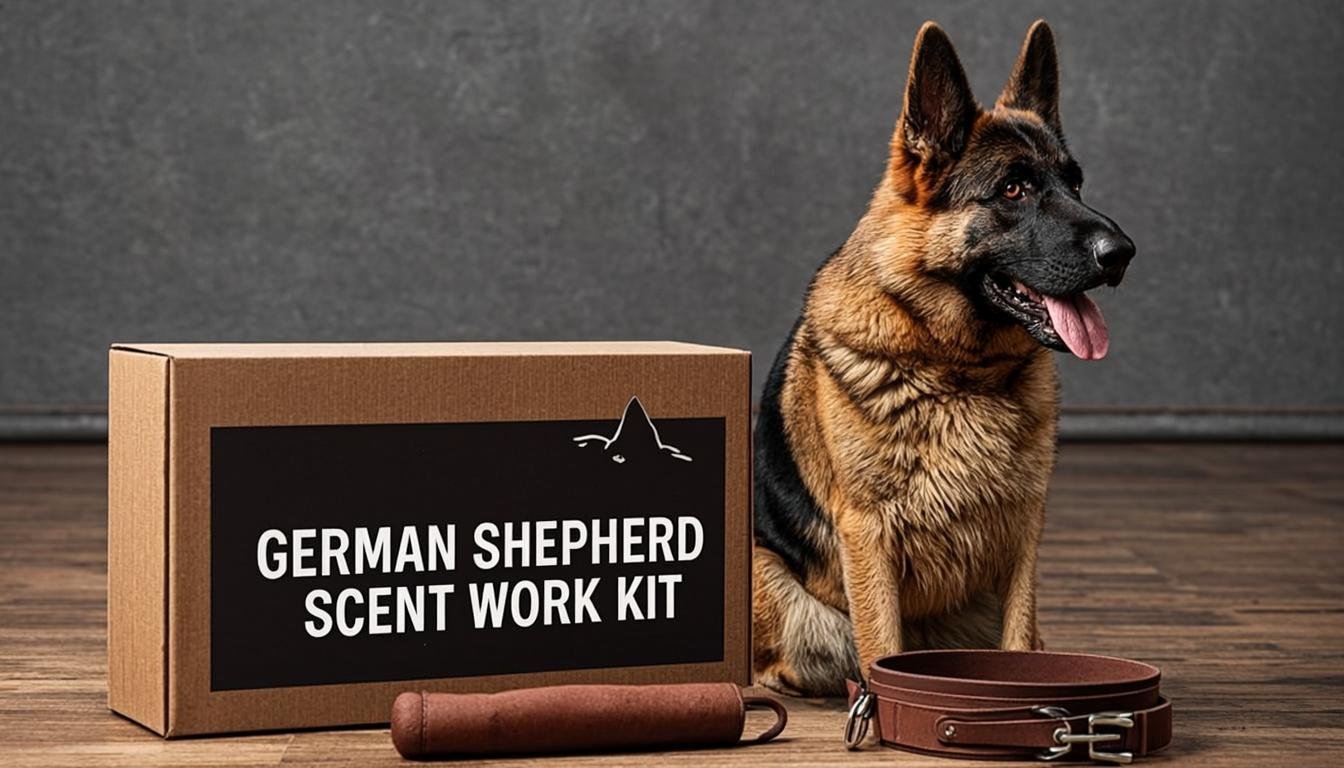
- Nose work starter kits (Amazon) — boxes, tins and hides to begin the standard way.
- Scent training tins and odor kits (Amazon) — controlled odors for clean, consistent hides.
- Quick-access treat pouches (Amazon) — reward within one second of the alert.
- Low-value and high-value treats (depending on your dog’s drive).
- Several identical opaque containers (muffin tins, plastic food containers with holes, or small cardboard boxes) for beginner searches.
- A small toy your dog likes for play rewards.
- A designated scent source: at home you can use a food treat or a cloth with a target odor. If you later pursue organized scent work, trainers introduce specific odor kits per sport rules.
- A calm, low-distraction room to begin building the behavior.
Choose treats appropriate for your dog’s age and health. If your German Shepherd has dietary restrictions or medical concerns, consult your veterinarian before using food-based rewards. That flexibility is another quiet advantage of german shepherd scent work: toys work just as well as food for high-drive dogs.
Your first german shepherd scent work game: step by step
Start with very short sessions (3–6 minutes) and focus on predictable success. The objective is to create a clear association between the search behavior and a rewarding outcome. Think of this first german shepherd scent work session as teaching vocabulary, not running a test.
- Capture interest: With your dog on a loose lead or in the same room, let them see and sniff a treat or toy, then place it in an open container on the floor. Encourage a simple indication (touching with nose or paw) and mark it with a verbal cue like “Yes!” followed immediately by giving the treat. Repeat several times so the dog learns that finding items equals fun.
- Hide, but keep it easy: Once confident at seeing the drop, place the treat inside a shallow box or under a towel where it’s still easy to discover. Use an excited voice to cue the search, then let them find and reward. Keep language consistent—pick a simple cue like “Search.”
- Increase the challenge gradually: After several easy finds, place the target inside a closed container with small air holes or among identical decoy containers, so your dog learns to discriminate the correct one. Reward generously when they indicate the right container.
- Fade visible cues: Make sure you’re not signaling the location with your eyes or body. If your dog begins to watch your hands, pause and reset with a very simple visible trial before returning to less-cued hides.
- Build duration and distance: Increase search area size slowly and vary locations: behind a couch, on a low chair, or in another room. Keep sessions short and end on a high note.
Throughout, use only positive reinforcement: praise, treats, or play. Avoid scolding if your dog fails to find a scent—reset to an easier level and re-establish success. End every german shepherd scent work session while your dog still wants more.
Progressions and variations to keep scent work engaging
Once your dog reliably locates simple targets, introduce controlled variations to maintain mental stimulation. Vary one variable at a time; that rule alone fixes most german shepherd scent work plateaus.
Container discrimination
Use a lineup of identical containers with the target hidden in only one. Reward only for the correct container. This hones focus and odor discrimination. Container searches are the backbone of competitive german shepherd scent work for good reason.
Room searches
Hide the target in a small room and release your dog to search from a starting position. Reward when they indicate the correct area. Increase room complexity gradually. Room searches show you how much stamina german shepherd scent work quietly builds.
Elevated hides and scent boxes
Place a target slightly off the floor (e.g., on a low stool). Use scent boxes with filters for subtle progression. Keep these changes incremental to avoid frustration. Elevated hides add a third dimension that keeps german shepherd scent work mentally fresh for years.
Multiple target tasks
Introduce two targets of the same odor placed separately. Teach your dog to find both and return between them. Break the task into manageable steps so your dog understands you expect multiple finds per trial. Multi-hide drills are where german shepherd scent work starts to look like real detection work.
Troubleshooting common problems
Even with patient progression, you may encounter challenges. Here are practical fixes for typical issues. Almost every stumble traces back to progress that outran the dog — german shepherd scent work rewards patience more than pressure.
Disinterest or low motivation
- Make rewards more valuable: swap kibble for smelly treats or an energetic play session after the find.
- Shorten sessions and increase reward frequency—success breeds enthusiasm.
- Check the environment: remove distracting noises or other pets during early training.
Obsessive or over-aroused searching
- Teach calm restart cues: ask for a sit or a brief down before releasing to search. Reward calm behavior as well as finds.
- Keep sessions structured and finite; end games before your dog becomes frustrated or overly frantic.
False alerts or guessing
- If your dog indicates the wrong container, withhold reward but remain neutral. Reset with an easy find to rebuild clarity.
- Reinforce the indication you want (sit, paw, or return) so your dog knows exactly how to communicate a find.
Safety, health, and age considerations
Scent work is adaptable across life stages, but keep safety and your dog’s health in mind.
- Puppies: Use short sessions and low physical strain. Focus on building motivation and the basic search behavior rather than long searches.
- Adults: Tailor difficulty to avoid frustration; scent work is mentally tiring even when physically easy.
- Seniors or dogs with mobility issues: Use elevated hides or tabletop searches to avoid bending and climbing.
- Environment safety: Avoid using toxic or hazardous items as targets; choose dog-safe treats and clean fabrics. Keep small objects out of reach if your dog tends to chew non-food items.
If your dog has medical issues (allergies, respiratory problems, joint pain), check with your veterinarian before starting regular sessions. Trainers and vets can recommend session length and reward types tailored to your dog’s condition. Professional eyes catch details in german shepherd scent work sessions that owners routinely miss.
Fitting german shepherd scent work into daily life
Scent work is most effective when short, frequent, and predictable. Even five minutes a day can provide meaningful enrichment.
- Morning: A quick search game after breakfast helps channel energy before a walk. Five focused minutes of german shepherd scent work can settle a Shepherd faster than thirty minutes of fetch.
- Midday: A short mental session breaks up long rest periods for dogs left alone for a few hours.
- Evening: A calming search before settling in for the night can help with relaxation.
Vary rewards between food and play depending on context. For example, use food-based searches when you won’t be able to play immediately after, and toy-based searches when you want to follow up with a short tug or fetch session. Match the reward to the moment and german shepherd scent work becomes the highlight of your dog’s day.
When to seek professional help
If your dog shows persistent avoidance, signs of anxiety linked to searches, or you want to progress toward formal scent work competitions or detection work, a qualified reward-based trainer or a scent-work instructor can provide structured classes and individualized feedback. For behavior or health concerns, always consult a veterinarian or a certified behavior professional. The RSPCA’s training advice offers general, humane training principles that align with force-free methods: RSPCA: Dog Training. If problems persist, a german shepherd scent work instructor can spot handling errors in minutes.
Practical examples: three beginner scent exercises
Here are three quick exercises you can try tonight with minimal setup. Each exercise below scales up cleanly, which is exactly how german shepherd scent work should progress.
1. The Three-Box Game
- Line up three identical boxes on the floor. Show your dog a treat and then place it in one box while they watch initially.
- Give a simple search cue and let them investigate. Reward for the correct box with treats and praise.
- Once reliable, mix which box contains the treat and add more boxes.
2. Sock Hide
- Place a treat inside a clean sock and tie the end loosely so scent can escape.
- Start with visible placement, then progress to tucking the sock under a low blanket or chair leg.
- Reward the dog when they find the sock—then gradually increase difficulty.
3. Cup Shuffle
- Use three plastic cups and place a treat under one while your dog watches. Shuffle slowly so they can track the cup.
- If your dog waits and sniffs, encourage with the search cue. Reveal the treat and reward when they indicate the correct cup.
- As they improve, shuffle with greater speed and include decoy cups without treats.
German shepherd scent work kit: budget vs. upgrade
You can start german shepherd scent work with items already in your kitchen, which is part of its charm. Still, knowing what the upgrade path looks like helps you spend sensibly when motivation grows. The table below splits a starter kit from its serious-hobby version, so you can buy exactly what your current stage needs and skip the rest until your dog proves as hooked as most Shepherds do.
| Item | Budget version | Upgrade version | Worth upgrading? |
|---|---|---|---|
| Containers | Identical plastic tubs with drilled holes | Steel AKC-style scent vessels with vents | Only when entering trials |
| Target odor | High-value treats or a scented cloth | Pure birch, anise, or clove oil on cotton swabs | Yes, for clean odor pictures |
| Hide holders | Tea strainer or tin with lid holes | Magnetic hide tins and tweezers | Nice, not urgent |
| Search boundary | Room corners and boxes | Portable barrier gates | Rarely needed at home |
| Reward pouch | Any pocket or belt bag | Quick-open training pouch | Small daily quality-of-life gain |
| Gloves/handling | Wash hands before hides | Nitrile gloves to keep odor clean | Yes — cheap and improves clarity |
One upgrade rule keeps beginners sane: improve odor hygiene before improving equipment. Contaminated treats in your pocket, hides handled with lunch-smelling hands, or swabs stored next to snacks will confuse a dog faster than any missing gadget. Clean handling makes german shepherd scent work fair, and a fair game is the one dogs love most. The AKC Scent Work program page shows the competition equipment standard if you want the official picture before spending a cent.
Storage matters too. Keep target odors in sealed glass jars away from the kitchen, label everything, and never reuse a swab. Small habits like these separate frustration-free german shepherd scent work sessions from mysterious failures, and they cost nothing but discipline.
A 4-week starter schedule that builds momentum
This four-week plan turns the games in this guide into a rhythm. It assumes two short sessions on most days, five to ten minutes each, and one variable changed at a time. If a week needs repeating, repeat it — german shepherd scent work is built on successful repetitions, not on speed, and a dog that wins daily stays hungry for the game forever.
| Week | Sessions | Skill focus | Game to play |
|---|---|---|---|
| 1 | 5 × 5 min | Association: treat drop and easy finds | Three-Box Game, visible hides |
| 2 | 6 × 6 min | Hidden hides in containers | Three-Box Game hidden, Sock Hide |
| 3 | 6 × 8 min | Room searches and discrimination | One room searches, container discrimination |
| 4 | 6 × 10 min | Distance, elevation, and simple doubles | Elevated hides, Cup Shuffle, two-hide finds |
Log one line per session: what you hid, where, and how the dog looked when successful. That log becomes your troubleshooting map when progress stalls in month two, because german shepherd scent work problems almost always trace to a specific variable that changed too fast. End week four with a little showcase — search a room you have never used, and enjoy watching your dog check every corner like a professional.
By the end of the month most owners notice the side effects: a dog that settles faster after sessions, sleeps deeply on search days, and looks at boxes with new hope. That is the enrichment dividend of german shepherd scent work, and it compounds for years with five invested minutes at a time.
How searches build confidence in worried dogs
Beyond fun and fitness, german shepherd scent work has a quieter superpower: it grows confidence. Searching gives a dog control. There is no handler pressure, no correct speed, and no physical confrontation with anything scary — just a private puzzle the dog solves alone and gets paid for. For Shepherds that are environmentally unsure, noise-sensitive, or recovering from a bad experience, that agency is therapeutic in a way few other games match.
The mechanism is well understood in shelter and sport circles alike: successful problem-solving builds optimism, and optimism generalizes. A dog that learns “unfamiliar problem means I can investigate and win” starts applying that pattern outside searches — to new floors, new places, new visitors. Trainers often prescribe german shepherd scent work precisely for this transfer effect, and handlers of anxious dogs notice the calm-after-search effect within weeks. If your dog’s worries are separation-shaped rather than environment-shaped, pair searches with the departures in our German Shepherd separation anxiety plan“>separation anxiety guide for a genuinely powerful combination.
Keep two rules intact when using searches as confidence work. First, never search near whatever frightens your dog; the game builds bravery in safe zones that then spreads outward. Second, let the dog quit — ending a session early protects the association that searches are always safe. Handled this way, german shepherd scent work becomes quiet fear therapy dressed as play, which is exactly the kind of training that works with a Shepherd’s mind instead of against it.
FAQ: german shepherd scent work at home
How long until my dog is good at german shepherd scent work?
Most dogs grasp the basic association within two or three sessions and search a full room confidently within a month. True fluency — odors, distractions, multiple hides — develops over a season. German shepherd scent work rewards patience, and the early wins arrive fast enough to keep everyone motivated.
Can scent work make my dog obsessed with food?
No — searches spend food motivation productively rather than creating it. If anything, structured german shepherd scent work gives a food-motivated dog a job, which reduces begging and scavenging around the house. Keep search rewards separate from meal rewards and the two stay cleanly organized.
Is german shepherd scent work tiring enough to replace a walk?
It replaces mental tiredness, not physical exercise. Think of a ten-minute search as the brain’s equivalent of a long hike; your dog still needs walks for body health and environmental enrichment. The two stack beautifully: search first, walk after, sleep like a champion.
My dog starts guessing and alerting randomly — what now?
That is a fairness problem, not a dog problem. Random alerts mean the odor picture is unclear: hands smell of treats, containers were reused, or hides moved mid-session. Reset with clean handling and easier hides, and german shepherd scent work honesty returns quickly.
Can I start with an older Shepherd?
Absolutely — senior noses still work wonderfully, and searches can be designed around reduced mobility with floor-level hides and short distances. Many owners find german shepherd scent work becomes their senior’s favorite activity precisely because it asks for wisdom instead of speed.
When to take searches to the next level
Once the four-week plan is running smoothly, a fork appears in the road: keep searches as home enrichment, or level up toward structured goals. Both are legitimate — most dogs are perfectly fulfilled by the home version forever — but owners of high-drive Shepherds often find that a bigger project feeds the dog and the handler in equal measure. The signs that your dog is ready are unambiguous: flawless room searches across new locations, calm indication on multiple hides, and recovery from frustration without help. If all three describe your dog, here is what the next level looks like.
Level one: harder home problems. Before any formal training, stretch the home game. Add decoy scents (an empty treat bag that pays nothing), search zones your dog has never worked, and double-blind hides where you genuinely do not know the location — handling a blind search teaches you to read your dog instead of leaking answers. Introduce elevated hides on shelves and chair seats, then exterior searches along a fence line. A dog solving these is functionally doing sport-level german shepherd scent work in your living room.
Level two: structured classes. A local scent work class converts your living-room hobby into coached skill. Look specifically for reward-based instructors who run dogs individually — waiting crated between turns is part of the curriculum, and impatient dogs learn it quickly. Classes add three things home practice cannot: fresh odor pictures set by someone else, distraction dogs, and an instructor’s eyes on your handling. Our guide to choosing a private German Shepherd trainer“>finding qualified trainers applies directly here, and the AVSAB position statements offer the screening questions worth asking any prospective instructor.
Level three: the sport itself. Formal competition in AKC Scent Work or NACSW adds containers, interiors, exteriors, and vehicles — and, honestly, a wonderful social scene of obsessive dog people. Titles are optional; many teams trial once or twice for the experience and return to weekly class as their permanent routine. The practical entry path is simple: class first, then a mock trial, then a real one when your dog searches new venues like your kitchen. German shepherd scent work dogs tend to adore the trial environment precisely because each search is just the home game in a stranger’s building.
Whichever level you choose, protect the thing that made the game work: cleanliness, fairness, and a dog that wins often. Owners chasing titles sometimes forget the foundation, and a confident searcher quietly becomes a stressed one. Keep sessions short, keep rewards rich, and keep watching your dog rather than the scoreboard. The nose led you into this game; it should stay in charge of it.
Checklist: quick takeaways
- Start with very short sessions (3–6 minutes) and focus on easy wins.
- Use only positive reinforcement: treats, praise, or play—no punishment.
- Progress gradually: increase hide complexity, distance, and room size over multiple successful sessions.
- Keep searches varied to prevent boredom and to generalize the skill to new environments.
- Adapt hides and duration for puppies, seniors, or dogs with mobility issues.
- Seek a reward-based trainer or veterinarian for tailored help or if health/behavior concerns arise.
Sources and Limits
This article provides general guidance for enrichment and humane scent work at home. It is not a substitute for professional instruction or veterinary care. For formal sport rules and resources on organized scent work, see the American Kennel Club: AKC: Scent Work. For general, reward-based training principles, see the RSPCA guidance: RSPCA: Dog Training. For breed-specific training background, consult our articles on working-dog training principles and the breed’s working heritage.
Limits: Every dog is an individual. If your German Shepherd shows signs of stress, pain, or medical issues during scent sessions, stop and consult a veterinarian. If progress stalls or if you plan to pursue competitive scent work or detection training, a qualified, reward-based scent-work instructor can provide personalized guidance and safety oversight. Above all, keep german shepherd scent work a game your dog wins often.