
German shepherd chasing behavior — after bicycles, cars, runners, or skateboards — is one of the most dangerous habits this breed can develop, simply because Shepherds are fast and persistent. The instinct is normal; the outcome can be tragic. This guide gives you a layered plan for german shepherd chasing: immediate safety management, recall and impulse-control training, desensitization to bikes and cars, and the point at which professional help becomes non-negotiable.
Affiliate disclosure: As an Amazon Associate, German Shepherd Haven earns from qualifying purchases made through marked links on this page, at no extra cost to you. See our full Affiliate Disclosure.
Why german shepherd chasing instinct targets cars and bikes
Chasing is often rooted in natural predatory and play instincts. The sequence—orient, pursue, catch, kill/hold—can be triggered by fast-moving objects like bikes, scooters, skateboards, and cars. High arousal, excitement, and lack of training around these triggers make the behavior more likely. For some dogs, chasing is also about control or a frustrated attempt to engage with a moving source of novelty. Understanding that wiring is step one of managing german shepherd chasing safely.
Not the same as aggression
Chasing is not always aggression, but it can be dangerous. If your dog’s chasing includes lunging, snapping, or an intense fixated stare, treat it seriously and consider professional help. The ASPCA: Aggression and Chasing Behaviors has useful background on the difference between chasing and aggressive reactions. The distinction matters because german shepherd chasing responds to training, while true aggression needs professional help.
Immediate safety: how to manage risk now
When a dog chases vehicles, immediate risk management matters more than training. The goal is to keep your dog safe while you work on long-term change.
- Always use a secure leash on walks in areas with traffic; a standard 6-foot leash is safer than retractable leashes for control.
- Use a long line (10–30m) only in safe, enclosed locations and with practice in how to feed out and retrieve the line without losing control.
- Consider high-visibility gear for you and your dog (reflective vest, lamp) if you walk near roads at low light.
- If your dog has a history of running into traffic, avoid off-leash time near roads until recall is highly reliable.
If the dog’s reactions are intense, or you feel unsafe handling them, seek safer support for intense reactions from a qualified professional instead of trying to fix the behavior alone. Until recall is bulletproof, german shepherd chasing risk is managed with equipment, not hope.
Tools that help (and how to use them safely)
Good equipment makes management and training easier. Use gear as a safety and handling aid, not as a punishment. The right gear gives you seconds of advantage during german shepherd chasing moments, and seconds are enough.
Recommended gear for this stage:
- Long training lines (30-50 ft) (Amazon) — safety margin for recall work near triggers.
- Front-clip no-pull harnesses (Amazon) — better control if arousal spikes on walks.
- Fast-access treat pouches (Amazon) — sub-second reward delivery at distance work.
- Front-clip harness: Helps manage pulling and gives more steering control without pressure on the throat.
- Flat buckle collar or secure harness: Use a second attachment or martingale for dogs that slip collars; avoid choke or prong collars.
- Strong, short leash (4–6 ft) for street walks; keep slack controlled so you can respond quickly.
- Long line for controlled off-leash exercises in safe locations: learn to coil and retrieve the line safely so it doesn’t tangle or cause panic.
- Basket-style muzzle if needed for safety in public: introduce a muzzle with positive, gradual reward-based acceptance training so it becomes a safety tool, not a fearful device.
The AVSAB position statements support humane, science-based training and discourage aversive tools and techniques; see AVSAB: Humane Dog Training for principles to follow. Humane methods are not just kinder; they produce the kind of recall that actually interrupts german shepherd chasing.
Reliable recall: the foundation that stops german shepherd chasing
A solid recall (come when called) is one of the most important skills to prevent chasing-related incidents. Build it gradually using high-value rewards, short distances, and low distractions. Recall is the emergency brake for german shepherd chasing, so build it before you need it.
Recall progression example
- Start indoors: call the dog, mark the moment they move toward you (word like “Yes” or a click), and reward immediately with a treat they love.
- Move to the backyard or quiet yard: practice 5–10 fast, fun recalls per session, using random rewards and occasional high-value rewards for extra motivation.
- Add distance and mild distractions: increase distance slowly and practice near stationary bicycles or parked cars so your dog learns to come even with mild triggers present.
- Use a long line in a safe, open area and practice recalls while a friend walks past on a bike at a distance. Reward heavily for returning and staying calm.
- Gradually increase the challenge only when the dog is consistently successful. Never advance if the dog is losing engagement.
Keep sessions short (5–10 minutes) and frequent. Make recall the best option by pairing it with something wonderful: food, a toy, praise, or allowed play. Pay recall generously every time; german shepherd chasing incidents often trace back to a weakly rewarded cue.
Desensitization and counterconditioning to bicycles and cars
Desensitization reduces the dog’s emotional reaction by exposing them to the trigger at a low, non-threatening intensity while pairing it with positive outcomes. Counterconditioning changes the dog’s emotional response by creating a new association: the trigger predicts something good. This is the most reliable way to shrink german shepherd chasing arousal at its source.
Step-by-step bicycle desensitization
- Identify a calm location with space where bikes can be introduced at a distance—empty parking lots work well at quiet times.
- Start with a bicycle positioned far enough away that your dog notices it but stays relaxed. Reward calm attention and neutral orientation with treats.
- Ask the bicyclist to roll slowly and predictably at the same distant line while you feed continuous treats when the dog looks at you instead of lunging.
- Progress in small steps: reduce the distance only when your dog remains calm and engaged with you. Increase rewards as intensity rises.
- Introduce real-world variations once your dog handles controlled exercises—different bicycles, speeds, and riders. Always keep the challenge below the dog’s threshold.
For cars, use the same principles but maintain strict safety. Work where vehicles move slowly and predictably, ideally with a helper driving very slowly at a distance and increasing closeness only when the dog stays calm. Cars demand the same patience; german shepherd chasing habits fade at the speed of small wins.
Alternative behaviors that redirect german shepherd chasing
You can teach your dog a replacement action to do when they see movement, such as “look” (make eye contact), “leave it,” “sit,” or a brief recall to you. The idea is to give them a predictable, reinforcing option that interrupts the chase sequence. Trained alternatives give german shepherd chasing energy a legal outlet.
Training a “Look” cue
- Hold a treat near your face and say “look”. When your dog makes eye contact, mark and reward immediately.
- Repeat until the dog looks reliably with minimal prompting. Then practice with mild distractions and increase duration slowly.
- Use the “look” cue when you spot a bicycle or car approaching. Reward the dog for choosing you over the moving object.
Impulse control exercises like “wait,” “settle,” and brief controlled leave-it games help lower general reactivity. Short, consistent practice is more effective than occasional long sessions. Impulse games cut german shepherd chasing arousal better than extra miles of exercise.
Practical training session plan (6-week outline)
This sample plan outlines a conservative, safety-first approach. Adjust pace according to your dog’s stress signals and learning speed.
- Weeks 1–2: Focus on recall, “look,” and impulse control in low-distraction areas. 3–4 short sessions daily.
- Weeks 3–4: Add controlled exposure to stationary bikes and parked cars with high-value rewards. Begin long-line practice in safe spaces.
- Weeks 5–6: Introduce slow-moving bicycles at a distance with a helper; use long line and front-clip harness. Reward for calm, oriented behavior and reliable recalls.
- Ongoing: Gradually generalize to different locations and speeds, never skipping back to high-challenge work if your dog shows stress.
Progress may take longer than six weeks; patience and consistent reinforcement are key. If at any point the dog’s reaction escalates, return to an easier step and consult a professional. Treat every setback as information about where german shepherd chasing thresholds sit.
Handling incidents: if your dog chases a car or bike
If a chase happens despite precautions, stay calm and prioritize safety for people and animals.
- Do not chase after the dog yourself—this can escalate the chase or teach the dog that running away is fun.
- Call the dog using a high-value cue if they know it. If you have a recall whistle, use it rather than shouting in panic.
- If possible, have a helper block the path of the moving object or safely retrieve the object (for example, stop the bike) so the dog can be called back without danger.
- After the dog returns, avoid scolding. Instead, provide calm de-escalation: a short break, low-value attention, or time to settle. Later, work on training steps to build prevention.
If the chase resulted in an injury—either to your dog or another person/animal—seek veterinary or medical attention immediately and document the incident for local reporting if required by law. One scary incident is reason enough to rebuild german shepherd chasing management from the ground up.
When to get professional help and what to ask
If your German Shepherd’s chasing is frequent, intense, or accompanied by aggression, consult a qualified, reward-based behavior professional. Look for trainers who use positive reinforcement and who understand canine body language and thresholds. Ask specifically about their experience with german shepherd chasing cases and large-breed arousal levels.
Questions to ask a prospective professional:
- Do you use reward-based, force-free training? (Refer to AVSAB guidance.)
- Do you have experience working with chasing behaviors and large-breed dogs?
- What safety and management strategies will you use immediately?
- How will you measure progress and when might you refer to a veterinarian for medical evaluation?
For intense or complex reactions, find someone who can provide in-person coaching and create a written plan. You can also review options for reward-based training techniques to ensure the methods match best practices. A second opinion keeps german shepherd chasing plans honest and humane.
Everyday prevention and lifestyle adjustments
Long-term reductions in chasing also come from meeting your German Shepherd’s physical and mental needs. Consider these supports:
- Daily structured exercise: brisk walks, runs (if trained), and play appropriate for your dog’s age and health.
- Mental enrichment: nose work, puzzle feeders, obedience games, and short training sessions to burn energy productively.
- Consistent rules: everyone in the household should follow the same leash and recall expectations.
- Routine and predictability: dogs with clear daily structure often show less frustration-based reactivity.
If medical causes (pain, vision issues, cognitive decline) might be contributing, consult your veterinarian before intensifying training. Rule out pain first; german shepherd chasing sometimes spikes when discomfort makes dogs irritable.
German shepherd chasing risk assessment: score your dog’s exposure
Not every dog carries the same german shepherd chasing risk, and a quick structured assessment tells you how urgent your training timeline should be. Score each row below for your own dog: the higher the total, the more heavily you lean on management while training matures. Be honest — wishful scoring only delays the work that keeps everyone safe.
| Risk factor | Lower risk (0–1) | Higher risk (2–3) |
|---|---|---|
| Distance reaction | Notices bikes at 30+ m, stays engaged | Locks on from 50 m, hard to interrupt |
| Response to name/recall | Turns to you first in mild distraction | Ignores first two calls when aroused |
| Exposure frequency | Quiet streets, few cyclists | Daily passing bikes, cars, or joggers |
| Fence behavior | Watches traffic calmly or disengages | Runs fence lines with cars all day |
| History | No chase attempts yet | Has broken toward wheels at least once |
| Outlet balance | Daily exercise plus impulse games | High energy, few trained outlets |
Interpretation is straightforward. Dogs scoring mostly in the left column still need recall and impulse work — german shepherd chasing potential never fully disappears in this breed — but ordinary precautions suffice. Any row in the right column calls for the management-first posture in this guide: short leash near roads, visibility gear, and training conducted below threshold. Two or more right-column rows, especially a prior chase attempt or fence fixation, justify bringing a professional in from the start; our guide to choosing a private German Shepherd trainer“>hiring a qualified trainer shows what to look for.
Reassess the score monthly. German shepherd chasing risk moves in the right direction when exercise, outlets, and training all improve together, and it creeps back during adolescence, after gaps in training, or when a new cycling route opens near your home. The table is not a label — it is a dashboard, and dashboards exist to be checked.
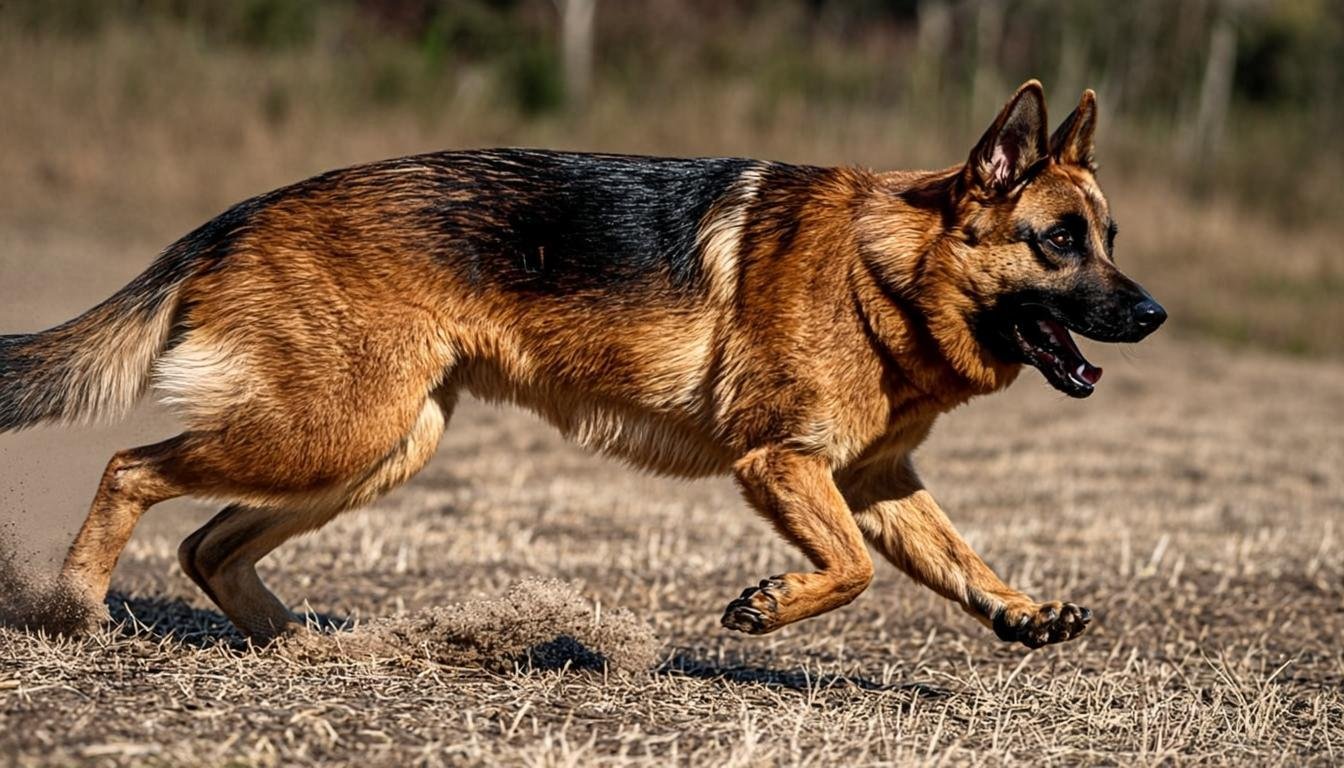
Impulse-control games that cut the chase
Chasing is arousal looking for a target, and impulse-control games drain that arousal at the source. Added to the recall and desensitization work above, five minutes of daily games measurably lowers german shepherd chasing intensity within weeks. These games also double as excellent relationship builders, because each one rehearses the same skill: notice the exciting thing, choose me instead, get paid generously.
- It’s Your Choice (food bowl version). Hold treats in a closed fist. The moment your dog stops pawing and pulls back, mark and pay from the other hand. This teaches that calm beats grabby — the exact decision german shepherd chasing requires on walks.
- The Flirt Pole Shutdown. Let your dog chase the lure twice, then ask for a sit before the third. Reward with the chase itself. You are literally rehearsing “stop chasing on cue,” the most direct antidote to german shepherd chasing there is.
- Waiting at thresholds. Doors, gates, and car exits are chase rehearsals in miniature. Ask for eye contact before each release. Doors that stay closed until calm build the muscle german shepherd chasing safety depends on.
- Round-robin recalls. Family members stand in a circle and call the dog in turn, paying each arrival richly. Add mild motion — a jogger relative — once fluency grows. Motion plus choice plus reward is the trifecta that retrains german shepherd chasing instincts.
- Toy swap ritual. Trade a prized toy for an equal or better one repeatedly. Dogs that believe giving things up pays well are far easier to interrupt mid-chase sequence.
Schedule two or three of these daily rather than all five weekly; frequency matters more than volume. Within a month, most owners see the change where it counts — on the street, the moment a bicycle appears, their German Shepherd’s head swivels toward them instead of the wheels. That head turn is german shepherd chasing prevention made visible, and it was purchased entirely with games. If reactivity beyond chasing — lunging, growling — appears during play or walks, read our German Shepherd aggression training guide“>aggression training guide to separate arousal from genuine aggression before continuing.

The real cost of chase incidents
Owners sometimes treat german shepherd chasing as an embarrassing quirk until the invoice arrives. The costs arrive on three fronts: veterinary and legal exposure if a chase ends in collision, insurance complications after an incident report, and the training bill for undoing a habit that has rehearsed itself into muscle memory. Understanding the stakes reframes prevention spending — every dollar of harness, long line, and class fees is cheap against a single accident.
Liability varies by jurisdiction, but the pattern is consistent: an owner whose dog ran into traffic or knocked a cyclist may face claims for damages, and some insurers reduce or deny coverage for dogs with documented chase incidents. Keeping dated training records, using appropriate equipment, and demonstrably managing risk all matter after an incident — and they matter even more before one. Our guide to pet insurance for German Shepherds“>pet insurance for German Shepherds explains how behavior clauses and liability riders typically work.
There is also the quiet daily cost many owners underestimate: the walks you stop enjoying, the routes you abandon, the muzzle or head halter debates with strangers. German shepherd chasing erodes quality of life for the whole household long before it produces a catastrophe. The layered plan in this guide reverses that erosion in the same order it arrived — safety first, training second, freedom last — and each layer returns a little more normalcy than the one before.
FAQ: german shepherd chasing and safety
Will german shepherd chasing go away on its own with age?
Rarely. Adolescence may amplify it, and time alone usually rehearses rather than reduces the habit. Structured german shepherd chasing training works at any age, and earlier intervention means fewer rehearsals to overwrite.
Are German Shepherds more chase-prone than other breeds?
Their herding heritage and high prey drive make movement unusually magnetic for many individuals, so german shepherd chasing deserves earlier management than in low-drive breeds. The upside is that the same drive makes Shepherds outstanding at impulse-control sports once trained.
Is a long line safe for training near roads?
Long lines belong in enclosed fields far from traffic. Near roads, german shepherd chasing safety comes from short leashes, distance management, and predictable routes — never from hoping a long line holds at the wrong moment.
Should I punish my dog after a chase incident?
No. Punishment after the fact teaches nothing about the chase itself and damages the recall you need in emergencies. Effective german shepherd chasing plans rebuild the moment of choice before it happens, not scold its aftermath.
When do I need a behaviorist rather than a trainer?
If your dog has actually reached a car or cyclist, bites at wheels, or panics when prevented from chasing, involve a certified behaviorist immediately. German shepherd chasing at that intensity involves safety engineering, not just training progressions.
An emergency plan for the worst-case moment
Training reduces german shepherd chasing incidents; it does not reduce them to zero, which is why every owner of a motion-fixated dog needs a rehearsed emergency plan. The goal is not drama — it is removing hesitation, because in the moment a dog breaks toward traffic, the decisions you have already made are the only ones available. Write the plan on one page, share it with everyone who walks your dog, and rehearse it on paper twice a year like any other household emergency drill.
Step one: the breakaway decision. If your dog breaks toward a road, never run parallel alongside or grab for a dragging leash mid-sprint — both turn a chase into a game or a disaster. The trained response is to move away from the dog’s line at an angle while calling the emergency recall in a bright, rehearsed voice, because dogs instinctively curve toward a handler who is leaving. Practice this body language weekly so it is muscle memory, not improvisation. If your dog carries a GPS tracker, note the app on your phone’s home screen.
Step two: the traffic interface. Know in advance who you call if an incident involves a vehicle: local non-emergency police number for property or near-miss reports, your veterinarian for injury assessment, and your insurance provider for documentation. Photograph the location, the leash and equipment in use, and any damage. Owners who document thoroughly protect themselves in liability conversations, and our guide to pet insurance for German Shepherds“>pet insurance for German Shepherds explains which behavior clauses typically apply after incidents. German shepherd chasing accidents are rare when management holds, but the paperwork is easier to prepare calmly in advance.
Step three: the recovery protocol. After any incident — even a near miss — the next 48 hours are diagnostic. Check your dog physically for pad injuries, nail tears, or stiffness that adrenaline masked. Then audit honestly: which management layer failed, at what moment, and why? A snapped leash, a dropped long line, a gate left unlatched, a handler change nobody briefed — each answer points at a specific fix. Resist the urge to punish the returning dog even if your hands are shaking; a dog that returns to anger learns that recall is dangerous, and you will need that recall more than ever after a scare.
Step four: recalibrate the training dial. Every incident, however minor, earns a two-week reset to easier environments: quieter routes, shorter long lines, higher-value rewards, and stricter distance thresholds from bikes and cars. This is not regression for its own sake — it is how german shepherd chasing plans stay honest after reality has shown you a gap. Handlers who skip the reset usually meet the same failure again; handlers who recalibrate typically close it permanently. The RSPCA dog behaviour resources offer good checklists for post-incident behavior reviews.
Prepare the humans, too. Family members who know the plan — who calls whom, where the emergency treats live, which routes to avoid at dusk — act instead of freezing. German shepherd chasing emergencies compress decision time to seconds, and the households that fare best are the ones that made their decisions months earlier, on a quiet evening, with nothing at stake. Write the page tonight; hope to never open it. That is what prepared means.
Checklist: immediate actions and longer-term plan
- Immediate: use a secure short leash, avoid off-leash near roads, add high-visibility gear.
- Short-term: begin daily recall and “look” training in low-distraction settings; use a long line safely.
- Medium-term: start controlled desensitization to bicycles/cars with a helper; reward calm behavior.
- Long-term: generalize training to new settings, maintain consistent management, and increase mental and physical enrichment.
- Get help: consult a qualified, reward-based behavior professional if reactions are intense or progress stalls.
Sources and Limits
This article explains general, non-diagnostic information about managing and training dogs that chase moving objects. It does not replace veterinary advice or a tailored behavior consult. For behavior safety and aggression context, see the ASPCA: Aggression and Chasing Behaviors. For recommendations on humane, science-based training, consult the AVSAB: Humane Dog Training. Between them, you can build a german shepherd chasing plan that holds up in the real world.
If your dog’s behavior is severe, escalating, or causing harm, contact a local, qualified veterinarian and a certified, reward-based behavior professional for an individualized assessment and a written, supervised plan. For additional training resources and support, look into safer support for intense reactions and review recommended reward-based training techniques. Pair those guides with the safety rules above and german shepherd chasing becomes manageable instead of frightening.
Limits: This article does not provide medical diagnoses, prescribe medication, or give step-by-step interventions for violent aggression. For medical, safety, or legal questions, seek qualified professionals in your country. Always prioritize immediate safety when a dog chases vehicles, and use management tools until training provides reliable control. Progress with german shepherd chasing is rarely linear, so keep the checklist handy.