
German Shepherds are one of the most intelligent and versatile dog breeds in the world — and that intelligence is a tool that needs a job. Proper training is what turns a strong-willed, high-drive puppy into the loyal, well-behaved companion the breed is famous for producing. Untrained, the same dog becomes its own project: barking, herding toddlers, redecorating the fence line. This guide walks through the complete training journey — the german shepherd dog training techniques professional trainers actually use, the timeline that works for this breed, the behavior problems to solve before they harden, and the mistakes that quietly undo good dogs.
Table of Contents
- Why Training Matters More for This Breed
- Understanding German Shepherd Behavior First
- The Training Timeline: 8 Weeks to Adolescence
- Core German Shepherd Dog Training Techniques That Actually Work
- Obedience and Advanced Control
- Specialized Training: Guard, Agility, Herding, and Nose Work
- Solving Common Behavior Problems
- Tools That Earn Their Place
- Common Training Mistakes to Avoid
- Maintaining Training for Life
- Training the Adolescent: Surviving Months 6–12
- Frequently Asked Questions
- Sources and Further Reading
Why Training Matters More for This Breed
Every dog benefits from training; a German Shepherd needs it. Bred for a century of daily working partnership, the breed arrives wired to observe, decide, and act — and if you do not supply the structure, the dog will improvise its own. Training delivers three returns that compound over a decade:
- Improved obedience and behavior — a Shepherd that responds to a quiet word the first time, in any environment.
- Better adaptability — calm reactions to vet visits, guests, travel, and urban chaos instead of stress responses.
- A deeper bond — training is a conversation, and this breed is at its happiest inside one. Working breeds do not merely tolerate direction; they seek it.
Understanding German Shepherd Behavior First
Effective training begins with understanding the traits you are working with. The German Shepherd’s core characteristics explain most training outcomes:
- Highly intelligent and eager to learn — new commands stick in a handful of repetitions when motivation is real.
- Loyal and protective of family — watchdog instincts arrive free; what you do with them is a training choice.
- Energetic and driven — mental and physical stimulation are not luxuries but daily requirements.
The same traits create predictable challenges when left unguided: excessive barking, separation distress, and over-protectiveness toward family or territory. None of these are flaws — they are breed features without a job attached. Early socialization is the training you do before “training”: exposing your puppy to varied people, animals, surfaces, and sounds while they can still file them under “normal.” A properly socialized Shepherd learns the difference between a visitor and a threat; an under-socialized one files everything under threat.
The Training Timeline: 8 Weeks to Adolescence
| Age | Training focus | Realistic goals |
|---|---|---|
| 8–12 weeks | Name response, crate comfort, potty routine, socialization | Comes when called indoors; sleeps through the night |
| 3–4 months | Sit, down, come, bite inhibition, handling tolerance | 5-minute focus sessions; gentle mouth on cue |
| 4–6 months | Leash manners, stay, leave-it, continued socialization | Loose leash past mild distractions |
| 6–12 months | Adolescence proofing: recall, impulse control, calm greetings | Reliable basics despite hormones and distraction |
| 12–24 months | Advanced control, specialized skills, real-world reliability | Off-leash reliability in secure areas |
Core German Shepherd Dog Training Techniques That Actually Work
Positive reinforcement and the marker system
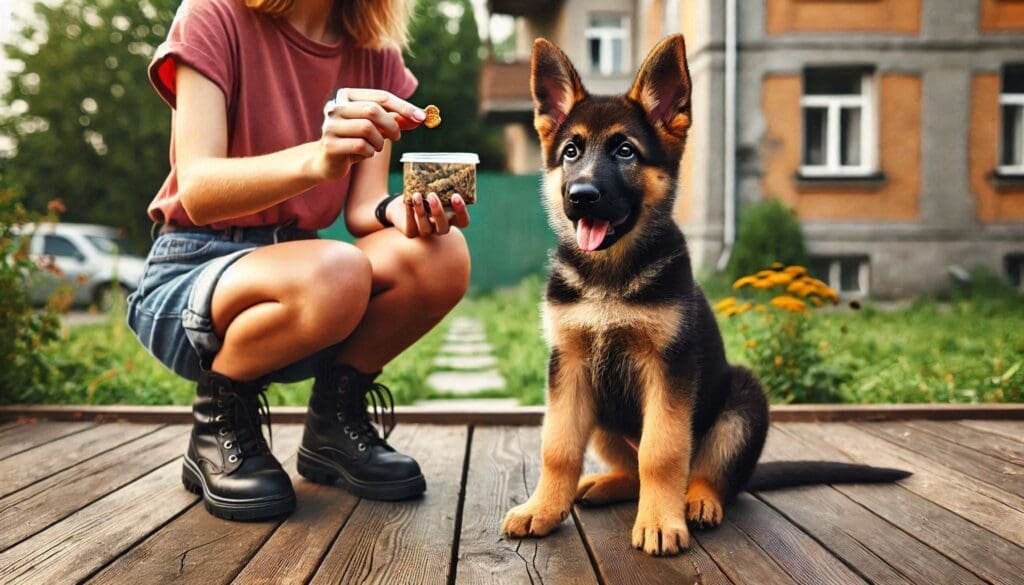
Reward good behavior the instant it happens — treats, praise, or play — and it will repeat. The professional upgrade is a marker: a clicker or a consistent word (“Yes!”) that pinpoints the exact moment your dog earns the reward. Markers let you communicate with surgical timing, which is how this fast-learning breed finishes new behaviors in days instead of months. Keep sessions short (5–10 minutes), frequent (2–4 daily), and always end on a win.
Teaching the basic commands
- Sit: Hold a treat above your dog’s nose and move it upward and back. As the rear hits the floor, mark and reward. Add the word only once the motion is reliable.
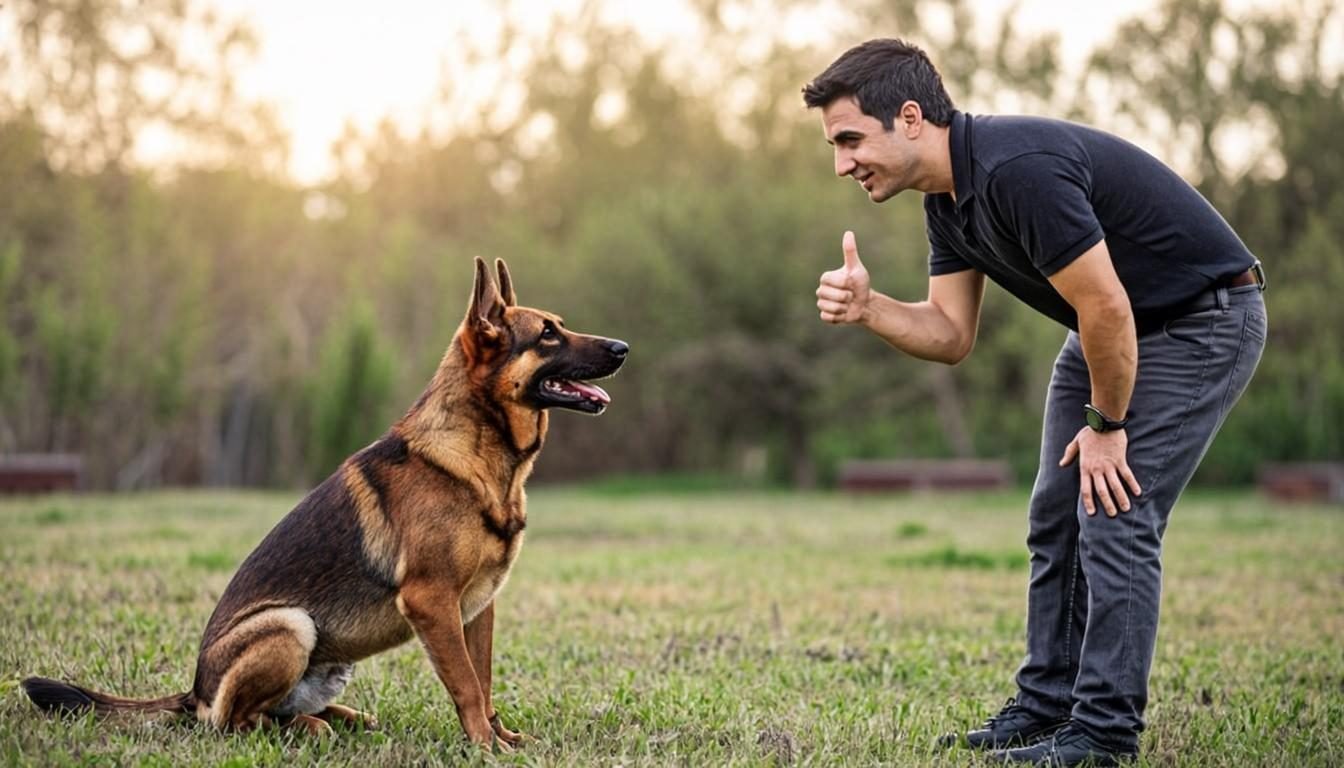
- Stay: Ask for a sit, say “Stay” with an open palm, take one step back, and return quickly to reward. Build distance and duration in small, successful increments — the classic error is going too fast.
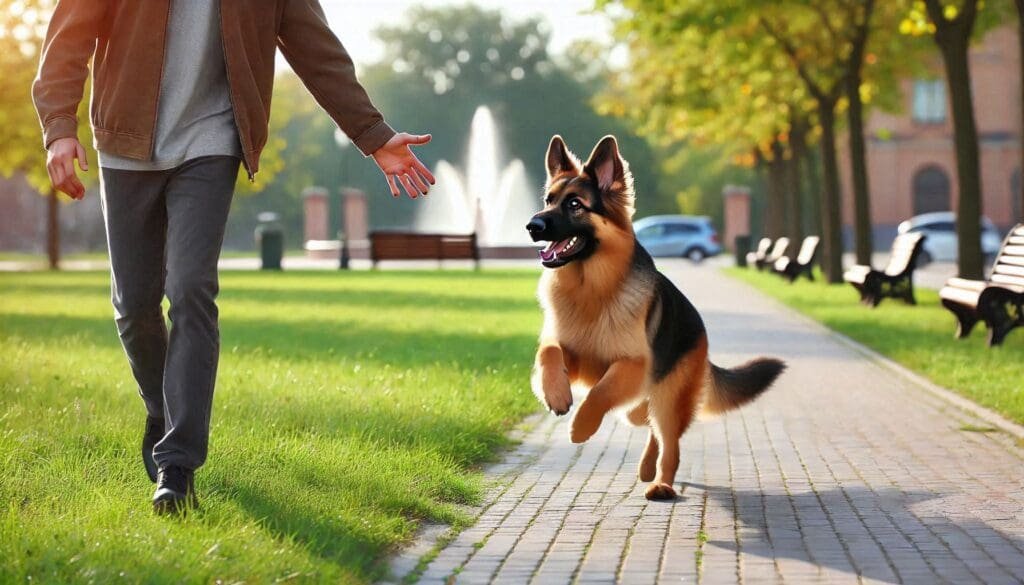
- Come: Use a long line in the yard, call once with genuine enthusiasm, and pay generously when your dog arrives. Recall is the one command you cannot afford to poison by calling for baths and nail trims.
Crate and potty training
Crate training provides a safe space, accelerates housebreaking, and gives your Shepherd a den-style retreat — introduce it positively, never as punishment. Potty training succeeds on schedule, not on luck: out after every meal, nap, and play session; immediate reward outdoors; supervision or confinement indoors until reliable. Most German Shepherd puppies are house-trained by 5–6 months when the routine is consistent.
Obedience and Advanced Control
Once the basics are solid, advanced training converts them into real-world control. Structured obedience classes — or a disciplined home program — build focus under distraction, the difference between a dog that obeys in the kitchen and one that obeys at the park. Transition to off-leash gradually: long lines in secure areas first, always setting the dog up to succeed.
Build recall like an investment account, rewarding every check-in, and practice impulse control exercises — leave-it, place, waiting at doorways — that teach the breed’s turbocharged brain to hand the steering wheel back to you. A well-conditioned adult Shepherd should hold a down-stay through chaos and recall past another dog; that is the standard this breed can reach with consistency.
Specialized Training: Guard, Agility, Herding, and Nose Work
The breed’s working heritage opens specialized paths beyond pet obedience. Working-line German Shepherds in particular excel when their drive has a channel, but any well-bred Shepherd enjoys these outlets:
- Guarding on cue: Start with obedience, then teach bark-on-command and its partner, the “Quiet” command, which gives you the volume knob the breed needs. Serious protection training belongs with professionals — done wrong, it manufactures insecurity, not protection.
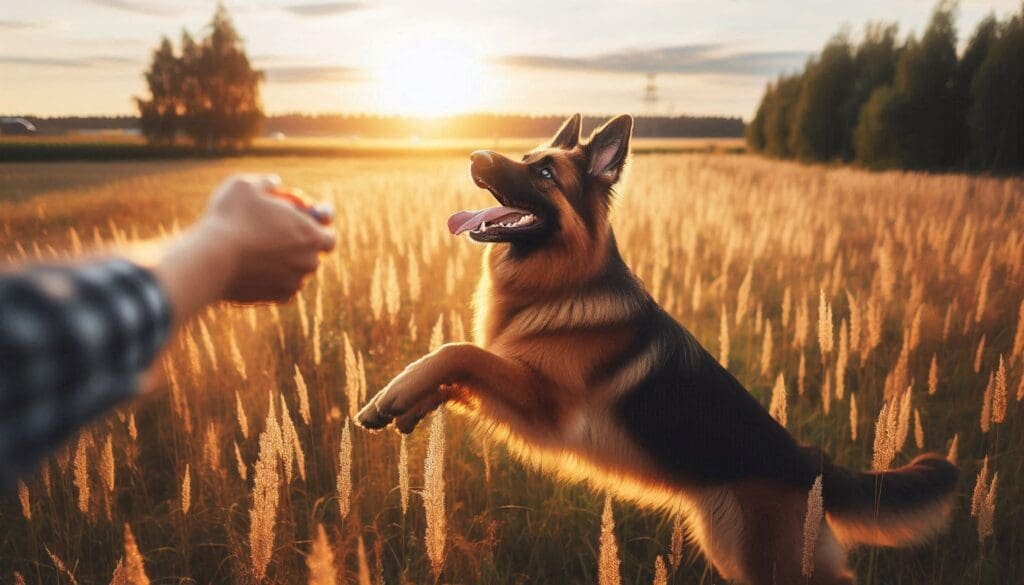
- Agility: Jumps, tunnels, and ramps build confidence and burn energy fast; guide with positive reinforcement and keep sessions playful.
- Herding: Real livestock work under experienced supervision taps the breed’s original purpose — a profound bonding experience where the instinct does the heavy lifting.
- Nose work: Scent games and detection-style searches tire this breed mentally faster than any leash walk, which is why detection agencies choose Shepherds for the work.
Solving Common Behavior Problems
Even well-trained Shepherds hit behavior bumps. Diagnose the root cause before reaching for a fix — most breed “problems” are unmet needs wearing a costume.
| Problem | Usual root cause | The fix that works |
|---|---|---|
| Excessive barking | Boredom, alert instincts, learned habit | More exercise and enrichment; teach “Quiet” on cue; manage window access |
| Jumping on people | Excitement, accidentally reinforced greetings | Four paws on floor = attention; calm greetings only; practice with volunteers |
| Nipping / mouthing | Play instinct, teething | Redirect to toys; end play on tooth contact; ensure enough sleep |
| Leash pulling | Handler too slow, never taught position | Stop-and-reset; reward slack leash; front-clip harness as backup |
| Over-protectiveness | Under-socialization, reinforced vigilance | Rebuild socialization; neutral, calm exposure; professional help if serious |
| Separation distress | Abrupt alone-time expectations | Gradual departures, crate as safe den, low-key arrivals |
For deeper diagnosis and step-by-step plans, our German Shepherd training and behavior guide covers each of these in detail.
Tools That Earn Their Place
You need less equipment than the pet aisle suggests. The kit that earns its keep: a flat collar or well-fitted harness, a 6-foot leash for walking, a 20–30-foot long line for recall practice, a treat pouch that keeps rewards coming at speed, an appropriately sized crate, and durable interactive toys for independent occupation. High-value treats (small, soft, and genuinely exciting) make or break early training — match the reward to the difficulty, and rotate toys weekly to keep the environment interesting. Skipping the pricey gadgets beats skipping the fundamentals every time.
Common Training Mistakes to Avoid
- Harsh punishment: Compulsion methods breed fear and defensive aggression — the exact opposite of the confident companion you are building. Reward-based methods win on results and welfare alike.
- Inconsistent commands: “Down” meaning lie-down for you and get-off-the-couch for your spouse teaches confusion. Agree on the vocabulary and enforce it as a household.
- Neglecting stimulation: A bored Shepherd becomes a destructive one. Under-training is rarely the issue; under-occupying usually is.
- Skipping the socialization window: Training cannot rebuild what missed socialization breaks. The clock runs out around 16 weeks — use it.
- Training too long: Twenty perfect minutes lose to five focused ones. Quit while your dog is still winning.
Maintaining Training for Life
Training is not a graduation; it is a maintenance habit. Revisit core commands weekly in new environments, keep introducing small new challenges, and balance the discipline with pure play — fetch, hikes, and games that make you the best part of your dog’s day.
Rotate enrichment toys and explore new walking routes to keep the working brain satisfied. Owners who keep the habits going discover the breed’s finest feature: a dog that stays trainable for life, learning new skills at eight years old as happily as at eight months. For age-specific expectations from the start, our guide to German Shepherd puppies and the feeding and nutrition guide (because behavior starts with how the dog is fueled) complete the picture.
Training the Adolescent: Surviving Months 6–12
Adolescence is where most German Shepherd training journeys stall, so prepare for the storm rather than being surprised by it. Between six and twelve months, hormones rewrite your reliable puppy’s personality: recall becomes negotiable, leash manners regress, and your dog tests every boundary you built — not out of defiance, but because the brain is literally rewiring. The playbook is boring consistency. Lower your expectations temporarily, raise the reward rate, double down on long-line recall (adolescence is when invisible dogs are made), and protect the fundamentals with short, high-success sessions.
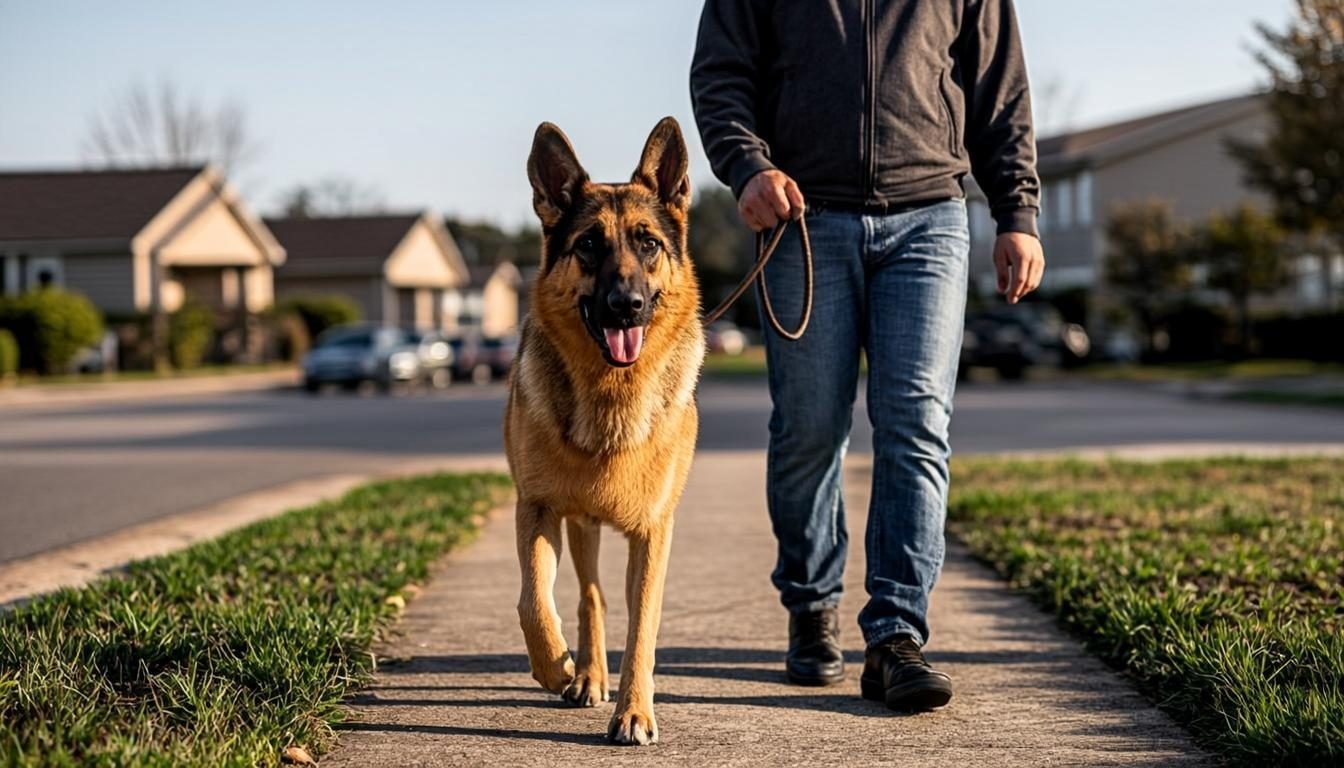
This is also the age where exercise discipline matters most: a 9-month-old Shepherd has an adult body’s energy and a puppy brain’s judgment, so channel the surplus into structured games, training, and sniffing walks rather than the destructive improvisation that fills the vacuum. Owners who hold steady through the storm report the payoff arriving like a switch — sometime between 18 and 30 months, the flaky teenager becomes the focused, reliable partner the breed promised, and every rep you survived pays dividends for the next decade.
Q: My adolescent stopped listening entirely — did I ruin the training?
No. Regression at 6–12 months is developmentally normal, not a verdict on your work. Return to basics in low-distraction settings, increase rewards, and consistency will restore the behavior as the brain matures.
Q: Should adolescent training include protection or bite work?
Not outside a professional club environment. Early informal “protection play” can build insecurity and uncontrolled reactivity. Obedience, nerve strength, and impulse control come first — real protection training starts after a year old, under qualified supervision.
Further reading: Keep building on those foundations with these focused guides: German Shepherd agility training stop a German Shepherd from chasing everything why your German Shepherd digs and how to fix it stop a German Shepherd from jumping on people.
Frequently Asked Questions
Q: What age should I start training my German Shepherd?
The day it comes home — around 8 weeks. Formal classes can begin once vaccination status allows; socialization and name games start immediately at home.
Q: Are German Shepherds easy to train?
For a committed owner, yes — among the easiest breeds, learning commands in under five repetitions. The catch is consistency: they also learn your inconsistencies just as fast.
Q: How long should training sessions be?
5–10 minutes, 2–4 times daily for puppies; 10–15 minutes for adults. Short and frequent beats long and tedious for every dog, and especially for this one.
Q: When should I start off-leash training?
After a rock-solid on-leash foundation and recall — typically 10–14 months — and only in secure areas with a long line as insurance. Off-leash reliability is earned, not granted.
Q: Can an older German Shepherd still be trained?
Absolutely. Adults learn quickly and often settle into focus faster than puppies. Rescue Shepherds become outstanding trained companions with patience and structure.
Q: Do I need a professional trainer?
Not necessarily — but a good puppy class is the cheapest insurance in dog ownership, and any aggression or over-protectiveness deserves professional eyes immediately. Look for certified, reward-based trainers (see CCPDT below).
Sources and Further Reading
The following authoritative resources provide additional context for the guidance in this article. They do not replace advice from a qualified veterinarian or behavior professional.