
Your nine-year-old German Shepherd has always moved like an athlete, so the moment you notice his hind paws scuffing the sidewalk — a soft scraping sound on every stride — the quiet alarm in your chest is correct. That sound is often the first trace of german shepherd degenerative myelopathy, an inherited disease of the spinal cord that the breed is regrettably famous for. It is not arthritis, it is not a slipped disc, and it does not hurt.
Affiliate disclosure: As an Amazon Associate, German Shepherd Haven earns from qualifying purchases made through marked links on this page, at no extra cost to you. See our full Affiliate Disclosure.
It is a slow, painless but progressive loss of the wiring that tells the back legs how to move, and German Shepherds sit near the top of the list of breeds it touches. There is no cure today, and pretending otherwise helps nobody. What genuinely helps is knowledge: the disease moves over months, not days, and the difference between a well-managed dog and a struggling one is almost always the head start the owner gave themselves. That head start is exactly what this german shepherd degenerative myelopathy guide is built to deliver.
This guide is written for that head start. We will cover what german shepherd degenerative myelopathy actually does inside the spine, why the breed’s gene pool makes German Shepherds especially vulnerable, the early signs worth filming this week, how vets separate DM from look-alike conditions, what SOD1 genetic testing can and cannot tell you, and every realistic care option from physiotherapy to rear wheelchairs. If your dog is already limping from joint disease instead, our guides on german shepherd hip dysplasia and german shepherd elbow dysplasia cover the orthopedic side of the breed, and our German Shepherd health problems guide maps the whole landscape.
What Is German Shepherd Degenerative Myelopathy?
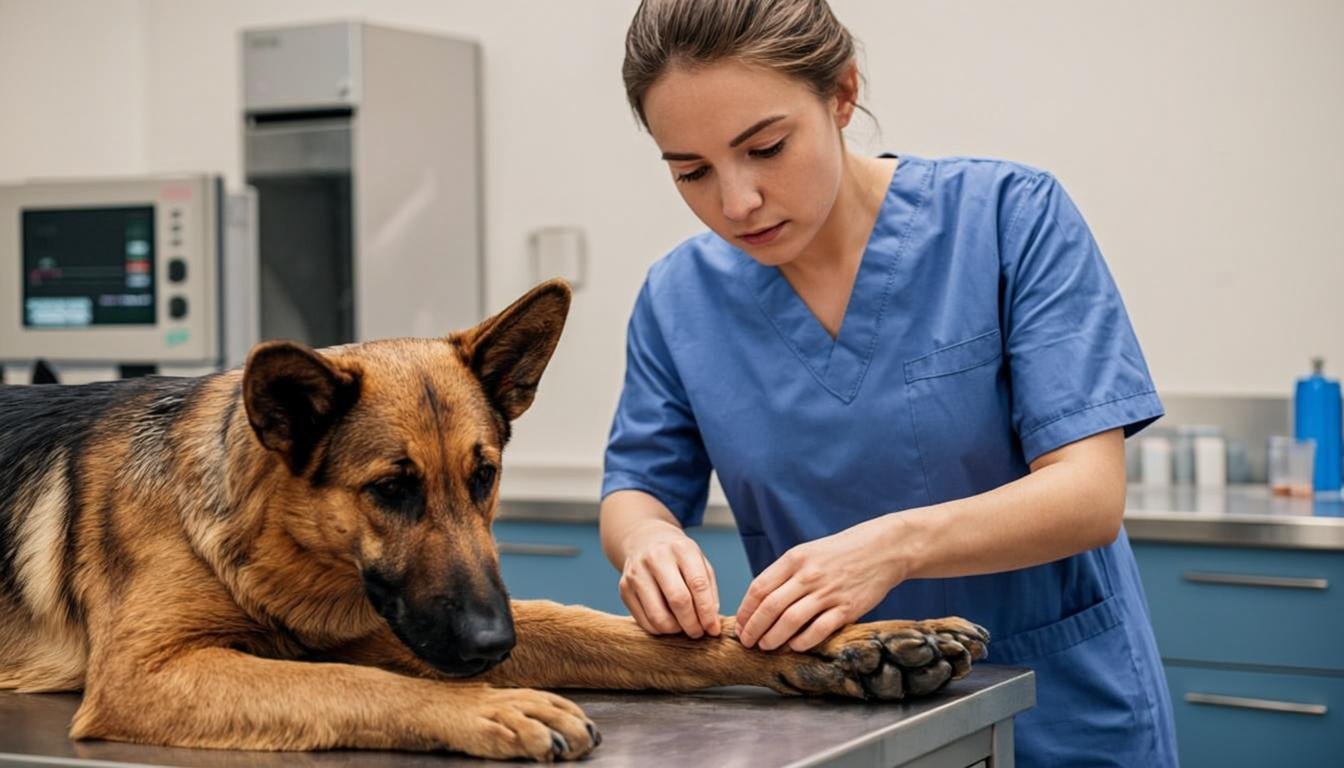
Degenerative myelopathy — DM for short — is a disease of the spinal cord’s white matter, the insulated cabling that carries movement commands from the brain to the legs. In a DM patient, that insulation and the nerve fibers beneath it degenerate slowly, starting in the mid-back (thoracic) region and creeping outward in both directions. The messages that keep a galloping dog coordinated arrive weaker and mistimed, which is why the disease looks like clumsiness long before it looks like paralysis. The classic veterinary description is that DM resembles a slow electrical failure in a house: some lights dim, then flicker, then go out — while the appliances themselves, the muscles and joints, stay perfectly healthy.
That last point matters enormously for owners. Because the disease targets the spinal cord and not the bones or joints, german shepherd degenerative myelopathy is painless. Dogs do not whine, guard their backs, or refuse stairs out of fear of discomfort. They simply stop being able to do what they used to, in small increments that are easy to blame on age.
The condition is also incurable and eventually fatal, typically because owners elect euthanasia once the hind end fails completely — though Cornell University’s canine health center notes that without intervention, progression can continue for more than three years, eventually reaching the front legs and even the muscles of breathing. The realistic goal of every german shepherd degenerative myelopathy care plan is not stopping the disease; it is stretching the window in which your dog is strong, mobile, and engaged with life.
One more framing fact sets expectations correctly. Research reviews, including the widely cited 2023 clinical summary published in the veterinary literature, emphasize that antemortem diagnosis is presumptive — meaning no blood test or scan while your dog is alive proves DM with certainty. Vets stack up evidence: breed, age, genetic test result, symptom pattern, normal spinal imaging, and the failure of other explanations. Stacking takes time and money, which is why understanding german shepherd degenerative myelopathy yourself is the single best cost-saving tool you have.
Why German Shepherds: the SOD1 Gene and Breed Risk
The genetic story behind german shepherd degenerative myelopathy starts with a mutation in the SOD1 gene — the same gene that drives some forms of ALS in humans. SOD1 produces an antioxidant enzyme that protects nerve cells from everyday oxidative damage. The mutation produces a subtly misfolded enzyme, and over years the accumulating damage strips the insulation from spinal cord fibers.
The mutation is inherited in what geneticists call an autosomal recessive pattern with incomplete penetrance. Translated: a dog needs two copies of the mutation (one from each parent) to be genetically at risk, and even then, not every at-risk dog develops symptoms — breed, age, and unknown modifiers shape whether the disease actually surfaces. Carriers with one copy are not considered at risk of disease, but they can pass the mutation to half their puppies.
Where do German Shepherds fit in? The breed is among the most commonly represented in DM case series worldwide, and the mutation circulates widely in the breed’s gene pool precisely because carriers are healthy — the ordinary-looking pool that german shepherd degenerative myelopathy hides inside. The Orthopedic Foundation for Animals, which administers the official DM genetic test registry, describes the disease as a progressive, fatal condition affecting many breeds with the German Shepherd consistently on the list it urges breeders to screen.
A healthy-looking, athletic eight-year-old can carry two copies — which is exactly why responsible breeders now test breeding stock before pairing, and why buyers of puppies should ask for DM test results on both parents. The disease cannot be diagnosed from a pedigree, but the risk absolutely can be managed by one — the quiet power of german shepherd degenerative myelopathy screening.
For owners of dogs already past the breeding stage, the genetic facts serve a different purpose: interpretation. If your Shepherd tests at-risk (two copies), it does not mean he has the disease today — many at-risk dogs reach fourteen without symptoms, which is why german shepherd degenerative myelopathy statistics must be read as risk, not sentence. What it means is that any future hind-end wobble deserves a fast, serious workup instead of a wait-and-see shrug, because you now know your dog belongs to the disease’s target population. Our breed-wide overview of German Shepherd lifespan and aging puts that risk in the context of everything else that changes as Shepherds grow older.
Early Signs of German Shepherd Degenerative Myelopathy
The first signs of german shepherd degenerative myelopathy are so subtle that most owners report noticing them “suddenly” when the dog has actually been compensating for months. The signature early picture, typically appearing between eight and fourteen years of age, includes the following — and each one is worth capturing on video the day you spot it, because gait footage is the most persuasive evidence you can hand your vet:
- Hind-paw scuffing and nail wear. The toes of the back paws drag lightly on the ground. You hear a soft scrape on pavement and see the tops of the rear nails or paw fur worn short — often the very first physical clue, and one your groomer may report before you see it.
- Knuckling. The paw flips over so the dog walks on the top of the knuckles for a step or two before correcting. It appears most when the dog turns tightly or stands up from a nap.
- Wobbliness in the hindquarters (ataxia). A swaying, drunken quality to the back end — most visible at a walk, and honestly easiest to spot from behind on grass, where the paw prints zigzag instead of tracking straight.
- Difficulty rising. The dog needs a beat longer than usual to stand from lying down, sometimes pushing harder with the front legs while the rear lags. Crucially, once up, he moves better — which distinguishes DM from arthritic stiffness that improves with movement but hurts.
- Asymmetric hind-limb weakness. One rear leg frequently takes the blame first, and owners and even some vets initially suspect a knee or hip injury. In DM, both legs are actually failing; one simply hides it better — the classic two-legged signature of german shepherd degenerative myelopathy.
- Muscle loss over the spine and hindquarters. Over weeks to months, the muscles alongside the lower spine and on top of the rear thighs visibly thin — from disuse, not starvation.
- Loss of fine control. Slower stairs, hesitation on slippery floors, a reduced tail-set bounce, or a changed sitting posture where the dog slumps onto one hip.
Two features argue strongly for DM over ordinary aging. First, the front legs stay normal: a nine-year-old who scuffs behind but trots perfectly ahead is presenting a DM-shaped picture. Second, the decline is relentlessly one-directional — there is no good week resetting the trend, unlike flare-ups of arthritis or back pain that wax and wane. If both descriptions match your dog, the video you film this week becomes the baseline that every german shepherd degenerative myelopathy conversation with your vet will build on.
The Four Stages of DM Progression
Veterinary neurologists describe german shepherd degenerative myelopathy in functional stages, and the stage your dog occupies dictates what care actually helps. The pace varies dog to dog — published case series describe roughly six to eighteen months from first signs to the loss of walking, though some dogs move faster and a fortunate few slower — but the sequence of losses is remarkably consistent:
| Stage | What you see | Mobility | Care focus |
|---|---|---|---|
| Early | Scuffed rear nails, subtle ataxia, occasional knuckling on turns | Fully walkable, long distances fine | Confirmation workup, fitness program, home traction, joint-friendly exercise |
| Middle | Obvious wobbliness, frequent knuckling, hind-end sway, falling on slick floors, visible muscle loss | Short controlled walks, stairs getting risky | Structured physiotherapy, lifting harness, rugs and runners, wheelchair fitting as walking shortens |
| Late | Paraparesis deepening to inability to support weight; urinary and fecal incontinence typically begin | Wheelchair-dependent for outings | Wheelchair mobility, bladder care, pressure-point protection, hygiene routines |
| End | Front limbs weaken; breathing muscles can eventually fail | Dependent care | Comfort, pressure-sore prevention, quality-of-life scoring, euthanasia planning |
Two practical notes about this table. Staging is also how german shepherd degenerative myelopathy costs get planned, as the pricing section shows. Incontinence is the milestone that changes daily life most, arriving usually with or after the loss of stable standing — it signals the spinal cord is no longer delivering bladder and bowel control signals reliably. And while dogs in well-fitted wheelchairs can stay genuinely happy for months, the end-stage reality in the table’s final row is why honest quality-of-life tracking (covered later) matters from day one, not at the crisis point.
How Vets Diagnose DM — and What Else It Could Be
Because no living test proves DM, diagnosis is a process of confident elimination. Expect your vet to work through a standard ladder, and expect to pay for the rungs that matter, because a german shepherd degenerative myelopathy workup is built in layers. The first rung is a neurological examination: your vet checks reflexes, proprioception (whether the dog knows where his paws are when placed upside down), spinal pain, and symmetry. DM produces a characteristic pattern — hind-limb ataxia and proprioceptive deficits with a painless spine and normal front legs. Conditions that hurt, like IVDD disc disease or lumbosacral stenosis, announce themselves differently, which is why the painless nature of german shepherd degenerative myelopathy is itself a diagnostic clue.
The second rung rules out orthopedic impostors. Hip dysplasia and cruciate ligament disease can both mimic early hind-end weakness, and X-rays of hips, knees, and the spine (typically 200 to 600 dollars at general practices in 2026) catch most of them, and in german shepherd degenerative myelopathy workups they come before any expensive imaging. The third rung, where budget allows, is spinal MRI — the gold standard for excluding disc disease, tumors, and inflammatory lesions. A DM patient’s MRI is classically normal or shows only subtle spinal cord shrinkage in the thoracic region.
MRI pricing runs roughly 1,500 to 4,000 dollars in the US, which is why many families decline it when the presentation is textbook: old German Shepherd, painless hind-end ataxia, both legs affected, front legs normal, and an at-risk genetic test. When those five boxes tick together, german shepherd degenerative myelopathy is the presumptive answer most neurologists land on. The 2023 veterinary review referenced above explicitly notes that in typical cases, the combination of signalment and testing makes a presumptive diagnosis reasonable without MRI.
Here is the realistic differential summary, comparing the conditions most often confused with german shepherd degenerative myelopathy:
| Condition | Key difference from DM | Typical test that separates it |
|---|---|---|
| Arthritis / hip dysplasia | Painful; stiffness improves with movement; single-leg lameness common | Orthopedic exam and X-rays |
| IVDD (slipped disc) | Acute onset, back pain, often one sudden bad day | Spinal MRI; pain response on exam |
| Lumbosacral stenosis | Pain on tail-lift or rising; may cause lameness that shifts legs | CT/MRI of the lower spine |
| Chronic degenerative radiculomyelopathy vs peripheral neuropathy | Neuropathy shows weak reflexes and generalized weakness | Neurological reflex mapping |
What this table should tell you is reassuring in one specific way: the conditions that look like DM but are not it are frequently treatable, and only after they are excluded does german shepherd degenerative myelopathy become the working diagnosis. Dogs misdiagnosed with old age sometimes actually have operable disc disease or manageable hip arthritis. That is the strongest argument for a proper workup before accepting any fatalistic label.
SOD1 Genetic Testing: Costs and What Results Mean
The genetic test for the SOD1 mutation is the cheapest, fastest diagnostic tool in the entire DM toolkit, and every German Shepherd owner weighing a hind-end concern should know exactly what it delivers, because german shepherd degenerative myelopathy workups should start at this cheapest rung. The test reads whether your dog carries zero, one, or two copies of the mutation: clear (no copies), carrier (one copy — not expected to develop disease), or at-risk / homozygous (two copies — the population in which DM virtually always occurs, though penetrance is incomplete).
University and commercial laboratories price the test in the range of 60 to 200 dollars depending on whether it is run standalone or inside a broader health panel, and results typically return within two to four weeks. The Orthopedic Foundation for Animals maintains the official results registry that breeders use, and the veterinary genetics laboratory at UC Davis plus commercial panel providers like Embark offer the test directly to owners.
Interpreting the result honestly requires holding two truths at once. A dog that tests at-risk is not diseased — many at-risk German Shepherds live out full lifespans without a single symptom, and scientists still do not fully understand why some at-risk dogs escape.
Conversely, a clear result essentially rules DM out as the cause of current symptoms and redirects the workup toward orthopedic or other neurological causes — genuinely useful when you are deciding whether an expensive MRI is justified. What the test can never do is predict timing. There is no result on that report card that tells you your dog has two years or four; the symptom timeline in the staging section above is what tracks the actual german shepherd degenerative myelopathy clock.
For breeders and puppy buyers, the test carries ethical weight rather than diagnostic weight. Pairing two carriers or an at-risk dog produces at-risk puppies by predictable odds, which is why the breed clubs push universal screening before breeding. If you are shopping for a puppy, asking to see both parents’ DM results is not an awkward favor — it is the question a serious breeder expects, and the single most effective german shepherd degenerative myelopathy prevention available today, and our guide to finding responsible German Shepherd breeders lists the full health-testing suite worth requesting.
Treatment and Care: What Genuinely Slows the Decline
Let’s be direct about the treatment landscape for german shepherd degenerative myelopathy, because owners spend real money on false hope. No drug stops or reverses DM. The aminocaproic acid and N-acetylcysteine protocol that circulated for years after Ohio State’s early work has not held up in practice, and most veterinary neurologists now treat it as optional at best. Anti-inflammatories, joint supplements, and stem-cell injections do not touch the disease mechanism either. Anyone selling a “DM cure” is exploiting a frightened owner, and you deserve better than that.
What the evidence and experienced rehabilitation clinicians do support is a disciplined lifestyle program that stretches the functional window — keeping muscles strong, joints protected, and the cardiovascular system fit for as long as the spinal cord permits:
- Structured physiotherapy. The single best-supported intervention — physiotherapy is german shepherd degenerative myelopathy treatment in the truest available sense: it manages the decline. Controlled strengthening — leash walks on stable footing, sit-to-stand drills, cavaletti rails, balance discs, and especially underwater treadmill sessions (typically 40 to 100 dollars per session) — preserves muscle mass and proprioceptive feedback. A published review notes that physical rehabilitation may slow german shepherd degenerative myelopathy decline and measurably improves quality of life.
- Consistent daily exercise. Movement is medicine here, in careful doses: regular, moderate, low-impact walks beat weekend warrior bursts. The rule of thumb rehab vets use is “tired but not wobbly” — end each outing before the hindquarters start to sway badly, then let muscle memory consolidate.
- Weight discipline. Every excess pound multiplies the load the failing hindquarters carry. A lean DM dog walks months longer than an overweight one, full stop — our feeding and nutrition guide covers the calorie math.
- Traction engineering. Falls are the enemy of stage-two dogs. Runners and yoga mats on hard floors, toe grips or rubber-bootie traction socks, and blocked stair access prevent the crash-landing cycle that accelerates loss of confidence and causes injury.
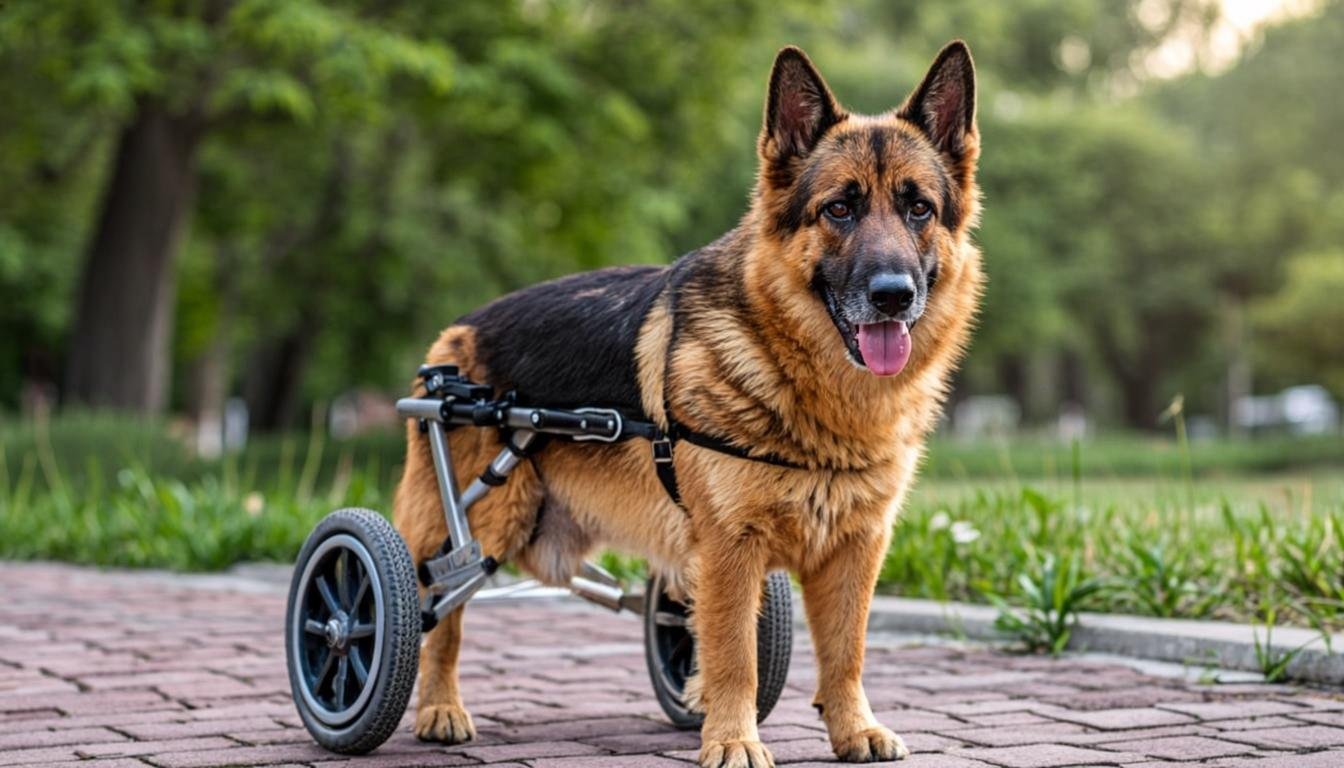
- Assistive equipment timed right. A rear-support lifting harness (40 to 120 dollars) buys safe stairs and car rides during the middle stage; a purpose-built dog wheelchair (typically 350 to 600 dollars) returns genuine independence once unassisted walking shortens. The timing matters — introducing the chair while the dog still walks, for short fun outings first, produces far better acceptance than a crisis introduction.
Home Modifications and Daily Care That Matter
The home you already own is the most underrated therapy for german shepherd degenerative myelopathy. Stage-two dogs lose confidence on exactly the surfaces modern houses are made of — hardwood, tile, and stairs — and the fixes cost less than one MRI consult. Lay runners and interlocking foam mats along your dog’s main traffic lanes, block staircases with baby gates when nobody is home to supervise, and relocate your dog’s bed and water to the room where the family actually lives, because a mobile dog with weak hindquarters will skip water trips it cannot safely make.
Ramps at the car and the sofa replace jumping, which stage-two hind ends can no longer absorb safely. If you have tiles, do this audit tonight: walk your own barefoot route to the kitchen, and every spot where you slip slightly is a spot your nine-year-old Shepherd will crash on within a week.
Daily care routines change gradually, and writing them down beats remembering them. Brush the hindquarters daily once grooming gets hard — dragged paws collect debris and mats fast. Trim rear nails more often; scuffing wears them unevenly and snagged nails cause the falls that break hips — housekeeping that every german shepherd degenerative myelopathy household does on a calendar, not on a whim. Once incontinence begins, washable belly bands or doggy diapers, waterproof bed covers, and twice-daily checks of the rear skin prevent the pressure sores and urine scald that threaten every immobile dog.
Bladder expression, if the vet determines it is needed, is a skill the veterinary team can teach in one appointment, and it protects the urinary tract far better than hoping for accidents. Dogs sense routine and predictability as safety; a dog whose days stay structured — consistent meal times, consistent walk slots, consistent rest zones — reads our daily routine guide as one of its own, and DM dogs thrive on exactly that scaffolding.
Mental exercise deserves equal billing, because the mind stays sharp long after the rear end does. Scent games on rugs, food puzzles, nose work in the yard, short training refreshers on cues the dog already knows — these cost nothing, burn energy the walks no longer burn, and keep the dog you love present rather than sidelined. German Shepherds in particular tolerate physical limitation poorly when bored; a dog earning its dinner from a puzzle feeder handles wheelchair life dramatically better than one staring at walls.
Costs of Caring for a DM Dog in 2026
Money conversations belong in the open with german shepherd degenerative myelopathy, because the disease is a marathon of small costs rather than one dramatic surgery bill. The genuinely good news: compared with cancer treatment or spinal surgery, DM care is comparatively affordable, and the biggest-ticket item — the wheelchair — is also the one that buys the most quality of life. Realistic 2026 US ranges, which vary by region and by whether you use general practice or specialty rehabilitation centers:
| Item | Typical 2026 US cost | Notes |
|---|---|---|
| SOD1 DNA test | $60 – $200 | Cheapest diagnostic tool in the DM toolkit; one-time |
| Neuro exam + orthopedic X-rays | $200 – $600 | Rules out treatable impostors first |
| Spinal MRI (optional) | $1,500 – $4,000 | Gold-standard exclusion; often declined in textbook cases |
| Rehab / underwater treadmill | $40 – $100 per session | Best-supported way to stretch the functional window |
| Rear-support lifting harness | $40 – $120 | Buys safe stairs and car loading in the middle stage |
| Dog wheelchair | $350 – $600 | Returns independence once walking shortens |
| Rugs, runners, toe grips | $50 – $300 | Fall prevention across the whole house |
| Incontinence supplies | $20 – $80 / month | Diapers, washes, waterproof covers |
| Pet insurance | varies | Most policies exclude pre-diagnosed DM — check waiting periods early |
That last row deserves its own sentence. Insurance rarely covers german shepherd degenerative myelopathy after symptoms appear, so the leverage point is years earlier — our review of pet insurance for German Shepherds explains how waiting periods and bilateral conditions interact. Budget-honest framing: a family that spends $1,500 to $3,500 across a full DM journey on testing, rehab sessions, traction, and mobility gear is managing the disease well. The catastrophic financial scenarios usually involve either misdiagnosis churn or late-stage complications that early planning prevents.
Quality of Life and the Hardest Decision
Every guide about german shepherd degenerative myelopathy owes you an honest chapter on endings, because the disease ends and you are the one holding the pen. The gift inside that hard truth is timing: unlike cancer or heart failure, DM rarely forces a 3 a.m. emergency decision. The decline is slow, visible, and trackable, which lets families plan with dignity instead of panic. Rehabilitation veterinarians recommend a simple tracking habit from the day of diagnosis — a weekly one-to-ten score for a handful of categories, written down, reviewed monthly as a trend rather than a mood:
- Appetite and enthusiasm — is breakfast still the best event of the day?
- Mobility with aids — can the wheelchair outings still produce a happy, tail-wagging dog?
- Hygiene and comfort — is the skin intact, is the dog clean, is sleep unbroken?
- Engagement — does the dog still seek the family, toys, and the doorbell drama?
- More good days than bad — the simple weekly ledger most hospice vets trust.
Two signals commonly mark the honest fork in the road. The first is when the dog can no longer stand even in the wheelchair support position, or fights the equipment it once tolerated — the disease is now stealing engagement, not just walking. The second is end-stage spread: front-limb weakness, labored breathing, or distress that position changes cannot relieve.
Owners frequently report the same hard wisdom afterward: they wished they had scheduled the goodbye while their dog could still enjoy one last favorite meal or a slow wheel through the park, rather than waiting for a crisis that flattened the choice. Discussing euthanasia with your vet early is not planning failure — it is the mark of an owner strong enough to prioritize the dog’s experience over their own countdown.
Support through this exists and is worth using. Breed-specific DM groups, rehabilitation clinicians, and hospice-focused vet services all help families navigate german shepherd degenerative myelopathy without improvising, and talking to owners a stage ahead of you is the cheapest counseling you will ever get.
Recommended gear for this stage:
- Rear-support dog wheelchairs for large breeds (Amazon) — restores walks and yard time once unassisted mobility shortens.
- Rear lifting harnesses with handle (Amazon) — protects your back and your dog’s hips on stairs and car loading.
- Traction grip socks for hardwood floors (Amazon) — cheap fall prevention for the stage-two hindquarters.
German Shepherd Degenerative Myelopathy FAQ
How long can a German Shepherd live with degenerative myelopathy?
Most dogs with german shepherd degenerative myelopathy live six months to three years from the first visible signs, with the typical arc landing between one and two years before owners elect euthanasia once walking and continence are lost. The spread depends on staging at detection, how disciplined the physiotherapy program is, and the individual dog’s pace of decline — Cornell’s clinicians note progression can run past three years in unassisted cases.
Is degenerative myelopathy painful for dogs?
No — and this surprises every owner. German shepherd degenerative myelopathy destroys spinal cord wiring without touching pain pathways, so affected dogs do not hurt; they lose coordination instead. Pain that appears during the journey usually comes from secondary problems like pressure sores, arthritis flare-ups, or injuries from falls, all of which are preventable or treatable.
At what age do German Shepherds usually show DM symptoms?
Most German Shepherds show the first signs between eight and fourteen years old, which is why the disease hides behind “normal aging” for months. A younger dog with hind-end wobbliness needs a broader differential workup, because german shepherd degenerative myelopathy presenting before seven is genuinely rare, since german shepherd degenerative myelopathy presenting before seven is genuinely rare.
Can a dog with DM live without a wheelchair?
For a window, yes — early-stage dogs walk normally for months after the first scuffed nails. But german shepherd degenerative myelopathy reliably progresses past the point where unassisted walking and standing are safe, which is why the chair conversation belongs in the middle stage rather than after collapse. Families who introduce the wheelchair early report better acceptance and longer happy outings.
Should I test my German Shepherd puppy for the SOD1 mutation?
Testing a puppy is cheap and harmless, but the more useful test is on the parents — reputable breeders screen breeding stock and can show you german shepherd degenerative myelopathy results before you commit. A puppy that tests at-risk may still never develop german shepherd degenerative myelopathy, since two copies raise risk without guaranteeing disease, so interpret results with your vet rather than panicking alone at midnight.
What’s the difference between DM and hip dysplasia?
Hip dysplasia is a painful joint problem that typically makes dogs stiff and lame in one or both rear legs, while german shepherd degenerative myelopathy is a painless spinal cord disease that steals coordination symmetrically. The two can coexist, which complicates diagnosis — a dog wincing on X-ray hips may also be scuffing nails from early DM, and only the neurological exam separates the threads.
Do DM dogs suffer at the end?
Handled well, no. Incontinence, immobility, and eventually front-limb and breathing involvement define the end stages of german shepherd degenerative myelopathy, and the weekly quality-of-life ledger exists precisely so families act before german shepherd degenerative myelopathy suffering starts. A planned goodbye on a good morning — favorite meal, family present — is the outcome every german shepherd degenerative myelopathy hospice plan works toward.
Your next step: if any sign in this guide matches your dog, film thirty seconds of gait from behind and beside today, then book a neurological exam this week and bring your phone video plus the family budget question list. And if your Shepherd is young and sound, do the unglamorous prevention: ask for SOD1 results on your next puppy, keep him lean, and keep the floors grippy — german shepherd degenerative myelopathy punishes surprises, and everything in this guide reduces the surprise it can deliver.
Sources and Limits
The references below informed this german shepherd degenerative myelopathy guide. This article is educational and does not replace examination by your veterinarian or a board-certified veterinary neurologist. Key references consulted: Cornell University’s Riney Canine Health Center overview of degenerative myelopathy; the Orthopedic Foundation for Animals’ DM disease and genetic-test registry page; the 2023 veterinary review on diagnosis and management of DM (Bouché et al., PMC); the PDSA owner guide to DM; and Vetster’s treatment summary on rehabilitation and quality-of-life management.
Cost figures for german shepherd degenerative myelopathy care are 2026 US market estimates assembled from clinic, laboratory, and specialty-hospital pricing and vary by region and case complexity. Progression timelines for german shepherd degenerative myelopathy are population averages, not promises for any individual dog. Diagnostic, treatment, and end-of-life decisions belong with professionals who can examine your dog, read the imaging, and know the full history.