
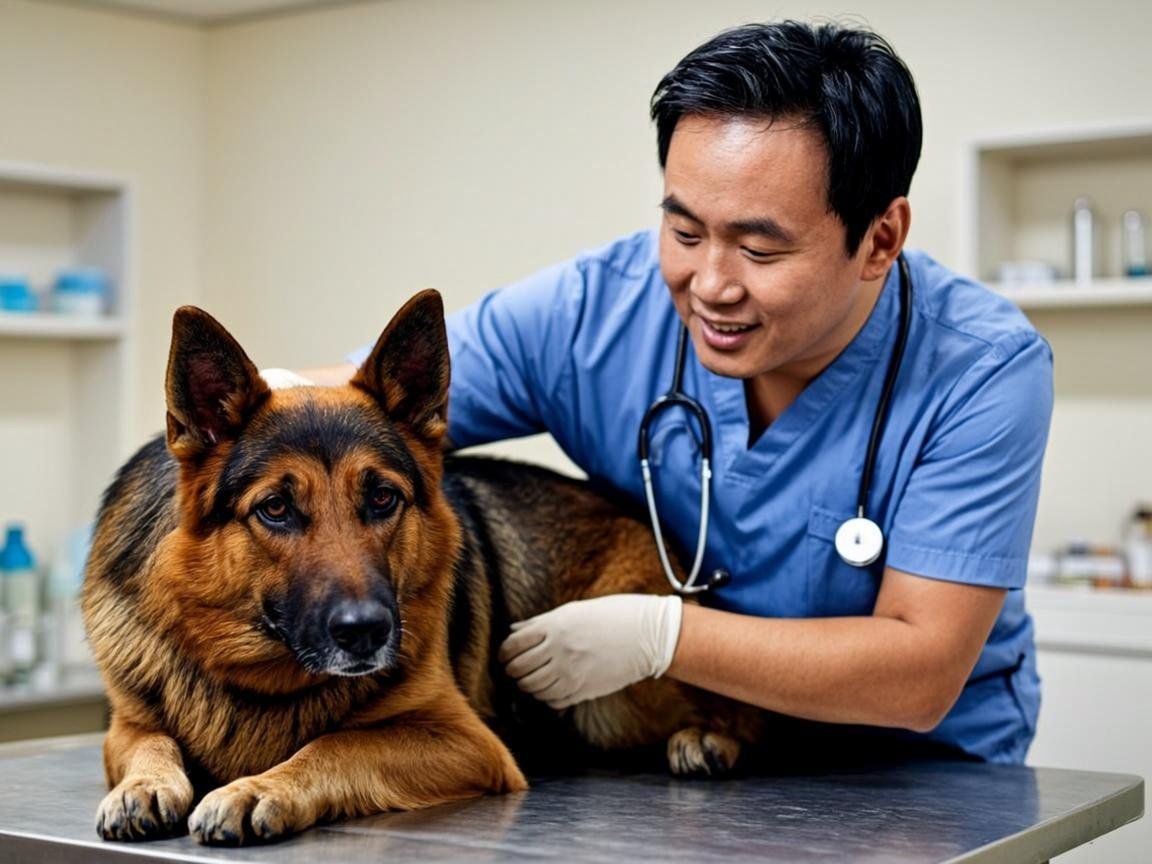
German Shepherd hip dysplasia is the most talked-about health issue in the breed, and for good reason: screening data from the Orthopedic Foundation for Animals consistently place German Shepherds among the most affected breeds, with roughly one in five screened dogs showing dysplastic hips. German Shepherd hip dysplasia is, in other words, a breed-wide reality that every owner should plan for from day one. The condition can quietly shape everything from your puppy’s growth plan to your long-term budget, because the average cost to diagnose hip dysplasia runs about $1,500, and the average cost to treat it lands near $5,200, with some surgical options exceeding $7,000 per hip.
Affiliate disclosure: As an Amazon Associate, German Shepherd Haven earns from qualifying purchases made through marked links on this page, at no extra cost to you. See our full Affiliate Disclosure.
The good news is that owners have far more control over German Shepherd hip dysplasia than they realize. Early recognition, smart growth-phase management, and modern treatment options can add comfortable, active years to a German Shepherd’s life. This guide walks through what hip dysplasia actually is, the warning signs at every age, how diagnosis works, what each treatment really costs in 2026, and the prevention steps that veterinary research supports. It is written for education and planning — your veterinarian remains the decision-maker for diagnosis and treatment.
- Key takeaways: German Shepherd hip dysplasia is a developmental joint condition influenced heavily by genetics and early growth.
- Screening matters: around 19–20 percent of German Shepherds tested by the OFA show dysplastic hips, so ask breeders for hip scores before you buy.
- Costs add up fast: expect roughly $1,500 for diagnosis and anywhere from $1,000 to $10,000+ for treatment, depending on the procedure chosen.
- Prevention is real: keeping puppies lean, feeding for controlled growth, and choosing screened breeding lines measurably reduce risk.
- Insurance timing is critical: pet insurance must be in place before symptoms appear, because dysplasia is usually excluded as a pre-existing condition afterward. See our guide to the best pet insurance for German Shepherds.
What Is German Shepherd Hip Dysplasia?
German Shepherd hip dysplasia is a developmental orthopedic condition in which the ball-and-socket joint of the hip forms incorrectly. In a healthy hip, the femoral head — the “ball” at the top of the thigh bone — sits deeply and snugly inside the acetabulum, the “socket” of the pelvis. In a dysplastic hip, the socket is too shallow, the ball is too flat, or the ligaments and joint capsule are too loose. The result is instability: the joint slides and micro-scrapes with every stride, and over months and years that friction wears away cartilage and reshapes bone.
Veterinarians describe German Shepherd hip dysplasia in two phases. The first is joint laxity, which begins during puppyhood while the skeleton is still growing. The second is degenerative joint disease (osteoarthritis), the irreversible remodeling phase that produces the classic stiffness and pain owners notice in adolescence or middle age. This two-phase nature is why early decisions — breeder selection, growth feeding, exercise management — carry so much weight: they act on the phase you can still influence.
It is also worth understanding what German Shepherd hip dysplasia is not. It is not an injury from a single accident, and it is not caused by one bad landing or one month of too much fetching. It is a multifactorial disease — genetics load the gun, but growth rate, nutrition, muscle mass, and activity patterns pull the trigger. That framing matters because it shifts the question from “who is to blame?” to “what can we manage?” Dogs with moderate radiographic dysplasia can live comfortable lives with excellent management, while some dogs with mild X-ray findings show significant discomfort. The X-ray tells you the anatomy; the dog tells you the function.
Within the broader landscape of German Shepherd health problems, German Shepherd hip dysplasia is the condition prospective owners research most — and the one with the strongest evidence base for prevention. If your long-term goal is a dog that hikes, works, and plays well into old age, this article will give you the vocabulary and the numbers you need to plan ahead.
Why German Shepherds Are One of the Most Affected Breeds
The German Shepherd’s signature angulated silhouette is part of the answer. The breed standard calls for a sloping topline and long, angled hind limbs that produce that admired elastic gait. But that same conformation places high mechanical demands on the coxofemoral joint: powerful rear-drive propulsion, sharp turns, and abrupt decelerations all pass through the hips. When you combine athletic conformation with a large, fast-growing body, small errors in joint development get amplified under load. This mechanical reality is a core reason German Shepherd hip dysplasia is overrepresented in fast-growing working breeds.
Genetics does the rest of the German Shepherd hip dysplasia story. The disease is highly heritable, with published heritability estimates commonly ranging from 0.2 to 0.6 depending on the population and scoring method, and multiple genes are involved rather than a single “dysplasia gene.” A landmark demographic study of canine hip dysplasia in the United States and Canada confirmed that large working breeds — German Shepherds prominently among them — carry substantially higher prevalence than the general dog population. The authors also documented how prevalence varies by region and reporting source, which is one reason screening registries exist: they create a standardized, comparable record of how each breeding line’s hips actually develop.
The numbers from the OFA’s breed statistics are sobering but empowering. Across decades of evaluations, roughly one in five German Shepherds screened shows hip dysplasia, and only a minority receive “Excellent” ratings. On the flip side, this is exactly what makes screening data so valuable to owners. Responsible breeders submit their breeding stock to OFA or PennHIP evaluation, publish the results, and select away from dysplasia across generations.
When you ask a breeder for the parents’ hip scores — and the grandparents’ — you are not being difficult; you are applying the single most effective consumer pressure the breed has. Few defenses against German Shepherd hip dysplasia are cheaper or more decisive than five minutes of score-checking before you pay a deposit. Puppies from two well-scored parents still carry some risk, but the probability curve shifts dramatically in your favor.
Environment completes the German Shepherd hip dysplasia triangle. Two siblings with identical genetics can land in very different places depending on how they grow: one kept lean on a large-breed puppy formula with controlled exercise, the other free-fed, overweight, and doing repetitive jumping on concrete at four months old. Studies repeatedly show that keeping puppies slim during the growth phase significantly reduces the risk and severity of dysplasia symptoms later. In other words, the breed’s genetic ceiling is fixed at conception — but whether that ceiling is ever reached is largely a management story, and that story is yours to write.
Early Warning Signs of German Shepherd Hip Dysplasia by Age
German Shepherd hip dysplasia rarely announces itself with a dramatic limp on day one. It usually arrives as a collection of small compensations that owners easily misread as clumsiness, laziness, or normal puppy behavior. Recognizing German Shepherd hip dysplasia early is worth real money: interventions during the juvenile window (before the growth plates close) can reshape how the joint develops, while interventions after arthritis sets in are mostly about comfort management. Here is what to watch, age by age.
Veterinarians broadly agree on seven proven warning signs of German Shepherd hip dysplasia: a bunny-hopping gait, the adult lazy sit, audible hip clicking, reluctance to rise, exercise intolerance, a narrowed hind-foot stance, and unexplained behavior changes around the hindquarters. Each appears below, organized by age, so you can match what you see at home to the stage where it typically shows up.
| Age range | Typical early signs | What it can look like at home |
|---|---|---|
| 8–16 weeks | Usually silent; subtle looseness may be detectable by palpation | Unsteady rear end on slick floors, “swimming” puppy gait, sitting oddly to one side |
| 4–8 months | Exercise intolerance, bunny-hopping gait, audible clicking, reluctance to rise | Puppy moves both rear legs together when trotting, hesitates at stairs, collapses into a “lazy sit” with legs sprawled |
| 8–18 months | Pain after activity, declining engagement in play, muscle loss over thighs | Stiff for the first few steps after a nap, skips jumping into the car, narrows hind-foot stance |
| 18 months–3 years | Often a deceptive “quiet phase” as the joint stabilizes | Fewer obvious symptoms — do not stop monitoring; arthritis is still developing underneath |
| 4+ years | Osteoarthritis signs: chronic stiffness, reduced range of motion, behavior changes | Slow to rise, irritable when touched near the hips, reluctance to be groomed over the hindquarters |
Three specific gait patterns deserve special attention in German Shepherds. First, bunny hopping — moving both hind legs together like a rabbit when running — is a classic stability strategy for loose hips, though it can occasionally appear in fast, healthy puppies during play, so context matters. Second, the adult lazy sit: a mature German Shepherd that consistently slumps onto one hip with hind legs splayed sideways rather than sitting square may be avoiding discomfort. Third, hip “clicking” or popping audible across the room during walking deserves a veterinary look, especially when paired with any hesitation to jump, climb, or rise.
Behavioral signs count too. Dogs rarely understand where the pain comes from — they simply start avoiding the things that hurt. A dog that used to meet you at the door and now waits on the couch, a puppy that suddenly growls when a child climbs near its hindquarters, a dog that stops mid-walk and sits down: these are data points.
Because German Shepherds are famously stoic and motivated to work through discomfort for their people, by the time one “looks lame” the discomfort has often been building for months. Trust small changes, and bring your notes to the vet — a two-week video diary of your dog rising, trotting toward you, and climbing stairs is often more diagnostic than anything the vet can see in a ten-minute exam room visit.
German Shepherd Hip Dysplasia or Normal Puppy Clumsiness?
New owners often struggle to separate genuine German Shepherd hip dysplasia signals from ordinary puppy chaos, and the confusion is understandable — German Shepherds grow unevenly, and many are briefly gangly at five months. The difference lies in patterns and persistence. Normal clumsiness is random: a puppy skids on the kitchen floor once, misses a step once, then moves beautifully for the rest of the day. German Shepherd hip dysplasia produces repeatable patterns: the same bunny-hop every time the dog accelerates, the same hesitation at the same staircase, morning stiffness that improves with gentle movement and returns after long rest.
Time is the second discriminator. Growing pains and soft-tissue strains resolve within days to a couple of weeks; German Shepherd hip dysplasia does not improve on its own, because the underlying joint geometry is not going to change by itself. Screening a suspicion costs a few hundred dollars; ignoring it can cost the DPO window.
If a suspected limp persists beyond two weeks, or if any single sign from the seven listed above appears consistently, schedule a veterinary gait evaluation and bring video. Film your puppy from behind and from the side at a trot on a loose leash — German Shepherd hip dysplasia often shows in hind-end symmetry long before the dog looks obviously lame. When German Shepherd hip dysplasia is the question, video plus a veterinary exam is the answer.
How Vets Diagnose Hip Dysplasia in German Shepherds
Diagnosing German Shepherd hip dysplasia follows a two-track process: a physical assessment that estimates joint laxity and pain, and imaging that reveals the actual anatomy. Neither track alone is sufficient. A dog can have loose-feeling hips and mild arthritis, or tight-feeling hips with severe remodeling hidden inside the joint — so good diagnosticians always pair the hands-on exam with X-rays.
During the physical exam, your veterinarian will palpate the hips looking for two classic maneuvers. The Ortolani sign detects the “clunk” of the femoral head sliding partially out of a shallow socket and back in, which indicates laxity. The Barlow maneuver gently pushes the femoral head out of the socket to test how easily it subluxates. The vet will also watch your dog trot, check muscle symmetry between the two hind limbs, and assess range of motion — dysplastic hips often lose internal rotation first. Expect the vet to ask detailed questions about when you first noticed changes, whether stiffness improves with rest or exercise, and how the signs have trended over weeks and months.
Imaging is where German Shepherd hip dysplasia gets graded. Three systems matter to German Shepherd owners:
- OFA hip evaluation (standard X-ray): the dog lies on its back with legs extended inward — a position many dysplastic dogs dislike, so sedation or heavy restraint is typical. Three board-certified radiologists independently grade each hip as Excellent, Good, or Fair (collectively “normal”), or Borderline, Mild, Moderate, or Severe (dysplastic). Official OFA certification requires the dog to be at least 24 months old, because joint maturity changes scores.
- PennHIP (distraction radiography): a specialized technique that measures actual joint laxity with a compression-distraction device, producing a “distraction index” from 0 to 1. PennHIP can be performed as early as 16 weeks of age, making it the preferred early-screening tool, and research shows a high distraction index at six months predicts later arthritis risk.
- CT and advanced imaging: typically reserved for surgical planning, when the orthopedic surgeon wants three-dimensional detail of the socket before recommending a procedure like DPO or total hip replacement.
Practical expectations for German Shepherd hip dysplasia workups: a basic diagnostic X-ray appointment commonly runs $300–$600 including sedation, but the full diagnostic workup — exam, sedation, multiple views, and follow-up consultation — is where the frequently cited average of about $1,500 comes from. If your dog is a pet, the takeaway is simpler: insist on proper positioning and sedation for diagnostic films.
If your dog is a prospective breeding animal, factor in that official OFA submission fees, sedation, and possibly PennHIP at an accredited practice are recurring investments across the dog’s life. A painfully flexed, rotated X-ray taken without sedation produces misleading images, and misleading images produce wrong treatment plans. None of this changes the German Shepherd hip dysplasia decision tree — it only sharpens the images feeding it.
German Shepherd Hip Dysplasia Treatment Options: Conservative Care to Surgery
German Shepherd hip dysplasia treatment is a menu, not a mandate, and the right choice depends on four variables: the dog’s age, the severity of the anatomy, the degree of daily pain, and the owner’s budget. A five-month-old puppy with severe laxity is a completely different case from a six-year-old pet with moderate arthritis, and the two should not receive the same plan. Below is the full decision tree, ordered from least to most invasive.
Conservative (medical) management
Conservative management does not fix German Shepherd hip dysplasia anatomy — it maximizes the joint’s comfort and function around it. The core stack includes strict weight control (lean body condition is the single most effective pain intervention in dysplastic dogs), structured low-impact exercise such as swimming and leash walking, physical rehabilitation with a certified canine rehab practitioner, joint supplements containing glucosamine, chondroitin, and omega-3 fatty acids, and veterinary NSAIDs like carprofen or meloxicam for painful episodes. Injected polysulfated glycosaminoglycans ( Adequan-type products) are another well-established option. Done well, conservative management keeps many mildly-to-moderately affected dogs comfortable for years at a monthly cost that rarely exceeds $50–$120 for supplements and medications.
Femoral head and neck ostectomy (FHO)
FHO removes the femoral head entirely, letting the leg form a functional “pseudo-joint” of scar-tissue and muscle. It sounds drastic, but for dogs under about 40–50 pounds it typically yields a comfortable, active — if slightly stiff — gait. For German Shepherds, FHO is usually reserved as a salvage option: a smaller dog or a situation where budget precludes better procedures, or where the ball is severely damaged (for example, after traumatic dislocation). Cost commonly runs $1,000–$3,000 per hip including surgery and hospitalization.
Double or triple pelvic osteotomy (DPO/TPO)
This is the “puppy window” surgery for German Shepherd hip dysplasia. For dogs roughly 5–10 months old with documented laxity but no significant arthritis yet, the surgeon cuts the pelvic bone and rotates the socket to capture the femoral head more deeply, changing how the joint develops for a lifetime. The catch is timing: once arthritic change begins, the window closes permanently, which is why early PennHIP screening has real financial value. DPO/TPO typically costs $2,500–$4,500 per hip, and both sides are usually staged several weeks apart.
Total hip replacement (THR)
THR is the gold standard for mature dogs with end-stage German Shepherd hip dysplasia: the surgeon replaces both the ball and the socket with prosthetic implants, eliminating the painful joint entirely. Success rates in appropriate candidates are high, and most dogs return to running and playing. The trade-off is cost and complexity: $3,500–$7,000 per hip is typical, with some specialist centers charging $8,000–$10,000+, and board-certified surgeon availability varies by region. Both hips are almost never replaced simultaneously; the second side, if needed, follows months later.
Other procedures worth knowing
Juvenile pubic symphysiodesis (JPS) fuses part of the growing pelvis in very young puppies (under ~20 weeks) to induce socket deepening — minimally invasive and relatively inexpensive ($500–$1,500), but only effective when performed extremely early and generally debated for breed-wide use. Femoral head neck excision alternatives and various arthroscopy-assisted techniques round out the surgical landscape at specialized centers. When comparing quotes between clinics, ask exactly what is included: pre-surgical bloodwork, anesthesia, implants, hospitalization, pain management, and follow-up radiographs can swing the true total by thousands.
| Option | Typical cost per hip (2026) | Best candidate | Key limitation |
|---|---|---|---|
| Conservative management | $40–$120/month ongoing | Mild-to-moderate cases, seniors, budget-limited homes | Manages symptoms, does not alter anatomy |
| FHO | $1,000–$3,000 | Salvage cases, smaller dogs, fractured femoral heads | Reduced limb function vs. THR in large breeds |
| DPO/TPO | $2,500–$4,500 | Puppies 5–10 months with laxity, no arthritis | Strict age window; requires early diagnosis |
| Total hip replacement | $3,500–$7,000+ (up to $10,000) | Mature dogs with severe arthritis, good candidates | High cost; needs board-certified surgeon |
How Much Does German Shepherd Hip Dysplasia Cost in 2026?
Let’s total the realistic lifetime numbers for German Shepherd hip dysplasia, because budget surprises are the part nobody warns you about. The frequently cited industry averages — about $1,500 to diagnose and about $5,200 to treat — describe a “middle” case, but your actual path may look very different. A proactive owner who PennHIP-screens a puppy at 16 weeks, confirms early laxity, and pursues DPO before arthritis develops might spend $3,500–$5,000 total and buy the dog decades of normal joint function. An owner who misses the signs might spend four years on escalating NSAIDs, rehab, and supplements before facing a $6,000 replacement per hip — potentially $12,000 for both sides.
This is precisely where pet insurance earns its premium for German Shepherd hip dysplasia claims. Policies purchased before any documented hip symptoms typically cover diagnosis, surgery, and rehab for dysplasia subject to waiting periods and annual limits — effectively converting a five-figure emergency into a deductible plus your share. That asymmetry is the entire argument for insuring a German Shepherd puppy the week it comes home.
Policies purchased after a vet has noted stiffness or a “lazy sit” will almost universally classify hip dysplasia as a pre-existing condition and deny coverage for it. If you are weighing providers, waiting periods, and bilateral-hip scenarios, our complete pet insurance guide for German Shepherds breaks down which policies handle orthopedic claims best. Payment plans and medical credit lines such as CareCredit are also widely used by veterinary clinics to spread surgical costs over time.
One more budgeting note: treatment is not the only cost center. Screening before symptoms ($300–$1,500 depending on method and region), rehab and hydrotherapy sessions ($40–$100 each, often sold in packages), and home modifications — orthopedic beds, ramps, traction rugs — typically add $200–$800 over a dog’s life. Owners who plan for the full curve rather than a single surgery bill make calmer, better-timed decisions.
Non-Surgical Management That Genuinely Helps
Whether your dog had surgery, is awaiting it, or will never need it, daily management is where outcomes are actually won. In German Shepherd hip dysplasia care, daily management is not the consolation prize — it is half the outcome. Four pillars carry most of the weight.
Recommended gear for this stage:
- Orthopedic memory-foam beds for large breeds (Amazon) — even, pressure-free support for loaded hips during rest.
- Foldable car ramps for large dogs (Amazon) — removes the repeated jump impacts that aggravate the hip joint.
- Glucosamine & chondroitin joint supplements (Amazon) — a daily-support option to discuss with your vet.
1. Weight discipline. Excess kilograms translate directly into joint load, and fat tissue is also metabolically active, promoting inflammatory signaling that worsens arthritis pain. Keeping your German Shepherd at a visible waist with easily-felt ribs is not vanity — for a dysplastic dog it is medicine against German Shepherd hip dysplasia, and studies consistently show lean-fed dogs develop less arthritis and show it later. If you are unsure what “lean” looks like for this breed, our best food for German Shepherds guide covers body-condition feeding in detail.
2. Exercise curation. The goal is strong muscles supporting a loose joint without repetitive impact grinding cartilage. Favor steady leash walks, swimming, and controlled hill work; limit high-impact fetching on hard ground, jumping, and sudden stop-start games. Consistency beats intensity: thirty to forty-five minutes of moderate movement daily serves dysplastic hips far better than a two-hour weekend warrior session followed by five sedentary days. That consistency rule holds at every stage of German Shepherd hip dysplasia management.
3. Evidence-supported supplementation. Omega-3 fatty acids (EPA/DHA) have the strongest research support for reducing arthritic discomfort; glucosamine/chondroitin combinations and undenatured type-II collagen have mixed but generally favorable safety records; green-lipped mussel extract is a reasonable addition. Treat supplements as a multiplier on — never a replacement for — weight and exercise management, and always coordinate dosing with your vet, especially alongside NSAIDs.
4. Home environment engineering. Traction is underrated: runners and yoga mats on hardwood floors prevent the slips that strain loose hips. An orthopedic memory-foam bed away from drafts, ramps for cars and furniture, raised food bowls if posture seems awkward, and nail trims every three to four weeks all reduce cumulative joint stress. Cold damp weather stiffens arthritic joints; a heated pad in winter often produces visible improvement within days.
Preventing German Shepherd Hip Dysplasia in Puppies and Adults
You cannot rewrite genetics, but German Shepherd hip dysplasia risk is shaped by decisions you can control from the day you choose a breeder. Prevention stacks five evidence-backed layers, and each one matters more than the last, because German Shepherd hip dysplasia risk compounds fastest in a large, fast-growing breed.
Layer 1: Choose screened breeding lines. Ask for the OFA or PennHIP results of both parents — and look for the pattern across the pedigree, since siblings and grandparents reveal more than a single score. A breeder who volunteers hip scores without being asked is signaling exactly the mindset you want. A breeder who says “my lines have no dysplasia” without documentation is telling you they have not looked. Verification takes five minutes on the OFA’s public database, and it is the highest-leverage five minutes in German Shepherd ownership.
2. Feed for slow, controlled growth. Overnutrition — especially excess calories and calcium — accelerates growth beyond what developing joints can support, and studies in large-breed puppies link rapid growth rates to increased dysplasia risk. Feed a formula specifically designed for large-breed puppies, which balances calcium-to-phosphorus ratios and moderates calorie density. The target is not maximum size; it is steady growth with a visible waist. Our guide on how much to feed a German Shepherd puppy gives portion frameworks by age, and this is one phase where “a little thin” beats “a little chunky” every time.
3. Manage exercise during the growth phase. Puppy joints are wrapped in soft growth plates and loose ligaments that harden with maturity. Free play on varied surfaces builds balance and muscle — that is good. What is not good is forced, repetitive, high-impact motion: sustained jogging on pavement, stair sprints, jumping drills, and slick-floor fetch marathons in a 4–8 month-old puppy. A widely used rule of thumb keeps structured leash walks to roughly five minutes per month of age, twice daily, with free play as the puppy chooses to stop and start itself.
4. Keep the puppy lean — permanently. The landmark lifespan and feeding studies in large dogs showed that restricted-fed dogs developed less arthritis and showed it years later than free-fed siblings. Body condition is a habit, not a phase: weigh monthly, feel ribs weekly, and adjust portions by the dog you can see, not the amount the bag suggests. Treats count too — our treat and calorie budgeting guide shows how fast rewards consume a puppy’s daily calorie budget.
5. Screen early, decide early. If your puppy came from uncertain lines, a PennHIP evaluation at 4–5 months costs a few hundred dollars and either buys peace of mind or opens the DPO window while German Shepherd hip dysplasia surgery can still change the joint’s development. Skipping early screening does not avoid the cost of dysplasia; it merely relocates that cost to a point where the cheaper, more effective options have expired. And if you are considering your dog for breeding, official OFA certification at 24 months is the non-negotiable floor of ethical practice — breeding unscreened dogs propagates the disease the registry exists to reduce.
Living With a Dysplastic German Shepherd: A Workable Daily Routine
A German Shepherd hip dysplasia diagnosis changes your routine, not your relationship. Dogs live in the present; the dog who loved trail sniffing last year still loves trail sniffing this year, just at a different intensity. Owners consistently report the happiest outcomes when they restructure around three rhythms: morning movement before the day’s stiffness accumulates, midday rest on a supportive bed, and short evening walks rather than one long excursion. Keep a simple log — minutes walked, morning stiffness duration, any limping — because trends over weeks tell you and your vet far more than single bad days.
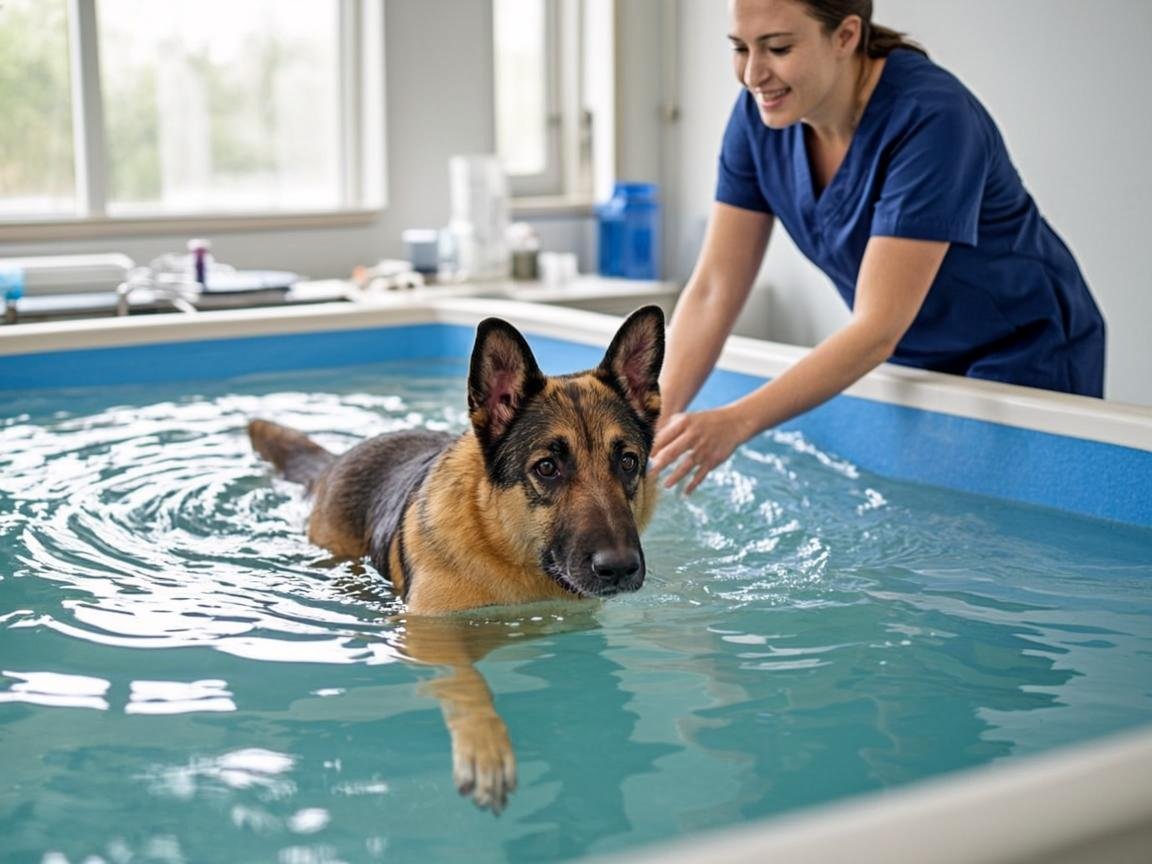
Rehabilitation deserves a serious look. Certified canine rehabilitation therapists offer underwater treadmill sessions, balance work, and targeted muscle-building protocols that measurably improve function; many owners describe hydrotherapy as the single best quality-of-life investment they made for German Shepherd hip dysplasia. Expect $40–$100 per session, typically packaged in blocks of six to ten. Pair formal rehab with home games that build rear-end strength safely: slow controlled hill walks, weight-shift exercises onto a cushioned platform, and nose-work games that engage the mind while the body recovers.
Long-term, remember that German Shepherd hip dysplasia is a marathon, not an emergency. The dogs that fare best belong to owners who accept the diagnosis early, commit to lean weight and consistent moderate exercise, maintain the medication and supplement plan their vet designs, and revisit imaging annually so treatment scales with the disease rather than chasing it. Many moderately dysplastic German Shepherds live full lifespans with good comfort — and the science-backed strategies in our lifespan guide apply double to dogs managing joint disease, because cardiovascular fitness, dental health, and weight discipline all compound in the same direction.
Real-World German Shepherd Hip Dysplasia Cases: Three Owners, Three Paths
Composite cases — typical of what veterinary practices see — make the German Shepherd hip dysplasia numbers concrete. Case one: a five-month-old male puppy from untested parents begins bunny-hopping after fetch sessions. A PennHIP evaluation confirms significant laxity — early German Shepherd hip dysplasia — and because arthritis has not begun, the owner elects a double pelvic osteotomy, the surgery that reshapes how the joint develops. Total cost: about $7,000 for both hips, staged several weeks apart. At four years old the dog hikes daily without medication. The lesson: German Shepherd hip dysplasia caught inside the juvenile window can be reshaped before it ever becomes arthritis.
Case two: a three-year-old rescue with an unknown history shows stiffness after weekend hikes. X-rays reveal moderate German Shepherd hip dysplasia with early cartilage wear — the reconstructive window has closed. The owner commits to lean weight, daily swimming, omega-3 supplementation, and NSAIDs during flare-ups. Five years on, German Shepherd hip dysplasia progression in this dog has been slow, and he remains comfortable on a management budget of roughly $70 a month. The lesson: when surgical timing is missed, disciplined management still buys years of good quality of life.
Case three: a seven-year-old with advanced arthritis faces a $6,500 total hip replacement; pet insurance, purchased as a puppy, covers most of the bill. Post-op rehabilitation takes twelve weeks, and the second hip follows a year later. The lesson: German Shepherd hip dysplasia is financially survivable when insurance predates symptoms — and nearly ruinous when it does not. Three cases, three budgets, one pattern: the stage at which German Shepherd hip dysplasia is discovered shapes every option that follows.
Frequently Asked Questions About German Shepherd Hip Dysplasia
At what age does German Shepherd hip dysplasia usually appear?
German Shepherd hip dysplasia shows two peaks. Juvenile cases surface between 4 and 12 months as puppies show bunny-hopping gait, reluctance to rise, or exercise intolerance. Adult-onset cases appear from 3 years upward as accumulated cartilage wear produces classic arthritis stiffness. Some dogs with significant radiographic dysplasia stay clinically quiet for years, which is why gait awareness matters throughout life.
Can a German Shepherd with hip dysplasia live a normal life?
Yes — with management. Mild-to-moderate German Shepherd hip dysplasia cases usually thrive on weight control, exercise curation, and supplements; severe cases may need surgical intervention, after which many dogs return to running and playing. The diagnosis is serious, but it is not a ceiling on a good life, and thousands of dysplastic German Shepherds hike, play, and work comfortably every day.
Is it worth getting pet insurance for hip dysplasia?
Only if the policy is in place before any symptoms appear. Once a vet has documented stiffness, lameness, or a dysplasia suspicion, insurance companies classify German Shepherd hip dysplasia as a pre-existing condition and exclude it. Enrolled early, insurance can offset the $3,500–$10,000+ surgical curve; enrolled late, it will not touch hip claims. Timing is the whole game.
Does exercise make German Shepherd hip dysplasia worse?
The wrong exercise does; the right exercise helps. Low-impact, muscle-building movement (swimming, steady leash walks, controlled hills) protects the joint, while repetitive high-impact activity (hard fetch, jumping, stair sprints — especially in growing puppies) accelerates cartilage wear. Frequency matters too: daily moderate movement beats weekend intensity.
Are there German Shepherd lines with low hip dysplasia risk?
Risk follows the pedigree, not the coat color or the breeder’s marketing. Working-line and show-line dogs both carry dysplasia; what matters is documented multi-generational OFA/PennHIP scoring for German Shepherd hip dysplasia. Check the parents, the grandparents, and the breeder’s willingness to discuss scores — that conversation predicts your puppy’s hips better than any line label.
Does German Shepherd hip dysplasia always show up on X-rays?
Not immediately. In early German Shepherd hip dysplasia, laxity can be present while standard X-rays still look normal — which is exactly why PennHIP distraction views exist, and why a puppy with suspicious gait signs deserves re-imaging at maturity. If symptoms persist but films are clean, ask about soft-tissue causes and repeat imaging in three to six months.
Can supplements alone prevent German Shepherd hip dysplasia?
No, and any product claiming otherwise deserves skepticism. Supplements support joint comfort within a German Shepherd hip dysplasia plan, but the plan’s foundation is genetics screening, controlled growth feeding, lean weight, and exercise management. Think of supplements as the roof of the house — useful, but only after the walls are built.
Is German Shepherd hip dysplasia inherited from the mother or the father?
From both. German Shepherd hip dysplasia is polygenic, meaning many genes from each parent contribute, so a superb dam cannot rescue an unscored sire or vice versa. This is why responsible breeders evaluate both parents — and why asking for two generations of scores is the single most practical question an owner can ask.
How common is German Shepherd hip dysplasia in working lines?
It remains common, though breeders who screen relentlessly tend to beat the breed baseline. The honest answer: German Shepherd hip dysplasia risk in any litter follows the parents’ scores and the pedigree pattern, not the “working” or “show” label. Verify scores independently before assuming a line is clean.
Final Thoughts and Next Steps
German Shepherd hip dysplasia rewards the prepared. The owner who asks for hip scores before choosing a puppy, feeds for controlled growth, keeps the dog lean, watches gait with an informed eye, and insures early holds every advantage the disease allows you to hold. The owner who meets the condition late still has good options — modern surgery, rehab, and daily management genuinely work — but every month of delay narrows the cheaper, more effective choices.
If you found this guide useful, take two next steps today: bookmark our complete German Shepherd health problems guide so you recognize related conditions early, and subscribe to our newsletter for breed-specific health and training guidance delivered straight to your inbox. Have questions about your own dog’s hips? Drop them in the comments — real reader questions shape the follow-up articles we research next.
Sources and Limits
This article is educational and does not replace veterinary diagnosis or treatment. Cost figures are 2025–2026 U.S. market estimates and vary by region, clinic, and case severity. Always consult a licensed veterinarian — ideally one with orthopedic experience — before making diagnostic or treatment decisions for your dog.
Key references consulted: the Orthopedic Foundation for Animals’ overview of hip dysplasia and its breed screening statistics; the demographic study of canine hip dysplasia prevalence in the United States and Canada by Loder and Todhunter (PMC5366211); the American Kennel Club’s hip dysplasia guide; and veterinary financing cost ranges published by CareCredit’s veterinary resource center.