
Bringing home a German Shepherd puppy is one of life’s great joys — and one of its biggest responsibilities. Within days, most new owners find themselves standing in the pet food aisle, staring at a wall of bags, asking the same question: how much to feed a German Shepherd puppy, and how often? It is the single most important daily decision you will make during your dog’s first year, because nothing shapes a puppy’s long-term health quite like nutrition.
Table of Contents
- How Much to Feed a German Shepherd Puppy Depends on Growth Phase
- German Shepherd Puppy Feeding Chart by Age
- How Many Meals a Day Does a German Shepherd Puppy Need?
- What to Look for in a Large-Breed Puppy Food
- Best Puppy Foods for German Shepherd Puppies (2026 Picks)
- 5 Common Feeding Mistakes German Shepherd Owners Make
- How to Switch Puppy Foods Without an Upset Stomach
- Is Your Puppy Eating Right? The Body Condition Check
- Frequently Asked Questions
- The Bottom Line
Affiliate disclosure: As an Amazon Associate, German Shepherd Haven earns from qualifying purchases made through marked links on this page, at no extra cost to you. See our full Affiliate Disclosure.
Feed too little, and your puppy may miss the nutrients needed to build strong bones, dense muscle, and a resilient immune system. Feed too much, and you accelerate growth in a breed that is already predisposed to painful joint conditions. This guide removes the guesswork: exact daily amounts for every stage, a printable feeding schedule, the nutrition criteria that genuinely matter for large-breed puppies, our pick of the best puppy foods for German Shepherds, and the five mistakes owners make most often.
How Much to Feed a German Shepherd Puppy Depends on Growth Phase
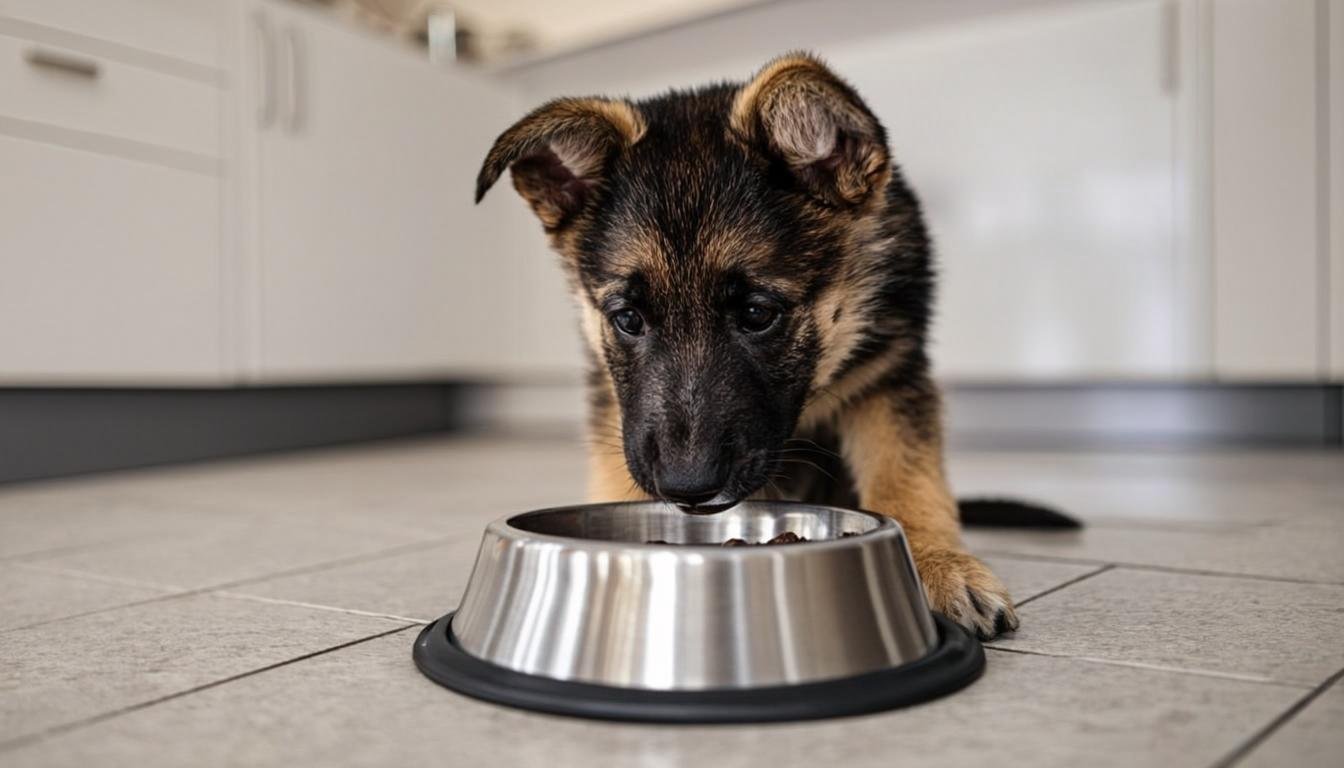
German Shepherd puppies are not simply small versions of adult dogs. Between eight weeks and eighteen months, a healthy GSD puppy multiplies its weight roughly fifty to sixty times, eventually reaching 60 to 80 pounds or more. To fuel that transformation, the skeleton lengthens months before the muscles, tendons, and ligaments that must support it have caught up. During this window the growth plates — soft cartilage zones at the ends of the long bones — remain open and unusually vulnerable to anything that pushes the body to grow too fast.
This is why overfeeding a large-breed puppy is far riskier than slightly underfeeding one. Veterinary nutritionists have shown for decades that puppies growing too quickly, or consuming excess dietary calcium, face a higher risk of developmental orthopedic disease, including hip dysplasia, elbow dysplasia, and osteochondritis dissecans. Because German Shepherds already rank among the breeds most affected by hip and elbow dysplasia, keeping growth slow and steady is the single most effective nutritional protection you can give your dog.
Portion control matters for a second reason too. German Shepherds are a deep-chested breed, which places them at higher risk of gastric dilatation and volvulus (GDV), or bloat — a life-threatening emergency in which the stomach fills with gas and can twist on itself. Measured, structured meals are part of the standard prevention advice, so the feeding routine you build now protects your dog well beyond puppyhood.
German Shepherd Puppy Feeding Chart by Age
The schedule below shows typical daily amounts for a German Shepherd puppy eating a premium large-breed puppy formula of roughly 400 calories per cup. Treat these figures as starting points rather than laws: individual puppies differ in metabolism and activity level, and the feeding chart printed on your specific bag of food always takes priority. Weigh your puppy weekly, run the body condition test described later in this guide, and adjust portions up or down by about ten percent as needed.
| Age | Meals per day | Total cups per day | Roughly per meal |
|---|---|---|---|
| 8–12 weeks | 4 | 1.0–1.5 cups | 1/4 to 3/8 cup |
| 3–6 months | 3 | 1.5–2.0 cups | 1/2 to 2/3 cup |
| 6–9 months | 3 | 2.0–3.0 cups | 2/3 to 1 cup |
| 9–12 months | 2–3 | 2.5–3.5 cups | 1 to 1 1/4 cups |
| 12–18 months | 2 | 2.5–4.0 cups | 1 1/4 to 2 cups |
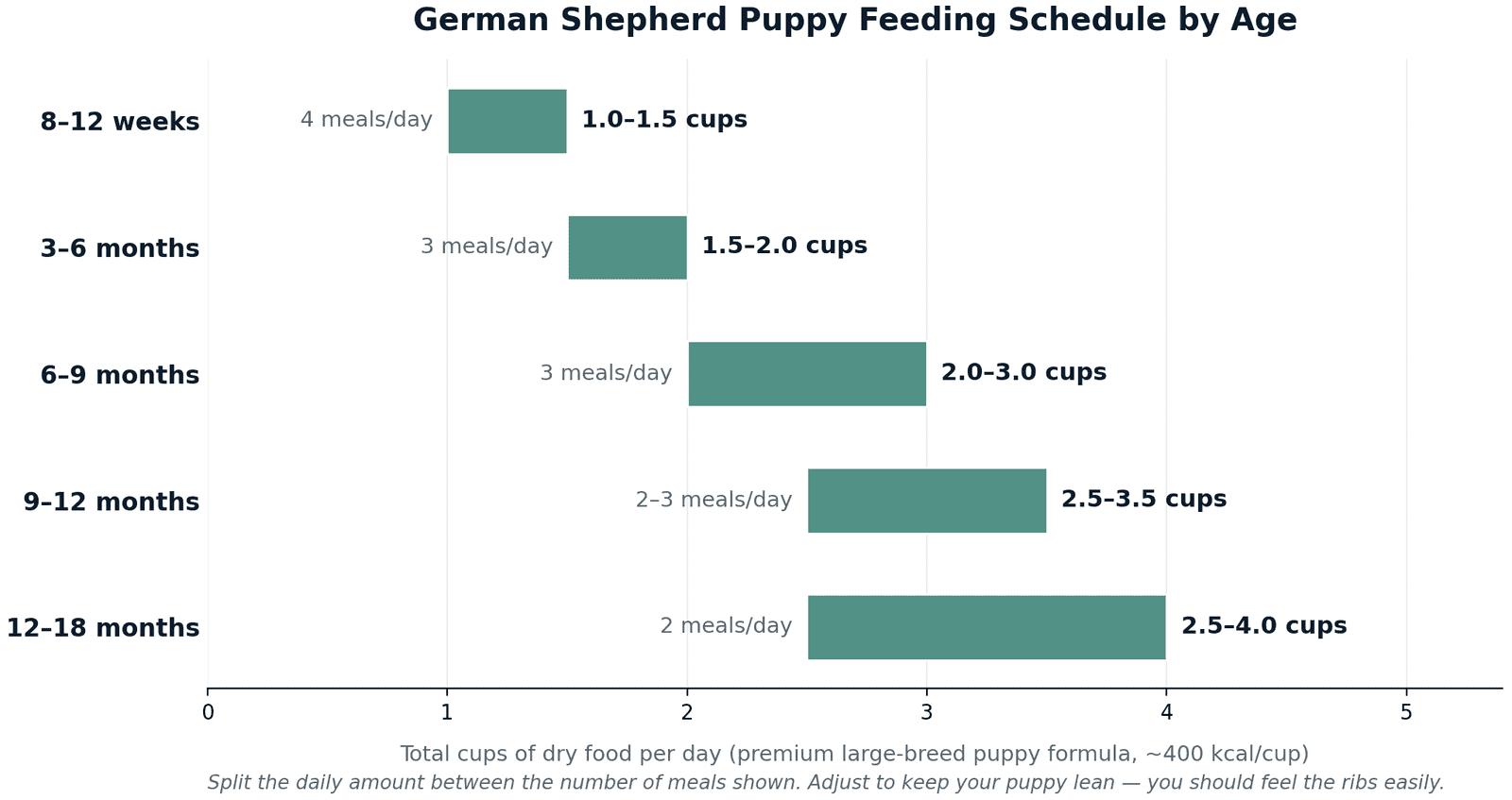
Notice the pattern: the daily amount climbs steadily while the number of meals falls. A young puppy’s small stomach cannot hold enough food in three sittings to fuel safe growth, which is why puppies under three months eat four small meals a day. As the digestive system matures and the growth rate naturally slows after nine months, fewer and larger meals become appropriate — and considerably more convenient for you. Keep an eye on weight as well as volume: during peak growth, between three and seven months, many German Shepherd puppies gain one to two pounds per week, and a steady curve matters more than any single number.
How Many Meals a Day Does a German Shepherd Puppy Need?
Until twelve weeks of age, plan on four meals spaced roughly four hours apart. Very young puppies are prone to dips in blood sugar, and small frequent meals keep their energy stable through the day. From three to six months, three meals a day are enough. Between six and twelve months, most puppies transition happily to two or three meals, and by the first birthday the classic two-meals-a-day routine — morning and evening — becomes the lifelong standard for the breed.
Whatever schedule you choose, consistency is what matters most. Feed at the same times each day, in the same quiet spot, and remove any uneaten food after fifteen to twenty minutes. This routine helps with house training, prevents grazing, and gives you a reliable early-warning system: a German Shepherd puppy that suddenly leaves food behind is often showing the first sign of an upset stomach. Once meals run on autopilot, it becomes far easier to start training your puppy on a calm, focused stomach.
Finally, build a buffer around exercise. To reduce bloat risk, avoid vigorous play, running, or intense training for about an hour before and two hours after each meal, while calm leash walks are fine and can even help digestion. Fresh water should stay available at all times.
What to Look for in a Large-Breed Puppy Food
The amounts you feed only work if the food itself is right. German Shepherd puppies need a formula designed specifically for large-breed growth, and the label tells you everything — if you know where to look. Here are the four criteria that genuinely matter when you compare bags.
For portion basics, the AKC’s puppy feeding fundamentals guide is a solid reference — but large-breed puppies need the stricter calcium and growth rules described below.
The AAFCO statement for large-breed growth
Find the nutritional adequacy statement, usually in small print near the ingredient list. It should read something like: formulated to meet the nutritional levels established by the AAFCO Dog Food Nutrient Profiles for growth, including growth of large-size dogs (70 lbs or more as an adult). That final clause is essential. A food approved only for generic growth has not been evaluated for the controlled skeletal development large breeds require.
Controlled calcium and phosphorus
Calcium is the nutrient where large-breed formulas earn their name. Growing GSDs absorb dietary calcium very efficiently, so excess calcium from an ordinary puppy food can push skeletal growth beyond what the joints can support. Look for calcium between roughly 1.2 and 1.8 percent on a dry matter basis, phosphorus slightly lower, and a calcium-to-phosphorus ratio close to 1.2:1 to 1.4:1. You do not need to run laboratory tests — reputable brands publish full nutrient data for large-breed growth, which is exactly why we favor them in the picks below.
The right protein and fat levels
Despite old myths about limiting protein, modern veterinary nutrition supports moderate-to-high protein for growing large breeds — around 23 to 30 percent on a dry matter basis — as long as calories and calcium stay controlled. Fat should be moderate, typically 12 to 15 percent: enough for energy, skin, and coat, but not so rich that the puppy fills out faster than its frame can handle.
DHA and quality ingredients
DHA, an omega-3 fatty acid usually supplied by fish oil, supports brain and vision development and is worth prioritizing in a puppy formula. Then scan the first five ingredients: a named animal protein such as deboned chicken, chicken meal, or lamb should appear near the top. Do not fear grains — properly cooked grains are well digested, and grain-free diets have been investigated by the FDA for a possible link to heart disease (DCM), so there is no reason to pay extra for grain-free.
Best Puppy Foods for German Shepherd Puppies (2026 Picks)
Any complete and balanced large-breed puppy formula can raise a healthy GSD. That said, three foods come up again and again in breeder and veterinary circles for this breed, covering the main budget levels. Whichever you choose, apply the seven-day transition described later to every change of food.
1. Royal Canin German Shepherd Puppy — breed-specific precision
This is the only major formula designed specifically for the breed. The exclusive kibble shape suits the GSD’s long muzzle, the calcium content is calibrated for controlled skeletal growth, and the recipe relies on highly digestible proteins and fibers that suit the breed’s notoriously sensitive digestion. The main drawback is price, so many owners use it for the critical first eight months, then transition to a less expensive large-breed formula.
Check today’s price on Amazon: Royal Canin German Shepherd Puppy (30 lb) →
2. Purina Pro Plan Large Breed Puppy (Chicken and Rice) — best value
A favorite of working-dog breeders, Pro Plan delivers excellent nutrition at a reasonable price. Real chicken leads the ingredient list, DHA is included for brain development, and Purina runs extensive feeding trials — a rarity in the industry that adds real credibility. It contains corn and wheat, which is nutritionally fine for the vast majority of puppies despite common fears. For most families, this is the sensible all-rounder.
Check today’s price on Amazon: Purina Pro Plan Large Breed Puppy, Chicken and Rice →
3. Hill’s Science Diet Large Breed Puppy — the vet favorite
The brand most often recommended in veterinary clinics offers precisely controlled calcium for large-breed growth, no artificial colors or flavors, and decades of feeding-trial history. Protein sits at the moderate end of the range, which suits calmer household puppies perfectly.
| Food | Best for | Calcium control | Notable point |
|---|---|---|---|
| Royal Canin GSD Puppy | Breed-specific precision | Excellent, breed-calibrated | Kibble shaped for the GSD muzzle |
| Purina Pro Plan LB Puppy | Best value all-rounder | Very good | Feeding trials, chicken first |
| Hill's Science Diet LB Puppy | Vet-first households | Very good | No artificial colors or flavors |
Check today’s price on Amazon: Hill’s Science Diet Large Breed Puppy →
5 Common Feeding Mistakes German Shepherd Owners Make
These are the errors veterinarians and experienced breeders see most often — and every one of them is easy to avoid once you know what to watch for.
1. Free-feeding all day
Leaving food down around the clock invites constant grazing, makes portion control impossible, and stacks a second risk factor on top of a breed already prone to bloat. Measure every meal, put the bowl down at set times, and lift it after fifteen minutes, whether or not the food is finished.
2. Racing growth with extra food and rich treats
A bigger puppy is not a healthier puppy. Extra kibble, fatty table scraps, and calorie-dense training treats push growth beyond what developing joints can support. Keep treats below ten percent of daily calories, and count them inside the daily total rather than on top of it.
3. Adding calcium or vitamin supplements
It sounds like insurance, but supplementing a complete puppy food with calcium is one of the most damaging things an owner can do to a large-breed puppy. Excess calcium interferes with normal bone maturation and is directly linked to the orthopedic diseases described earlier. Unless your veterinarian prescribes a specific supplement for a diagnosed deficiency, your puppy needs none.
4. Switching foods overnight
An abrupt change of food almost guarantees diarrhea in a breed with sensitive digestion, and stress on the gut at a young age costs valuable nutrients during the growth window. Every transition should take a full seven days, following the schedule in the next section.
5. Judging portions by the bowl instead of the body
Feeding charts are averages; your puppy is an individual. The final authority is the body condition test described below — ribs you can feel but not see, a waist visible from above, and a tuck visible from the side. Adjust portions to the body, not to the bag.
How to Switch Puppy Foods Without an Upset Stomach
Whether you are changing brands or eventually moving to adult food, the rule is the same: transition gradually over seven days. For the first two days, serve 75 percent old food mixed with 25 percent new food. On days three and four, go fifty-fifty. On days five and six, serve 25 percent old and 75 percent new, and from day seven feed only the new food. Watch the stool throughout the week. Soft stool simply means you should hold the current ratio for two or three extra days; watery diarrhea, vomiting, or lethargy is a call to the veterinarian, not a reason to push through.
Is Your Puppy Eating Right? The Body Condition Check
Weight alone cannot tell a muscular puppy from a chubby one. Once a week, run this three-step test. First, place both hands flat on your puppy’s ribcage: you should feel the ribs easily under a thin layer, the way you would feel fingers through a glove. Second, look at your puppy from directly above: there should be a clear waist behind the ribs. Third, view from the side: the belly line should tuck upward behind the ribcage.
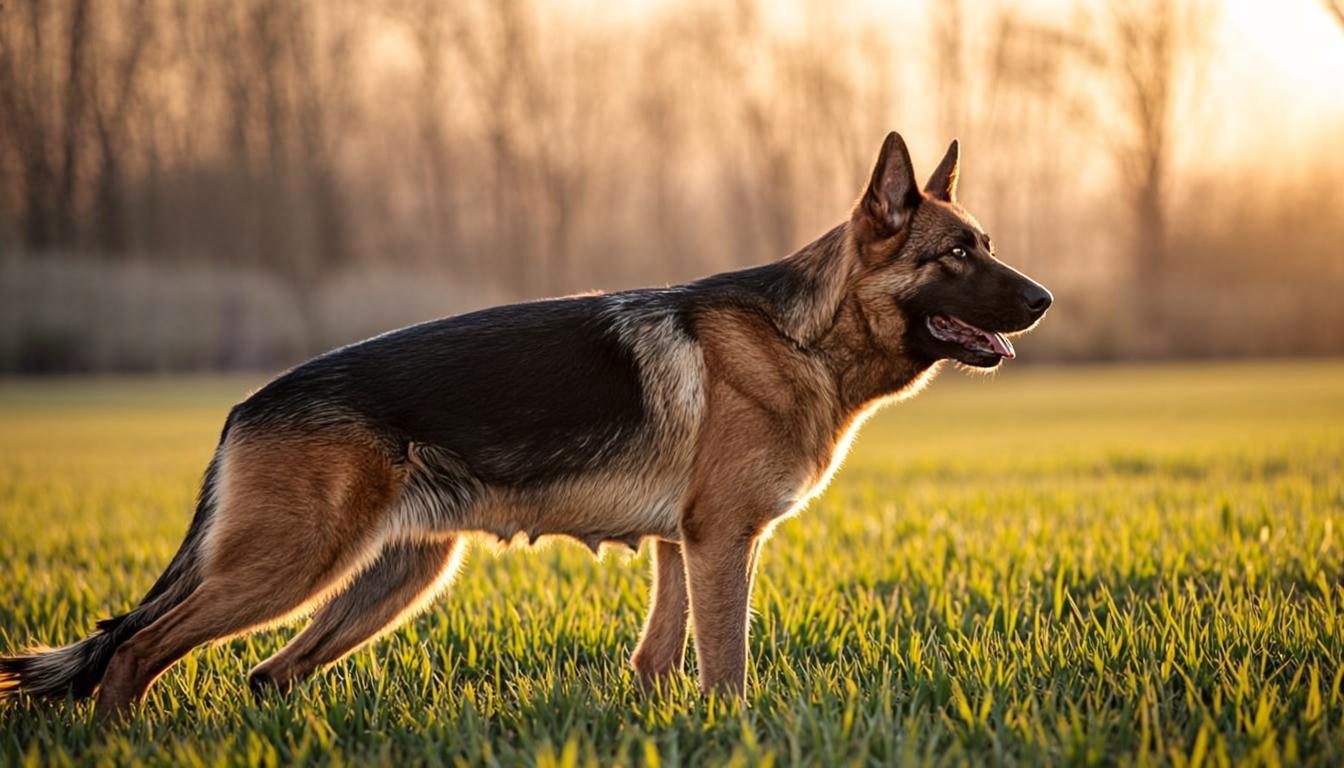
The photograph above shows the long-term goal: a lean, athletic adult German Shepherd. If you cannot feel the ribs, the waist has disappeared, or the belly line sags, reduce daily portions by about ten percent and recheck in two weeks. If ribs, spine, and hip bones are sharply visible, increase slightly instead. Slow down any puppy gaining weight too fast: rapid gain is the primary nutritional driver of the joint problems described earlier.
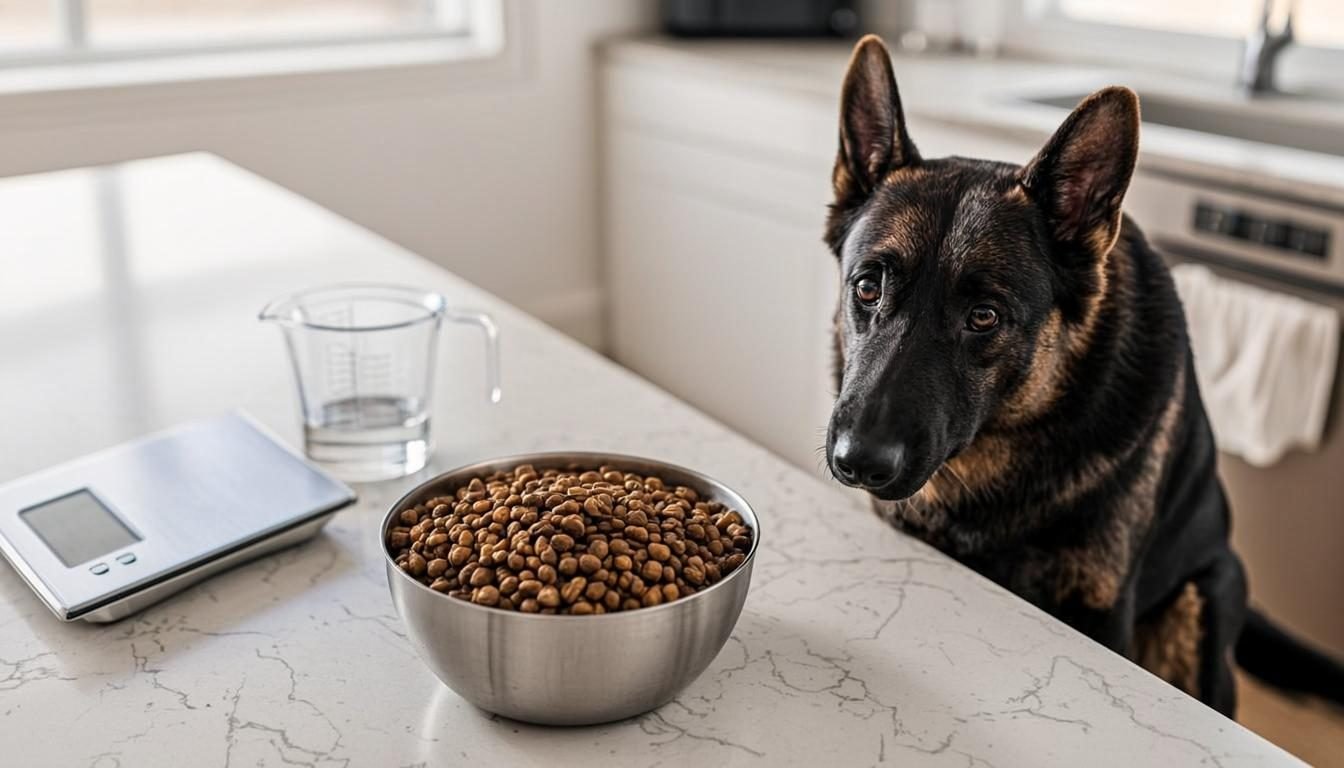
Track weight weekly on the same household scale and jot it down: a smooth growth curve matters more than any single number, and your log becomes gold-standard information for your veterinarian. Persistent diarrhea or vomiting, appetite loss beyond twenty-four hours, or a swollen, drum-tight abdomen always warrants an immediate veterinary visit.
Frequently Asked Questions
When should I switch my German Shepherd puppy to adult food?
Most German Shepherds stay on a large-breed puppy formula until 14 to 16 months of age, with females often ready closer to 12 to 14 months and slower-maturing males closer to 16 to 18 months. The gold-standard signal is closure of the growth plates, which a veterinarian can confirm on an X-ray during a routine check. Switch using the seven-day transition method described above.
Can a German Shepherd puppy eat adult dog food?
A stolen mouthful of the adult dog’s kibble is harmless, but adult food is not formulated for controlled large-breed growth, and its calcium and calorie levels differ from what a growing GSD needs. As a staple, it increases orthopedic risk rather than reducing it, so keep puppy food in the bowl until maturity. When that day comes, our comparison of the best food for adult German Shepherds takes over seamlessly.
How much water should a German Shepherd puppy drink?
A useful rule of thumb is about half an ounce to one ounce of water per pound of body weight each day, which works out to roughly half a cup to a full cup for every twenty pounds the puppy weighs. Keep the bowl topped up and expect regular refills after play and meals. A sudden, dramatic increase in thirst that lasts more than a day or two is worth mentioning to your veterinarian, since it can signal an underlying issue.
Do German Shepherd puppies need supplements?
No, not if they eat a complete and balanced large-breed puppy food, which already contains every nutrient the growth phase requires. The only worthwhile additions are the ones your own veterinarian prescribes for a diagnosed need — most commonly an omega-3 for skin or joints. Never add calcium on your own initiative.
Is wet food better than dry food for puppies?
Either is fine as long as the label carries the large-breed growth statement. Dry food is more economical, convenient to measure, and better for dental hygiene; wet food adds hydration and palatability for picky eaters. Many owners mix both, in which case the kibble portion must be reduced so total calories stay on target.
The Bottom Line
Feeding a German Shepherd puppy comes down to four habits: measured portions adjusted to a lean body condition, a large-breed puppy formula with controlled calcium, a fixed meal schedule that reduces bloat risk, and slow, steady growth over fast growth. Practice those four habits consistently for the first eighteen months and you will have given your dog the strongest possible foundation for the long, active life the breed deserves. Bookmark this page, weigh your puppy weekly, and let the body condition test — not the bag — make the final call. Get those four habits right and how much to feed a German Shepherd puppy becomes a predictable daily routine.
Reviewed against the AAFCO Dog Food Nutrient Profiles for growth, including growth of large-size dogs (70 lbs or more as an adult). This guide is general information, not a substitute for advice from your own veterinarian.