
Buying the best dog crate for German Shepherds is not like buying a crate for most other dogs. A German Shepherd combines the size of a large guardian breed with the problem-solving drive of a working dog, and that mix breaks cheap crates in ways nobody warns you about. Owners describe it the same way every time: the crate was fine for two weeks, then one afternoon they came home to bent wire, a broken latch, and a dog bleeding from a paw or a tooth. The crate you choose is not furniture — it is safety equipment, and for this breed it needs to be engineered accordingly.
Affiliate disclosure: As an Amazon Associate, German Shepherd Haven earns from qualifying purchases made through marked links on this page, at no extra cost to you. See our full Affiliate Disclosure.
This guide ranks the seven best dog crates for German Shepherds across every real-world use case: the escape-proof premium build, the crash-tested travel kennels, the budget steel alternative, the starter wire crate that actually fits an adult Shepherd, and the lightweight travel option for smaller lines. Every pick is sized for a full-grown German Shepherd, evaluated for the specific ways this breed destroys and escapes confinement, and matched to a realistic budget. We also include a complete size guide, a crate training plan adapted to Shepherds, and the five buying mistakes that cost owners the most money.
Whether you are crate-training a German Shepherd puppy or upgrading after an escape attempt, the seven crates below earn their place on strength, safety testing and real owner feedback.
Table of Contents
- Why German Shepherds Need a Different Class of Crate
- How We Picked the Crates in This Review
- Quick Comparison: the Best Dog Crates for German Shepherds in 2026
- Impact High Country Collapsible: the Best Dog Crate for German Shepherds Overall
- GUNNER G1 Kennel: the Crash-Tested Travel Pick
- MIM Variocage DoubleMax: the Safest Car Crate for Two Dogs
- SmithBuilt Heavy-Duty: the Best Budget Escape-Proof Crate
- Midwest iCrate XXL: the Best Starter Wire Crate for Trained Shepherds
- Frisco Fold & Fly: the Best Mid-Range Double-Door Wire Crate
- Petmate Ultra Vari 48": the Best Lightweight Travel Kennel for Smaller Shepherds
- Crate Size Guide: What Size Crate Does a German Shepherd Need?
- Wire, Plastic, or Heavy-Duty Steel? Choosing the Right Crate Type
- How to Crate Train a German Shepherd Without Tears
- The 5 Crate-Buying Mistakes That Cost Owners the Most
- FAQ: Best Dog Crate for German Shepherds
- Sources and Limits
- The Bottom Line on the Best Dog Crate for German Shepherds
Why German Shepherds Need a Different Class of Crate
The German Shepherd Dog ranks among the most popular large breeds in the United States, and it carries a specific physical profile that most crate manufacturers simply do not design for. Adult males typically stand 24 to 26 inches at the shoulder and weigh 75 to 95 pounds, with females running slightly smaller.
That mass alone pushes you out of the 36-inch crate range that suits most family dogs and into 42-to-54-inch territory before you have added a single comfort accessory. But size is the easy part. The real issue is behavioral: this is a breed developed for patrol work, with high intelligence, strong jaw muscles, and a well-documented tendency to test physical barriers when stressed.
Any owner who has dealt with a Shepherd that panics when left alone knows the pattern described in the veterinary literature on German Shepherd separation anxiety: vocalization, then escape attempts, then self-injury. A standard wire crate is not a match for a 90-pound dog that has decided to leave it.
Wire crates for large breeds routinely fail at the door latch and the corner welds, and veterinarians see the consequences — broken teeth, torn claws, and muzzle lacerations from dogs forcing their snouts through gaps. This is why the heavy-duty steel category exists at all: much of its design innovation came directly from Shepherd and Malinois owners who kept bending everything else.
Size is the easy part. The real issue is behavioral: this is a working breed with strong jaws, high drive, and a documented talent for testing physical barriers when stressed or under-stimulated. Cheap wire crates fail Shepherds in predictable ways — bent panels, popped latches, and sharp wire ends that create real injury risk. A dog that breaks a cheap crate is not a training failure; it is a purchasing failure that happened months earlier.
Health considerations add another layer. German Shepherds carry one of the higher rates of hip and elbow dysplasia among large breeds, which means many adults eventually need a crate with low, easy entry and room to change positions without twisting loaded joints.
Stiffness after long confinement is a real complaint among owners of middle-aged Shepherds, and the Orthopedic Foundation for Animals reports that roughly one in five screened Shepherds has dysplastic hips, which is why crate comfort overlaps directly with joint care. If your dog already shows hip changes, you will also want to read our guide to German Shepherd hip dysplasia, because crate choice and joint management are the same conversation.
How We Picked the Crates in This Review
Every crate in this review was evaluated against six criteria that matter specifically for German Shepherds, and we will be blunt about method: we did not laboratory-test these crates ourselves. Instead, we synthesized the available evidence — manufacturer engineering claims that can be verified against third-party standards, the patterns in thousands of verified owner reviews from large-breed households, veterinary guidance on confinement and travel safety, and the collective experience of Shepherd trainers and rescues who crate this breed daily in volume.
The six criteria, in order of weight: escape resistance (latch design, bar spacing, weld and hinge quality, no pinch points a clever dog can exploit), adult-Shepherd fit (internal dimensions that let a 26-inch dog stand, turn, and stretch flat), durability of hardware (the corners and doors that fail first on cheap crates), ease of cleaning (removable pans, wipeable surfaces), safety for travel (where applicable, whether the manufacturer reports crash testing against recognized child-restraint standards), and value over the crate’s full life, not sticker price alone.
A $90 crate replaced twice in two years costs more than a $400 crate bought once — and the vet bill from the failed crate is not included in that math.
We also excluded whole categories on purpose. Soft-sided crates are lovely for calm small dogs and wrong for this breed in every case we have seen. Cheap single-wall plastic “airline style” kennels sold at big-box stores are fine for calm transport but have a documented failure mode with determined large dogs. And GPS-tracked “smart crates” at four-figure prices solve problems most Shepherd households do not have. What remains is the seven crates below, organized by what you actually need one to do.
Quick Comparison: the Best Dog Crates for German Shepherds in 2026
Here is the short version before the detailed reviews. Price bands are typical retail ranges at the time of writing and move with sales, so treat them as orientation rather than quotes.
| Crate | Type | Best for | Typical price band |
|---|---|---|---|
| Impact High Country Collapsible | Aluminum | Escape-artist Shepherds, premium build | $650–$900 |
| GUNNER G1 Kennel | Rotomolded plastic | Crash-rated car transport | $475–$650 |
| MIM Variocage DoubleMax | Crash-tested steel | Split car safety, anxious travelers | $900–$1,300 |
| SmithBuilt Heavy-Duty | Steel tube | Budget escape-proofing at home | $180–$300 |
| Midwest iCrate XXL (54″) | Wire | Trained adults, puppy with divider | $120–$200 |
| Frisco Fold & Fly | Wire, double door | Mid-range everyday home crate | $100–$170 |
| Petmate Ultra Vari 48″ | Plastic shell | Lightweight travel for smaller lines | $110–$180 |

Impact High Country Collapsible: the Best Dog Crate for German Shepherds Overall
If money is not the constraint and your problem is a Shepherd who treats confinement as a challenge, the Impact High Country Collapsible is the crate the working-dog world keeps recommending. It is built from welded aluminum panels with rounded corners, a paddle latch system that requires coordinated motion from both sides of the door, and hardware designed so there is nothing for a jaw to get meaningful purchase on. Owners of Shepherds and Malinois who have already destroyed one or two cheap crates describe the same experience: the dog tries its usual techniques for a few days, then stops, because nothing flexes, squeaks, or gives.
Two design details justify the premium price. First, the collapsibility is genuine engineering rather than a marketing line — the crate folds flat without tools and holds together structurally when assembled, which matters if you travel with a protective breed and need a crate that works in hotel rooms and trial grounds. Second, the bar spacing and panel strength are consistent across the whole box, not just the door.
Cheap crates put all their strength in the front panel and leave the sides as the weak point; Shepherds find that weakness within a week. The trade-offs are exactly what you expect at this price: weight (you will want two people for casual repositioning), a price that stings, and an industrial look that will not match your living room. Buy it if your Shepherd has already beaten one crate and you are done paying the cheap-crate tax. Everything else below is a compromise from this standard.
Check current price: Impact collapsible aluminum dog crates on Amazon.
GUNNER G1 Kennel: the Crash-Tested Travel Pick
The GUNNER G1 is a rotomolded polyethylene kennel — the same molding process used in kayak hulls — and it has become the default recommendation in Shepherd and sporting-breed communities for people who drive a lot with their dog. The manufacturer reports third-party crash testing against standards adapted from child safety seat protocols, and the G1 uses a two-stage latch, a tie-down system for the vehicle, and a double-wall shell intended to deform on impact rather than shatter. We present those as manufacturer claims rather than independent certification, but the consistency of the testing story and the reported test videos put it well ahead of ordinary plastic kennels for serious transport.
For everyday home use, the G1 is overkill: it is heavy, it does not fold, and its insulated shell holds heat, which matters in summer. Where it earns its money is the scenario Shepherd owners know too well — an 80-pound dog riding in the cargo area at highway speed, unprotected.
In a sudden stop, an unrestrained or under-protected large dog becomes a projectile, and no wire crate addresses that honestly. The sizing matters: a full-size male Shepherd needs the Medium G1 (the brand sizes by weight and measurements, and the commonly reported fit for Shepherds is their Medium with the extended length option for taller lines). Measure your dog nose-to-tail-base and floor-to-crown as described in our size guide below before ordering.
Check current price: GUNNER G1 kennels on Amazon.
MIM Variocage DoubleMax: the Safest Car Crate for Two Dogs
The MIM Variocage is the Swedish-engineered option for owners who want the most rigorous crash-testing story in the industry. The manufacturer reports testing against European child-restraint crash standards and US FMVSS-style protocols, with a deformable crumple-zone design built into the crate frame — the idea being that the crate absorbs energy and protects the dog rather than behaving as a rigid box. The DoubleMax variant is a divided, double-door unit that seats two dogs independently, which is exactly the configuration many Shepherd households need. The doors include escape-hinge safety so they cannot trap the dog after a collision, a detail that shows how much of this design starts from crash-scenario thinking.
The honest caveats: it is the most expensive crate in this review, it is not collapsible, and the sizing requires care — Variocage sizing is based on the dog’s length and height in centimeters, and ordering too small is the most common mistake. It is also a crate that lives in the car; most owners who buy it also keep a home crate. Buy the Variocage if you drive long distances with one or two Shepherds, or if you transport dogs regularly and want the strongest documented safety case. Buy any other option on this list if the car is a once-a-month vet run.
Check current price: MIM Variocage crates on Amazon.
SmithBuilt Heavy-Duty: the Best Budget Escape-Proof Crate
The SmithBuilt Heavy-Duty crate is the entry point to the escape-proof category for owners who cannot stomach the four-figure options. It uses welded steel tube construction with thinner stock than the premium crates, a two-latch door system, and removable casters that make a 100-plus-pound crate moveable on a hard floor. For Shepherds, the relevant real-world pattern from owner reviews is consistent: it stops the benders and ratters — the dogs that flex wire panels and work latches — though the most determined heavy chewers can still mark the tube coating over months. That is the honest limit of every steel-tube crate at this price.
The value math is the reason it ranks here. A Shepherd household that discovers too late that their dog is an escape artist typically spends money twice: once on the wire crate that fails, and again on the replacement. SmithBuilt sits at the low end of the heavy-duty price range and survives the standard Shepherd test cases, which makes it the rational first purchase for adolescent Shepherds whose adult temperament is still unknown.
Two practical notes from long-term owners: check and re-tighten the bolt hardware after the first weeks of use, and put a crate pad down — the pan floor without bedding is hard on pressure points, especially for dogs predisposed to joint issues.
Check current price: SmithBuilt heavy-duty crates on Amazon.
Midwest iCrate XXL: the Best Starter Wire Crate for Trained Shepherds
Every Shepherd owner should know about the 54-inch Midwest iCrate not because it is the best dog crate for German Shepherds in the escape-resistance sense — it is not, and no honest review will tell you a wire crate beats welded steel with a determined dog —
but because it is the right tool for the most common situation: a properly crate-trained adult Shepherd who needs a roomy, affordable home den. The XXL size gives a full-grown male genuine stretch-out space, the included divider panel makes it double as a puppy-sizing crate during the growth months, and the double-door configuration lets you place it where it fits your rooms rather than where the single door dictates.
The failure cases are well known and avoidable. Wire crate failures with this breed happen when owners use them for panic-prone dogs, skip the training phase, or leave an adolescent crated far beyond its capacity to settle. If your Shepherd enters the crate voluntarily, settles within minutes, and has never attempted escape, the iCrate XXL does everything you need at a fraction of heavy-duty prices.
If your dog is showing the first signs of barrier panic — pacing, panting, rattling the door, bending bars — stop using wire immediately and step up to the SmithBuilt or better, because each failed escape attempt rehearses the behavior. Used correctly with the right dog, this crate remains the best value in the entire category, which is why rescues and foster homes buy it by the case.
Check current price: Midwest iCrate 54-inch crates on Amazon.
Frisco Fold & Fly: the Best Mid-Range Double-Door Wire Crate
The Frisco Fold & Fly occupies the middle ground between the budget iCrate and the heavy-duty tier: a folded-wire construction with double doors, rounded corner edges, and a build that several generations of large-breed owners have rated above the cheapest wire on frame rigidity. It folds flat quickly for storage and moves with built-in handle cutouts, which is the feature that separates it from basic boxes — Shepherd households reposition crates more than they expect, between rooms, during travel, and through the puppy-to-adult furniture shuffle.
In practice, choose it over the Midwest if you want the slightly stiffer frame and better finish and you know your dog is a settled crating candidate; choose the Midwest if you want the divider and the lowest price. Neither wire option is the answer for an untrained adolescent or an anxious adult, and that remains the critical decision point in this whole review. The Frisco’s pan is thinner than ideal — owners who use washable crate mats report better long-term pan condition, and the mat also solves the noise problem of tags clinking against the pan at midnight.
Check current price: Frisco Fold & Fly crates on Amazon.
Petmate Ultra Vari 48″: the Best Lightweight Travel Kennel for Smaller Shepherds
The Petmate Ultra Vari is the classic single-wall plastic travel kennel done properly: an American-made rotomolded shell, steel door with a secure squeeze latch, and ventilation windows sized for airflow in a cargo context. It earns a place in this review for a specific Shepherd population that bigger-is-better logic overlooks: smaller European-line females, senior Shepherds, and dogs recovering from procedures who need a den-like, enclosed space rather than a wire box. For those dogs, the fully enclosed shell often settles better than open wire — many owners report calmer crating with visual cover, which is also why vet clinics use plastic kennels by default.
Be precise about its limits. This is not an escape-proof crate, and it is not the right transport solution for a full-size male riding unrestrained in a cargo area — for that, see the G1 or Variocage above. The 48-inch Ultra Vari fits Shepherds up to roughly the 90-pound class by manufacturer sizing, but taller lines are tight, so measure as described below before committing.
Where it wins is weight-to-durability: it is dramatically lighter than steel at the same nominal capacity, which matters for one person loading a car, and its shell cleans with a hose. As a secondary crate for travel and vet stays, it fills a slot none of the metal options cover.
Check current price: Petmate Ultra Vari kennels on Amazon.

Crate Size Guide: What Size Crate Does a German Shepherd Need?
Size is where most Shepherd crate purchases go wrong, and they go wrong in both directions. Too small, and the dog cannot stretch flat or stand at full height, which turns the crate into a source of joint stress and resentment. Too large, and you lose one of the crate’s genuine functions: a properly sized den feels enclosed and calming, while an oversized box invites eliminating in the far corner and turns house-training regressions into habits.
The measurement that matters is not weight alone — it is the dog’s physical dimensions, and there is a simple standard: your German Shepherd should be able to stand with its head at natural height, turn around without bumping, and lie fully stretched on its side without contact on both walls at once.
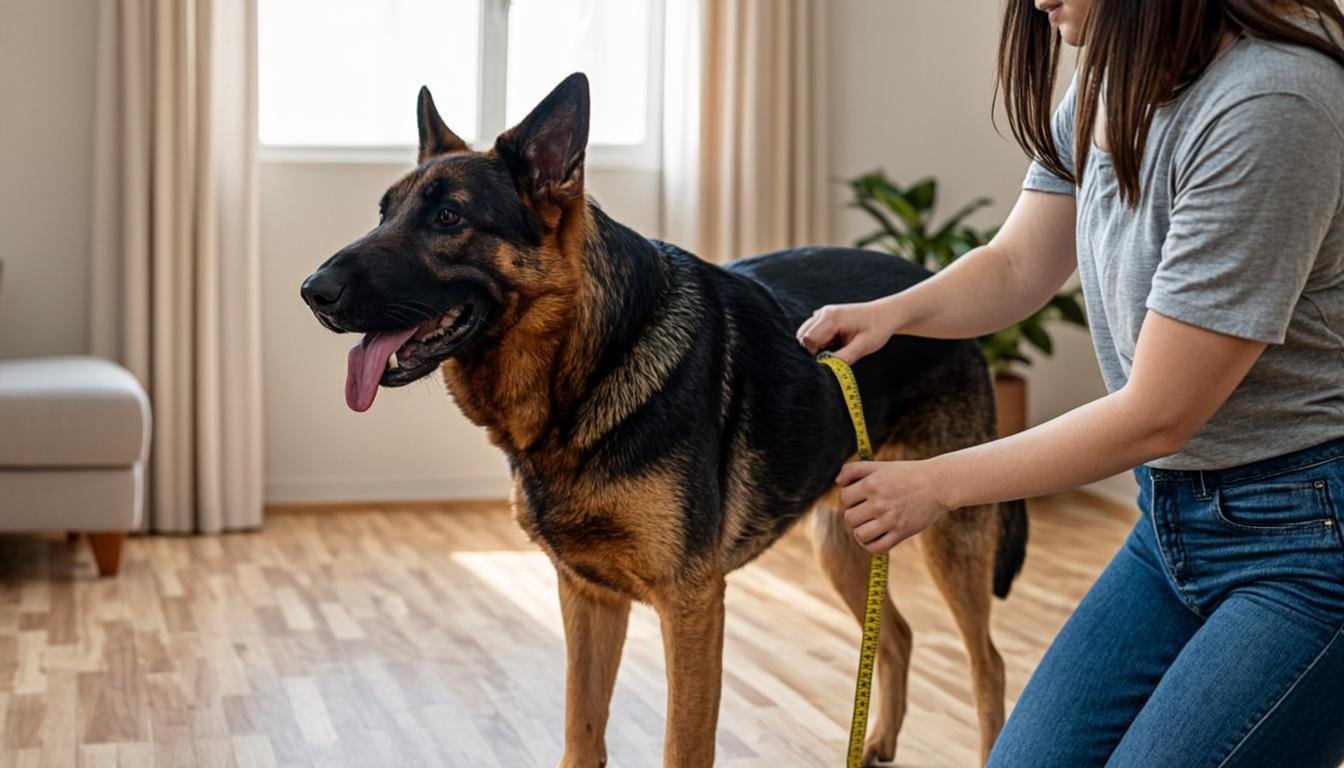
Measure your adult dog from the tip of the nose to the base of the tail, and from the floor to the top of the head or ear tips, whichever is higher, while standing. Add 4 to 6 inches to the length and 4 to 6 inches to the height to get your minimum crate dimensions.
For a typical adult male Shepherd that lands you in a 48-to-54-inch crate; for a typical adult female, 42 to 48 inches. Taller European working lines often need the upper bound or beyond — when in doubt between two sizes with wire or steel crates, size up, because those categories tolerate the extra room better than the denning function requires.
| German Shepherd profile | Typical adult weight | Recommended crate length | Recommended interior height |
|---|---|---|---|
| Small female, American lines | 55–65 lb | 42″ | 28–30″ |
| Average female | 60–75 lb | 42–48″ | 28–32″ |
| Average male | 75–90 lb | 48″ | 30–32″ |
| Large male, European working lines | 90–100+ lb | 48–54″ | 32–36″ |
For puppies, the rule is different: buy for adult size, but use a divider panel so the living space grows with the puppy. This is included with the Midwest iCrate and available separately for most wire brands. Without a divider, a young puppy with 48 inches of space will sleep in one corner and relieve itself in the other, which sabotages the house-training schedule you are trying to build.
Expect a Shepherd puppy crate-trained from eight weeks to need the full adult space somewhere between six and nine months, and adjust the divider in stages as growth shows — the dog’s own weight curve tracks this well, which our German Shepherd puppy feeding guide covers in parallel.
Recommended crate gear for German Shepherds:
- Orthopedic XXL crate pads — joint-friendly bedding for a breed that carries dysplasia risk.
- 54-inch crate covers — visual calm for reactive or easily distracted Shepherds.
- Attachable crate water bowls — hydration without tipping a bowl through wire bars.
Wire, Plastic, or Heavy-Duty Steel? Choosing the Right Crate Type
The three crate families fail and succeed in different ways, and matching the type to your dog matters more than matching it to your budget. Wire crates maximize airflow and visibility, fold for storage, and cost the least, but they offer the least escape resistance and the most opportunity for a stressed dog to hurt itself on the hardware.
Plastic-shell kennels offer den-like enclosure that many dogs settle in faster, clean easily, and travel well, but single-wall versions are not escape-proof and fixed shapes are awkward in small homes. Heavy-duty steel is the only category that reliably contains a determined adult Shepherd, at the cost of weight, price, and a look most living rooms forgive but do not love.
The decision sequence we recommend: if your Shepherd is crate-trained, calm, and past the destructive adolescent phase, wire serves you fine for years — start with the Midwest or Frisco. If you are crate-training a puppy, wire with a divider again, with the understanding that you may upgrade later.
If your adult dog has already escaped or bent any crate, or you know from history that yours panics when confined, go straight to heavy-duty steel and treat it as medical equipment, not furniture. And if the crate’s main job is car transport, the crash-testing conversation overrides everything else in this section — the AVMA’s guidance on traveling with your pet is blunt about restraint being a safety necessity, not a luxury.
Placement inside your home is the underrated half of this decision. Crates in high-traffic hallways keep anxious dogs on edge all day; crates in isolated garages fail the breed’s core need to be near its family. The sweet spot for a Shepherd is a room corner where the dog can see household activity but not be touched by it constantly, away from direct sun and heating vents — enclosed plastic shells in particular need airflow discipline, and the AVMA’s hot weather safety guidance applies directly to kennel placement in summer.
How to Crate Train a German Shepherd Without Tears
Crate training a German Shepherd is mostly a scheduling exercise, and the breed’s intelligence works for you if you keep every early association positive. Start with the door open and feed meals one foot inside the crate, then progressively further back across a week of meals. Do not close the door until your puppy or new adult walks in voluntarily and settles — for most Shepherds this takes three to seven days of meal-feeding, scattered treats, and praise, and rushing it is the single most common owner error. The crate must never be the place punishment happens; if the crate predicts trouble, you have taught the opposite of safety.

Once the dog eats inside comfortably, close the door for short intervals while you remain visibly nearby — thirty seconds to two minutes at first, then building. The exit rule is fixed: open the door only when the dog is calm, never while vocalizing or pawing, because releasing a protesting dog teaches that protest opens doors.
Build to leaving the room, then the house, in increments matched to the dog’s success rather than a calendar. Most trained adult Shepherds handle a full workday crating by four to six months of consistent practice, though working-line dogs with high energy need real exercise before every confinement window — a Shepherd crated eight hours with no morning run will find something to do with its frustration, and the crate hardware will pay for it.
For owners whose dogs already show panic-level distress — drooling, self-injury, bent bars — the crate is not the fix and quick fixes will not apply. That presentation is the domain of systematic desensitization, covered step by step in our separation anxiety training plan, and the research consensus summarized by Sargisson’s review of canine separation-related behavior makes the key point clear: management tools like crates only work inside a broader behavior program, not as substitutes for one.
The 5 Crate-Buying Mistakes That Cost Owners the Most
After the type and size questions, five specific mistakes account for most crate regret we see in Shepherd households. First, buying for the puppy instead of the adult: a 10-week-old Shepherd fits a 36-inch crate beautifully for about six weeks, and owners who sized for the puppy then face a mid-growth emergency repurchase — the divider system exists precisely to solve this. Second, underestimating latch intelligence: German Shepherds are famously good at simple sliding and flip latches, so test any crate’s latch with two-hand coordination in mind before trusting it overnight.
Third, skipping the bedding budget: owners spend three figures on a crate and nothing on the floor the dog lies on for hours, which is backwards for a dysplasia-prone breed — a proper pad is not a comfort luxury, and for seniors it is joint care, aligned with the picks in our German Shepherd dog bed review. Fourth, ignoring cleaning access: a crate you cannot clean easily will not be cleaned, and hygiene failures in a crate drive skin and paw problems in large dogs; removable pans and washable pads earn their money here.
Fifth, letting price drive the safety decision: the difference between a wire crate and an escape-proof box is the difference between a tool and an eventual emergency, and Shepherd owners learn this either cheaply (a bent crate) or expensively — an injured dog, which is where a review of the best pet insurance for German Shepherds stops being optional reading.
FAQ: Best Dog Crate for German Shepherds
What size crate does a full-grown German Shepherd need?
Most adult German Shepherds need a 42-to-48-inch crate, with large males and European working lines needing 48 to 54 inches. The reliable method is measuring your own dog: nose-to-tail-base length plus 4 to 6 inches, and standing height plus 4 to 6 inches. Weight-based size charts are approximations; your dog’s actual measurements are the truth.
Is it cruel to crate a German Shepherd at night?
No, provided the crate is correctly sized, the dog was trained into it gradually, and nighttime crating comes with real exercise and interaction beforehand. Dogs are den-adapted animals, and a crate-trained adult Shepherd will typically choose its crate when it wants quiet. Cruelty begins where the crate becomes indefinite warehousing — hours without exercise, interaction, or training are the actual problem, not the enclosure.
How long can a German Shepherd stay in a crate?
Adult trained Shepherds handle four to six hours comfortably during the day, with a midday break pushing that to a standard workday; eight hours is the practical ceiling for daytime crating, and only for dogs with adequate exercise bookends. Puppies follow the rough month-plus-one rule — a three-month-old handles about four hours maximum. Overnight is different: dogs sleep through and an eight-hour night is normal for healthy adults.
Are wire crates strong enough for a German Shepherd?
For a calm, well-trained adult, yes — many Shepherds use wire crates for a lifetime without incident. For an untrained adolescent or a dog with confinement anxiety, no: large-breed wire crate failure usually happens at the latch and corner welds, and a dog that escapes once will try again harder. If any escape attempt has happened, move to heavy-duty steel; each successful escape strengthens the behavior.
Do I need a crash-tested crate for car travel?
If your Shepherd rides in the car regularly, yes, and the reasoning is the same as your own seatbelt: in a 30-mph collision, an unrestrained 80-pound dog carries thousands of pounds of force. Regular plastic kennels and wire crates are not designed to contain a large dog in a real impact. Crash-tested options like the GUNNER G1 and MIM Variocage exist because standard crates fail this job.
Where should I put my German Shepherd’s crate?
In a corner of a lived-in room where the dog can observe family activity without being in the middle of it — Shepherds want proximity to their people, and isolation placement backfires with this breed. Avoid direct sun, heating vents, and drafty doors, and give enclosed plastic kennels extra airflow attention in summer. Never place the crate where the dog gets punished, and never in the garage used as banishment.
Sources and Limits
This review synthesizes manufacturer specifications and testing claims, aggregated large-breed owner review patterns, and veterinary guidance on confinement and travel safety, including the AVMA’s pet travel resources, the MSU College of Veterinary Medicine’s material on canine hip dysplasia, and the OFA breed statistics that inform our joint-comfort recommendations. We did not perform independent crash or escape testing, and price bands move; verify current claims and sizing with manufacturers before purchase, especially for crash-rated products where testing standards vary between brands.
The Bottom Line on the Best Dog Crate for German Shepherds
The best dog crate for German Shepherds is the one matched to your dog’s temperament and your actual failure scenario, and the decision tree is simpler than the marketing suggests. A trained, settled adult does beautifully in a 48-inch wire crate like the Midwest iCrate XXL or Frisco Fold & Fly — spend the savings on an orthopedic pad.
A Shepherd with escape history or unknown adolescent temperament needs heavy-duty steel immediately, and the SmithBuilt covers that need at the category’s entry price. Regular car travelers should treat crash-tested containment as non-negotiable, with the GUNNER G1 as the practical default and the MIM Variocage DoubleMax for two-dog households with the budget for the strongest safety case available.
Whatever you buy, the training matters as much as the steel. A well-trained Shepherd in an adequate crate is a calm dog that chooses rest; an untrained Shepherd in a premium crate is still an untrained Shepherd. Buy once, train patiently, and the crate becomes what it should be for this breed — not a cage, but the one room in your house that belongs entirely to your dog.