
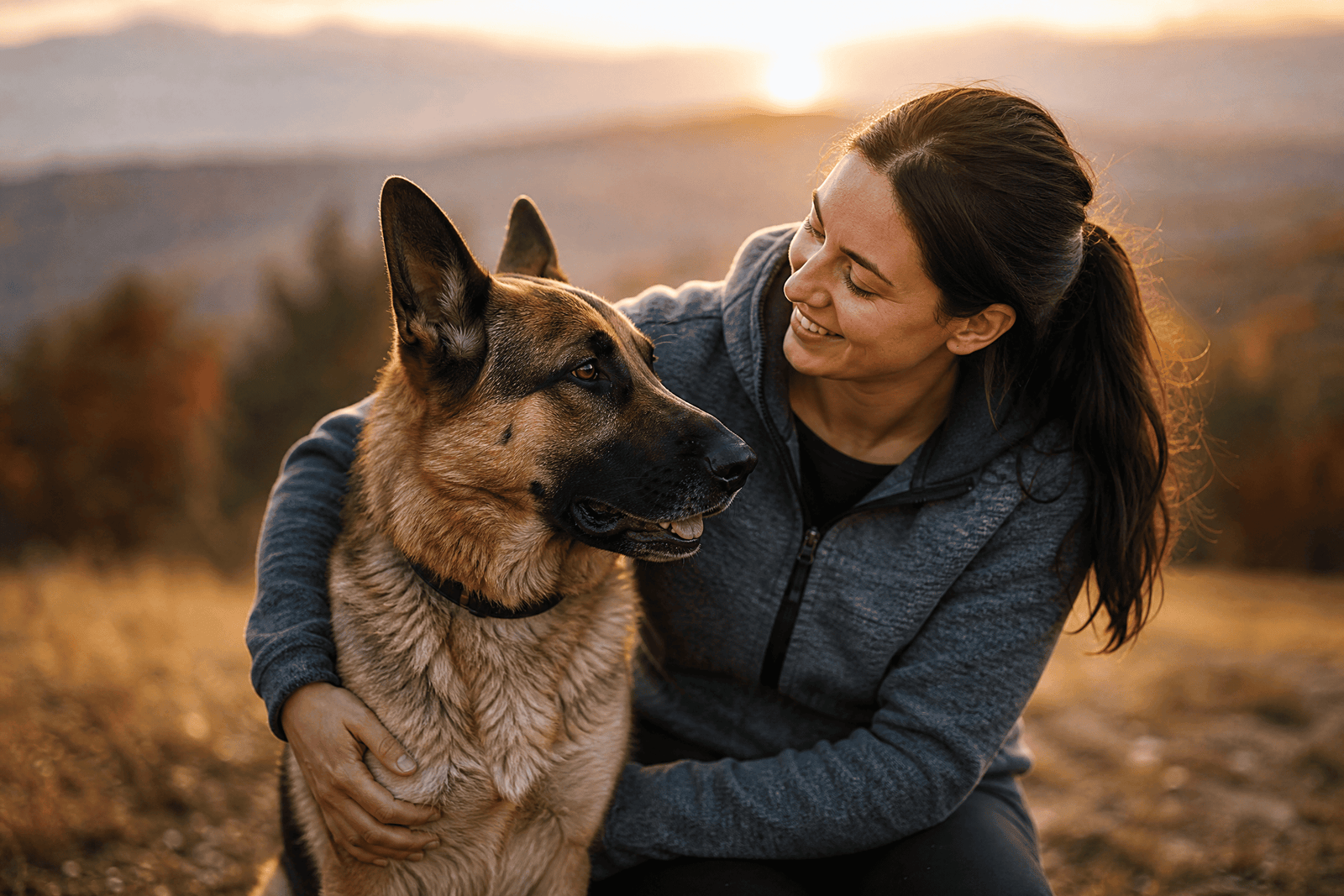
Dive into the heartwarming story of Max, a brave German Shepherd who risks everything to save a lost child during a wildfire. A gripping tale of loyalty, courage, and the unbreakable bond between humans and dogs — and, after the final chapter, a practical look at what real dogs like Max are made of.
Chapter 1: The Guardian of Pine Ridge
Nestled between snow-capped mountains and dense forests, the quiet town of Pine Ridge thrived on simplicity. Its cobblestone streets, cozy cabins, and the ever-present scent of pine needles made it a haven for nature lovers. But the town’s true guardian wasn’t human — it was Max, a striking German Shepherd with a jet-black saddle, tan legs, and eyes that gleamed like polished amber.
Bred from a lineage of working dogs, Max embodied the intelligence and loyalty his breed was renowned for. At three years old, he’d already earned a reputation as the town’s unofficial protector. His handler, Jake Thompson, a retired search-and-rescue officer, had trained him since puppyhood. Together, they’d located missing hikers, sniffed out avalanche survivors, and even foiled a burglary at the local general store.
“You’re more than a dog, Max,” Jake often said, ruffling the fur behind Max’s ears. “You’re family.”
Chapter 2: The Storm Approaches
One sweltering August afternoon, the scent of smoke tinged the air. A record-breaking heatwave had parched the land, turning Pine Ridge’s lush forests into tinderboxes. Weather warnings blared on radios, urging residents to stay vigilant.
Max sensed the tension. His ears twitched at the distant crackle of dry branches, and his nose lifted instinctively. Jake noticed the change. “What’s wrong, boy?” he murmured. But before Max could react, the town’s emergency siren wailed — a wildfire was spreading rapidly from the north.
Volunteers scrambled to evacuate homes, while firefighters battled the encroaching flames. Amid the chaos, nine-year-old Emily Carter vanished. Her parents, owners of the town’s diner, had been helping neighbors pack when she wandered into the woods chasing her kitten.
“Max, we’ve got work to do,” Jake said, clipping a search harness onto the dog. Max barked once, tail stiff with focus. Time was running out.
Chapter 3: Into the Inferno
The forest was a nightmare. Smoke choked the air, and embers rained like hellish fireflies. Max surged ahead, nose to the ground, weaving through charred underbrush. Jake followed, shouting Emily’s name until his voice frayed.
Max’s training kicked in. He ignored the searing heat and deafening roar, fixated on Emily’s scent — a mix of strawberry shampoo and the vanilla cookies she’d shared with him earlier that week. Deeper into the woods, he paused at a fallen oak, sniffing a scrap of pink fabric caught on a branch.
She’s close.
A whimper echoed through the haze. Max bolted toward the sound, Jake struggling to keep pace. They found Emily huddled in a shallow creek, her face streaked with soot and tears. The fire encircled them, advancing like a pack of wolves.
Chapter 4: The Escape
“Max! Jake!” Emily cried, clinging to the dog. Flames licked at the creek’s edges, and the heat warped the air. Max nudged Emily toward Jake, then turned to face the fire, growling low.
“There’s no way out!” Jake yelled, pulling Emily into his arms. But Max refused to retreat. With a sharp bark, he dashed through a gap in the flames, his fur singed by sparks. Jake hesitated, then followed, trusting the dog’s instincts.
Max led them downhill, where a hidden ravine offered shelter. They stumbled into a limestone cave just as the firestorm swallowed the path behind them. Safe for now, Jake radioed their coordinates. Two hours later, a helicopter scooped them to safety.
Chapter 5: The Hero’s Welcome
News of Max’s bravery spread like wildfire (pun intended). By dawn, Pine Ridge’s town square buzzed with relief and gratitude. Emily, wrapped in a foil blanket, refused to leave Max’s side. “He saved me,” she told reporters, her small hand buried in his fur.
Jake beamed with pride. “That’s what German Shepherds do. They don’t just follow commands — they think. They care.”
The governor awarded Max a medal for valor, and donations poured in for the fire department. But to Max, the real reward was Emily’s laughter as they played fetch later that week, the scars of the fire fading with each passing day.
Why German Shepherds Are Unmatched Heroes
Max’s story underscores why German Shepherds excel as working dogs:
- Intelligence: Quick problem-solving in crises — the breed consistently ranks among the top three for working intelligence, learning new commands in fewer than five repetitions.
- Loyalty: Unwavering dedication to their handlers, the trait that makes them risk everything without hesitation.
- Courage: Fearlessness in the face of danger, bred into lines that faced wolves, gunfire, and collapsing buildings.
- A scenting machine: With roughly 220 million olfactory receptors to our 5 million, a trained Shepherd can discriminate a single person’s trail from a crowded street.
- The work ethic: Shepherds don’t merely tolerate a job — they need one. That drive is what turns training into real-world saves.
What Max’s Story Teaches Us About the Breed
Beneath the drama, the tale holds three truths every Shepherd owner should absorb. First, the famous “thinking dog” is real: Shepherds were selected for independent judgment — Max didn’t wait for instructions in the cave decision any more than a real SAR dog improvises around a collapsed floor. That intelligence is a gift that cuts both ways: an under-stimulated Shepherd designs its own job, and you will not approve of the job it picks.
Second, the bond is a trained asset, not a birthright. Jake’s years of daily partnership are what made Max look to him under maximum stress. The loyalty stories people love about this breed are written by the hundreds of unglamorous hours that precede the headline moment — the recall drills, the scent games, the calm patience rewarded and the panic never punished.
Third, heroes are conditioned, not born. Max’s paws could cross burning ground because his conditioning was elite. Your own Shepherd will never face a firestorm, but the same fitness, lean weight, and joint care that would carry a SAR dog through a deployment are what carry a family dog through a long, pain-free life — starting with what goes in the bowl every day.
How Dogs Like Max Are Made: The Training Behind the Heroics
Real search-and-rescue dogs train for one to two years before certification, and the foundation is built exactly the way Jake built Max: through play disguised as work. Scent work starts as a find-the-treat game in cardboard boxes, graduates to buried articles, and eventually becomes trained area and trailing search across terrain. Obedience is layered in drive — the dog learns that finding the victim, not the handler, triggers the party. Recall, directional commands sent from a distance, and stress-proofing (loud noise, strange surfaces, helicopters overhead) turn a talented dog into a deployable one.
You can borrow the same framework at home with our guide to German Shepherd training techniques: short sessions, high reinforcement, one new skill at a time, and always ending while the dog still wants more. Nosework classes, tracking clubs, and protection-sport foundations (IGP, PSA) exist in most regions and welcome pet Shepherds — the breed that finds a legal outlet for its drives rarely develops an illegal one.
The Real Maxes: German Shepherd Heroes in History
If Max feels believable, it is because history keeps producing him. Rin Tin Tin, rescued as a puppy from a World War I battlefield in France by American soldier Lee Duncan, became a global film star in the 1920s and is often credited with saving Warner Bros. from bankruptcy — and with popularizing the breed across America. Strongheart, one of the first canine movie stars, followed a similar path from a German police-dog program to Hollywood fame. In 2001, a German Shepherd named Trakr located the last surviving person pulled from Ground Zero rubble; his handler later cloned him, and five “Trakr twins” went on to work as search dogs themselves. Military working Shepherds like Lava and Cairo (the dog on the 2011 Abbottabad raid) continued the lineage of battlefield service that began when the German army deployed some 30,000 dogs in World War I.
Disaster teams still favor the breed today for the same mix of traits Max displays: a nose built for precision, courage that survives chaos, and a handler bond that holds when everything else fails. Every real deployment behind these names is another footnote to the legend our story borrowed — and another reason the breed keeps earning its place beside first responders.
Could Your German Shepherd Be a Hero?
You do not need wildfires to give your Shepherd a purpose. Consider one of these real-world paths, roughly in order of entry difficulty:
- Therapy dog work: calm, confident Shepherds visit hospitals and schools; certification runs through organizations like Pet Partners and rewards exactly the stable temperament the breed can deliver.
- Nosework and tracking trials: the closest civilian sport to Max’s actual skill set, and one where 10-year-old dogs still win ribbons.
- Volunteer SAR with a local unit: genuine commitment (weekly training for a year or more), but units actively seek the breed.
- Trail and hike companion: the simplest job of all — a fit, well-mannered Shepherd covering miles beside you is living the life the breed was built for.
A Note on the Story
Max, Jake, and Emily are fictional — an illustrative tale written to honor the breed. But the fictional fire rests on real foundations: German Shepherd search-and-rescue dogs have located survivors in earthquakes, avalanches, and wilderness losses across the world, and the breed’s service history from both World Wars to modern disaster response is documented fact. The story compresses what thousands of real dogs have done into one bronze-worthy legend — which is, if anything, a fair tribute.
Epilogue: Legacy of a Legend
Years later, an older Max still patrolled Pine Ridge, his muzzle gray but his spirit undimmed. When he passed peacefully in his sleep, the town erected a bronze statue in his honor.
Today, Emily trains German Shepherds at a K-9 unit, inspired by the dog who taught her the meaning of bravery. And every August, Pine Ridge celebrates “Max’s Day,” a reminder that heroes come on four legs, too.
FAQs About Max and Heroic German Shepherds
Q: Is the story of Max true?
Max is a fictional character created as an illustrative tribute. The capabilities he displays — scent work, crisis problem-solving, handler devotion — are all documented in real German Shepherd search-and-rescue dogs.
Q: Can any German Shepherd be trained for search and rescue?
Not every dog, but many. SAR requires high drive, sound nerves, physical endurance, and a handler with serious time to commit. Temperament-tested Shepherds from working lines are among the most selected breeds for it.
Q: How long does SAR training take?
Typically 1–2 years to certification for wilderness airscent, longer for trailing or disaster specialties. The foundation, however, starts with the same games any pet owner can play in the living room.
Q: What should I feed a high-drive working Shepherd?
Working dogs burn 20% or more calories than pet lines and need performance-level protein and fat — our review of the best food for German Shepherds covers formulas that sustain real work.
Q: My Shepherd is timid. Is the breed’s courage overrated?
Courage is partly genetic and partly built. Nerve-stable breeding matters enormously, which is why health-and-temperament-tested lines cost more — but confidence also grows through positive exposure, and a “soft” pet Shepherd can still be a wonderful, if less bombproof, companion.
Sources and Further Reading
The following authoritative resources provide additional context for the guidance in this article. They do not replace advice from a qualified veterinarian or behavior professional.