
A German Shepherd puppy with the run of the house for four hours can destroy a baseboard, unstuff a sofa cushion, and eat something that costs you a vet visit — all before lunch. That is not mischief; that is a working breed wired for a job, confined to an environment full of jobs it invents.
German shepherd crate training exists precisely for this gap between the dog’s intelligence and your supervision: a crate is not a cage in the punitive sense, it is a den, a babysitter, a potty-training engine, and — done right — the dog’s own favorite room in the house. Dogs are den animals by instinct, and no breed responds to den conditioning more predictably than a Shepherd who craves structure.
This guide walks through the whole system the way a professional trainer would: choosing the right crate size (the 42-versus-48-inch question), the seven-step conditioning plan used by shelters and service-dog programs, age-by-age schedules you can copy tonight, the whining fixes that actually work, and the mistakes that quietly undo weeks of progress. Whether you are starting with an eight-week-old puppy or rebuilding trust with an adult rescue, the same principles apply at different speeds. If your dog’s distress runs deeper than crate complaints, read our guide on german shepherd separation anxiety alongside this one, because the two problems overlap and mistaking one for the other wastes months.
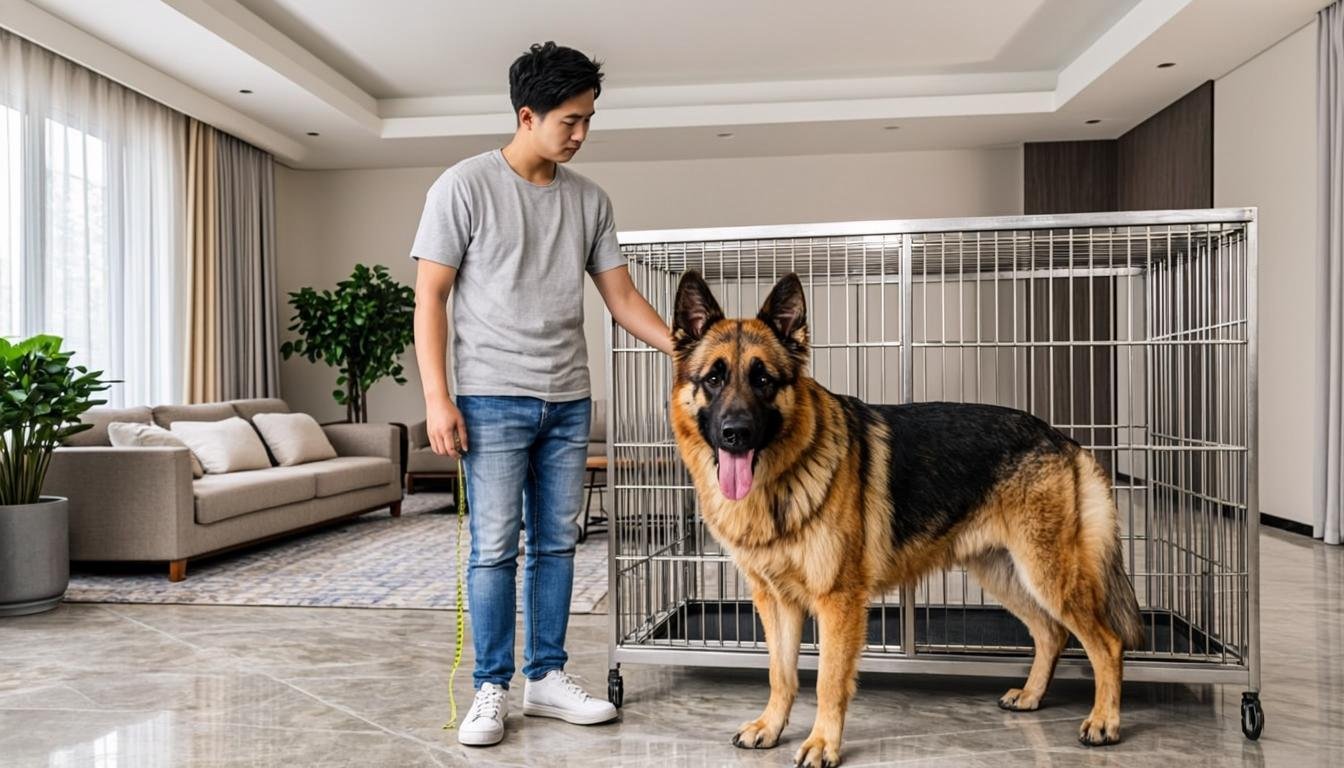
Why German Shepherd Crate Training Matters
The german shepherd crate training case rests on five practical pillars, and each one maps to a real moment you will face in the first two years of Shepherd ownership. First, house training: puppies instinctively avoid soiling their sleeping space, so a correctly sized crate is the single fastest potty-training tool that exists — the bladder learns the routine because the den enforces it. Second, safety during absence: a four-month-old Shepherd left loose can swallow a sock (a surgery that starts around 3,000 dollars), chew a live power cord, or topple a bookshelf; an hour in the crate removes the entire category of risk.
Third, travel and emergency readiness: a crate-trained dog loads calmly for road trips, accepts airline and evacuation kennels without panic, and recovers quietly after surgery when the vet prescribes strict confinement. Fourth, hotel rooms, boarding, and the homes of friends who did not sign up for a 80-pound houseguest’s independence. Fifth — the pillar people underestimate — the crate gives your dog a neurological off-switch, a place where the working brain is licensed to stop scanning, which the breed’s temperament needs more than most — german shepherd crate training installs that off-switch in about a week.
There is also an honest statement to make about what a crate is not. It is not a storage unit for a dog you are tired of, not a punishment room, and not a substitute for exercise, training, or companionship — that distinction is the ethical floor of german shepherd crate training.
A Shepherd who spends ten hours a day crated while young, under-exercised, and untrained is not crate trained — he is warehoused, and the behavior fallout (frustration barking, pawing, escalating destructiveness on the rare free hours) will be blamed on the dog. The crate works as part of a system that includes real exercise and engagement; our German Shepherd daily routine guide shows the full-day structure the crate slots into. Keep that frame and the tool becomes what it should be: the dog’s bedroom, not his cage.
Choosing the Right Crate Size for a German Shepherd
Size is where most Shepherd owners make their first expensive mistake, in both directions. A crate that is too small is cramped and cruel for a breed whose adult males stand 24 to 26 inches at the shoulder and weigh 65 to 90 pounds; a crate that is vastly too big defeats potty training, because the puppy simply sleeps in one corner and toilets in the other.
The professional consensus for this breed lands on a clear target: a 42-inch or 48-inch crate for adult German Shepherds, with 48 inches (roughly 48″L × 31″W × 35″H) the safe long-term choice for males, heavy-boned females, and anyone who wants headroom for a bed. Size guides for the breed, including the widely referenced large-breed fitting advice from PetMagasin, converge on exactly this range, and the working rule behind german shepherd crate training size-fitting is simple arithmetic: measure your dog nose to tail while standing, add 2 to 4 inches, and the crate’s interior length should meet or beat that number.
For puppies, the clever tool is the divider panel — a sliding metal partition included with most quality wire crates. You buy the 48-inch crate your dog will need at two years old, and you shrink the interior to den-size for the eight-week-old, moving the divider back every few weeks as the puppy grows. This one purchase decision solves both the size trap and the budget trap of buying three crates across the puppy’s first year — one divider panel carries german shepherd crate training from eight weeks to eight years. When comparing crates, weigh the four mainstream types against your actual life:
| Crate type | Typical price (48″) | Best for | Watch out for |
|---|---|---|---|
| Foldable wire crate (divider included) | $60 – $130 | Home training, house training, ventilation; the default choice | Not escape-proof against determined jaws; needs a cover for den feel |
| Plastic / flight kennel | $100 – $300 | Car and airline travel, dogs who prefer covered privacy | Fixed size, no divider; bulkier to store |
| Heavy-duty / escape-artist crate | $200 – $600 | Powerful or anxious dogs who break standard wire | Weight and cost; overkill for most well-conditioned Shepherds |
| Furniture-style crate | $200 – $500 | Living rooms where aesthetics matter | Check weight rating and ventilation for giant breeds |
One more fitting detail that saves grief: wire crates run cold in winter and echo in empty rooms, so a fitted crate cover (not a blanket that can be dragged and chewed) plus a washable pad turns steel into a den. Avoid pads entirely with destructive puppies until the chewing phase passes — our guide to German Shepherd chewing covers that phase in detail — and never place the crate against a radiator or in direct afternoon sun, because environment is half of german shepherd crate training and conditioning is the other half.
German Shepherd Crate Training: the 7-Step Plan
The method below follows the same sequence professionals use — it mirrors the stepwise conditioning the AKC recommends for crate training dogs in general — and it works for german shepherd crate training at any age, though puppies sprint through it and adults need more patience at steps four and five. The engine of the whole plan is one rule: every single crate experience ends well. Nothing bad ever happens at the crate, nothing boring happens at the crate, no dog is ever forced in — the three commandments of german shepherd crate training. Progress is measured in calm seconds, not rushed hours.
- Set the location first. Put the crate in the room where the family actually lives — kitchen corner, living room, or bedroom at night. Isolation teaches a puppy that the crate equals exile; social proximity teaches him that his den sits inside the pack’s territory.
- Open the door and disarm it. For the first day or two, take the door off its latch entirely or prop it open. Drop high-value treats just inside the threshold, then progressively deeper, and let the dog find them. No commands yet — discovery beats instruction.
- Feed every meal inside. From day two onward, the dog’s breakfast and dinner happen in the crate, door open. This is the highest-leverage step in german shepherd crate training: food converts the crate from furniture into a reward source within days. If the dog hesitates, put the bowl just inside and move it deeper over three meals.
- Add a cue and close the door in seconds. Once the dog walks in eagerly, introduce your cue (“kennel up” or “go to bed”), toss a treat to the back, praise, then close the door for ten seconds while you stay beside it. Open before any whining starts. Repeat, extending to thirty seconds, one minute, two — always opening during calm.
- Leave the room in micro-steps. With the door closed, take one step away, return, reward. Then leave for thirty seconds, one minute, five. This is where adults and rescues need the most reps, and where beginners make the mistake of rushing to a full workday on day four. Build toward twenty to thirty minutes of relaxed, lying-down quiet before any real absence.
- Extend to real-life durations with a ritual. A pattern like “kennel up, stuffed chew toy, cover on, lights out, you leave” gives the dog a predictable script. Vary the departure time and sometimes stay home anyway, so the sequence does not become a prediction of being abandoned.
- Protect the win condition. The door never opens on crying; it opens on quiet — for a count of five, at least. Every exception you make teaches the dog that persistence pays, which is the exact opposite of what crate conditioning depends on. (Night whining in young puppies is the one exception — a potty break, business, straight back in, minimal talk and lights.)
Worked literally, this plan produces a crate-happy puppy in one to two weeks and a confident adult in three to six. Worked loosely — skipped meals-in-crate, rushed durations, door opened on demand — german shepherd crate training produces the owner sitting on a forum in month three asking why the dog screams. The steps are boring on purpose; conditioning is repetition, not brilliance.
Crate Schedule by Age: Puppy to Adult
The schedule is where german shepherd crate training either hums along or breaks, because confinement duration is a biological limit, not a training goal. Puppies have tiny bladders and developing bodies; adults have social needs that pure duration ignores. The table below consolidates the guidance used by trainers and rescue organizations for the breed — including the common rescue rule that no Shepherd should be crated more than about six hours at a stretch — and it assumes the dog has had real exercise and a potty break before every crate period — the schedule discipline german shepherd crate training quietly runs on:
| Age | Daytime max per stretch | Overnight | Notes |
|---|---|---|---|
| 8 – 10 weeks | 30 – 60 minutes | 4 – 6 hours with 1 – 2 potty wakes | Bladder control barely exists; every exit goes straight to the potty spot |
| 11 – 14 weeks | 1 – 3 hours | 6 – 7 hours, usually one wake | Potty schedule does the heavy lifting; feed on a fixed timer |
| 15 – 16 weeks | 3 – 4 hours | 7 hours | Divider moving back; chew drive rising — stuffed toys only |
| 4 – 6 months | 4 hours | 7 – 8 hours | Adolescent energy needs an outburst of real exercise first |
| 6 – 12 months | 4 – 5 hours | 8 hours | Never a substitute for the day’s training and play quota |
| Adult (12+ months) | 4 – 6 hours | 8 hours fine for a conditioned adult | Six hours at a stretch is the humane ceiling most rescues apply |
Reading the table correctly matters as much as the numbers. “Maximum” is a ceiling, not a target — a dog crated to the maximum every single day is a dog on the edge of boredom-driven behavior problems, whatever his age. Two real-world constraints shape the schedule further. Puppies and seniors should never be pushed past three to four hours without a break, per widely published trainer guidance, because their bladder and temperature regulation lag behind adults.
And the midday gap for working owners is exactly where options matter: dog walkers, a lunchtime home visit, a mid-day daycare session, or an exercise pen attached to the crate all beat routinely stretching a young Shepherd past his biological limit. German shepherd crate training succeeds when the schedule fits the dog; it fails when a commute writes the schedule and german shepherd crate training pays the invoice in behavior problems.
One structural note that saves furniture: the transition window after the crate. A Shepherd emerging from four hours is a loaded spring — take him directly to a potty spot, then directly into five minutes of engagement (a fetch round, a sniff walk, a two-minute obedience drill) before expecting calm — the decompression valve german shepherd crate training needs in every household. Owners who release the dog and vanish back into their office meet the shredded rug twenty minutes later and blame the dog. The routine after the crate is part of german shepherd crate training, not an appendix to it.
Fixing Whining, Crying, and Barking in the Crate
Whining is the number-one reason owners quit german shepherd crate training, and the fix starts with a triage question: what is the whining asking for? There are four common answers, and each has a different response. Need-based whining (puppy bladder, heat, genuine distress) gets an immediate, boring, businesslike response — outside, business, back in, minimal words. Demand whining (the dog wants out, wants you, wants the drama) gets strategic deafness, because opening the door mid-fuss is a tuition payment that purchases a louder performance tomorrow.
Boredom whining (insufficient exercise before crating) gets a schedule fix at the front end, not a louder “quiet!” at the back end. And anxiety whining — trembling, drooling, frantically working the bars — gets a temporary step back in the training ladder, plus a serious look at the separation anxiety guide if it repeats, because that is a different problem needing a different protocol.
The mechanics of demand-whining extinction are precise and worth following exactly. Wait for a full stop of vocalization — not a pause, a genuine stop of five seconds — then open the door calmly. In practice the first silent five-count may take twenty minutes on night one, twelve minutes on night two, and be instant by day four, because dogs are magnificent learners of cause and effect in both directions.
What poisons the process is inconsistency: if Aunt Karen opens the door “just this once,” the extinction clock resets, and the dog learns the system has a soft spot that fussing finds. Household alignment — everyone agrees on the rule before night one — is half the battle in german shepherd crate training, and the half most homes skip.
Prevention beats extinction in german shepherd crate training, and the cheap versions work: a stuffed frozen chew toy (the classic rubber Kong filled and frozen) buys twenty to forty minutes of focused licking that lands most dogs straight in sleep; a crate cover removes visual stimulation for alert dogs; white noise or a radio masks hallway sounds; and crating after real exercise rather than before it converts the crate from a waiting room into a recovery room.
If the whining persists past two disciplined weeks — or escalates to salivation, self-injury, or bar-bending — stop troubleshooting alone and read the separation anxiety guide, because forcing a true anxiety case deeper into a crate damages both the dog and your months of work.
7 Crate Training Mistakes That Undo Progress
Most failed german shepherd crate training attempts trace to a short list of predictable errors, none of them exotic. Audit yourself against these seven before blaming the dog or the method:
- Using the crate as punishment. The moment “go to your room” becomes the consequence for misbehavior, the den collapses into a cell, and every future entry is contested. Time-outs belong to your training toolset, not to the crate.
- Crate too big for a puppy. Without the divider, a puppy sleeps at one end and soils the other, erasing the house-training advantage the crate exists to provide. Slide the panel and the problem usually vanishes within days.
- Rushing the ladder. Jumping from step three to a full workday in week one teaches the dog that the crate is where abandonment happens. The micro-steps are the method; skipping them is un-training.
- Opening the door on demand. One surrender to protest teaches persistence; ten consistent quiet-opens teach patience. The dog learns whatever the door history says, and he keeps the receipts.
- Crating over the biological limit. Soiling the den is not defiance, it is overflow — and each overflow event erodes both house training and the den instinct. Fix the schedule, not the dog.
- Leaving collar or harness on in the crate. Tags and buckles catch on wire bars, and crate-strangulation accidents are real and preventable. Collar off at the crate, every time.
- Treating the crate as the whole plan. A Shepherd crated eight hours, walked ten minutes, and fed kibble from a bowl is being managed, not raised. Exercise, training, and companionship are the other two-thirds of the system the crate slots into.
Notice what the list has in common: every german shepherd crate training failure above is owner-side, fixable, and reversible with one consistent week. Dogs forgive clumsy training quickly when the next week is consistent — the crate reputation is rebuildable, and german shepherd crate training restarts at whatever step the trust broke down.
Crate Training an Adult or Rescue German Shepherd
Adult dogs arrive at crate training with history instead of blank slates, and german shepherd crate training with a rescue runs on patience rather than the puppy timetable. Some adults slip into the den within a week — often dogs who were crated in a previous home. Others carry associations you cannot see: a shelter kennel spent waiting, a breeder who crated for punishment, or simply a lifetime of never meeting german shepherd crate training at all. The seven-step plan above still governs, with three modifications that respect the adult mind.
First, slow the ladder deliberately: where a puppy earns the next step in a day, give the adult three to five, because trust compounds slower in a dog who has watched humans come and go. Second, make the crate’s early life a permanent buffet — door open or removed, blanket draped over one end, treats discovered daily — for the first week before any door closing at all. Third, never test the dog’s ceiling during setup week; the first closed-door session should be so short it feels pointless, because pointless-short is what builds the long run.
Rescues from working lines sometimes arrive with the opposite problem: kennel-trained in the utilitarian sense, they accept the crate instantly but associate it with boredom and litigation-level barking. For these dogs the fix runs through enrichment and repurposing — meals always in the crate, stuffed frozen toys reserved exclusively for crate time, and the crate positioned in the family room rather than the garage, so the kennel history gets overwritten by a better contract.
Adult German Shepherds also read fairness acutely; a dog exercised, trained, and then offered his den settles into it with visible relief, while the same dog crated on a whim mid-play will give you a look you deserve. Our guide to German Shepherd puppy training foundations pairs with this one if you are starting from scratch with a young dog, and readers rebuilding after behavioral incidents should also see our German Shepherd aggression training guide for the broader picture.
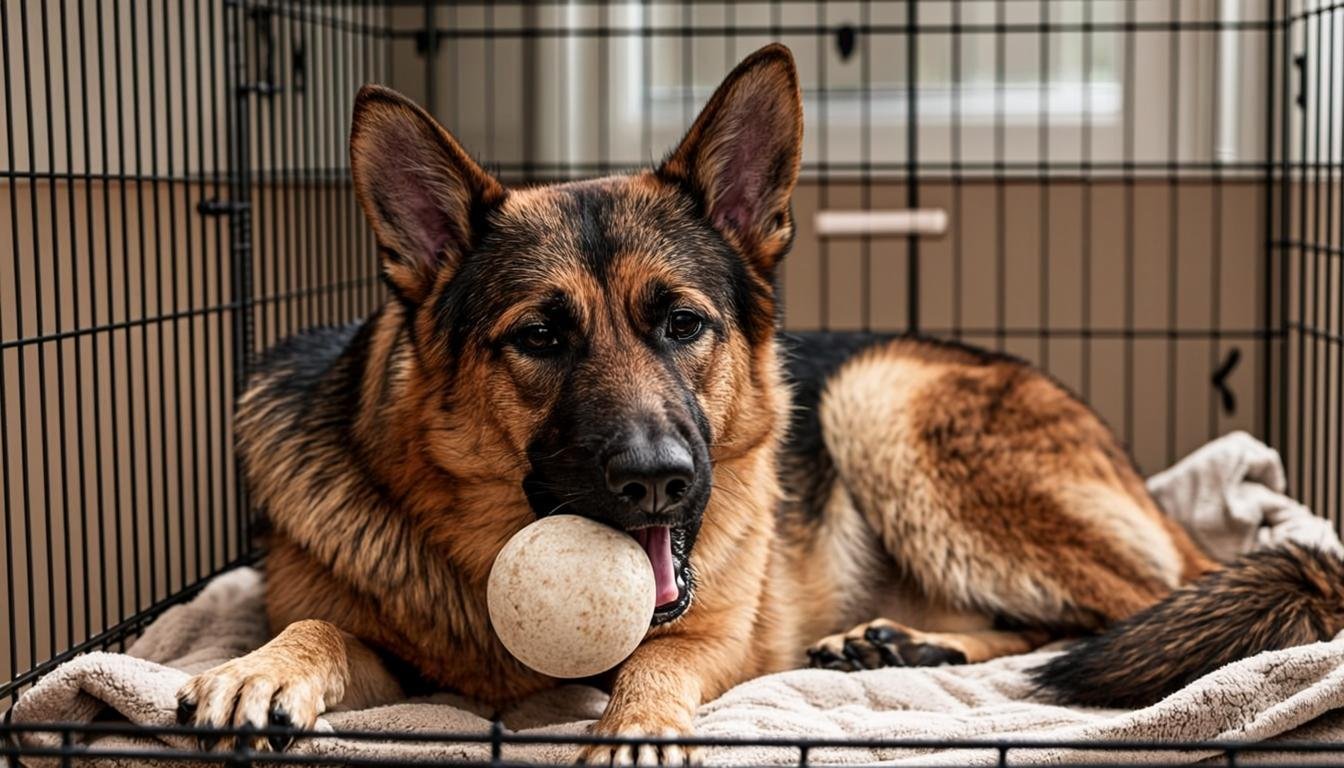
Crate Games and Positive Associations That Stick
Conditioning is not only meals and treats; german shepherd crate training cements fastest when the crate becomes a game venue. The three games below take minutes a day and convert reluctant dogs into door-rushers within a couple of weeks:
- Treat toss relay. Toss a treat into the crate, cue the dog in, mark the moment he exits, toss the next. Ten rapid reps teach the crate as a target rather than a trap, and the speed of the game sneaks past hesitation in dogs who stall at the threshold.
- The hidden jackpot. Randomly — one session in three — hide the highest-value reward of the week (a freeze-dried morsel, a new chew) deep inside the crate under a folded blanket. The dog learns to check the crate the way your phone checks for updates, which is exactly the reflex conditioning wants.
- Meal puzzles inside. Every meal from a puzzle feeder or stuffed rubber toy inside the crate builds the association that good things happen at the den. Reserve the single best stuffing recipe for crate sessions only, and it becomes the dog’s personal cinema.
Layer in the environmental touches once the games are rolling: a washable pad sized to the crate floor, a cover that leaves the front ventilated, and a consistent verbal script at every entry — the rituals that make german shepherd crate training feel safe rather than strange. Dogs keep time through ritual better than clocks, and a two-line script (“kennel up — good boy, see you soon”) repeated identically at every departure becomes a lullaby rather than an alarm. Readers who want the full enrichment picture beyond the crate — sniff walks, puzzle rotation, scent games — will find the complete program in our roundup of the best products for German Shepherds.
When Crate Training and Separation Anxiety Collide
Here is the boundary every owner must know: german shepherd crate training fixes containment problems, but it does not fix separation anxiety, and forcing the wrong fix makes both worse. True separation anxiety is a panic condition — drooling, escaping attempts that bend bars or break teeth, house soiling within minutes of departure, destruction aimed at exit points — and it activates whether the dog is confined or loose.
A crate in that picture is not a tool but a trigger: panic needs an exit, and a locked den removes it. The clinical guidance is blunt that confinement can intensify panic injuries, so dogs showing the signature signs need the desensitization and counterconditioning protocol described in our separation anxiety guide, ideally with a veterinary behaviorist involved for severe cases — before any german shepherd crate training resumes.
The gray zone is common, and it trips up well-meaning owners: a dog who whines for ten minutes then sleeps is german shepherd crate training still incomplete, not anxious; a dog who has never once settled, who injures himself at the latch, who is soaked in saliva at pickup, is anxious, not badly trained. The ten-minute rule separates them cleanly. Time, honest observation, and the courage to change protocols when the evidence points away from german shepherd crate training are the whole difference between the two paths — and taking that evidence seriously is what a working-breed dog deserves.
Recommended gear for this stage:
- 48-inch double-door wire crates with divider panel (Amazon) (Amazon) — the one purchase that covers puppy den-stage through adult size.
- Washable crate pads for large breeds (Amazon) (Amazon) — machine-washable comfort that survives chewing phases and accidents.
- Stuffable rubber chew toys (Amazon) (Amazon) — the frozen reward that turns crate entries into the day’s highlight.
German Shepherd Crate Training FAQ
How long does german shepherd crate training take?
A puppy conditioned by the seven-step plan usually sleeps happily in a closed crate within one to two weeks and tolerates a full workday by four to six months old. Adults vary from one week to two months depending on history. German shepherd crate training timelines compress with daily reps and stretch with skipped days, and the honest benchmark is not the calendar but the picture: a dog who walks in on cue, settles within minutes, and exits calm.
What size crate does an adult German Shepherd need?
Forty-two to forty-eight inches, with 48″L × 31″W × 35″H the safe standard for adult males and heavy-boned females. Apply the nose-to-tail-plus-inches rule, and buy the adult size once with a divider panel rather than buying up through three puppy crates — size errors are the most common german shepherd crate training mistake we see.
Is it cruel to crate a German Shepherd at night?
No — overnight crating of a conditioned dog is standard practice in the breed and serves house training, safety, and sleep quality. Nighttime is when german shepherd crate training earns its keep — potty discipline, safety, sleep — and it becomes cruel only through the known failure modes: no evening exercise, no potty break, collar left on, or a schedule that quietly stretches past the dog’s biological limit.
Can I crate my German Shepherd while at work all day?
Not as one unbroken stretch for a young dog. German shepherd crate training runs on the schedule table above — puppies max out at one to four hours by age, adults at about six hours at a time. A midday dog walker, lunch visit, or daycare split is what makes a working owner’s setup humane rather than marginal.
Should I cover the crate?
Usually yes for alert, visual dogs — a fitted cover that leaves the front open turns stimulation down and the den feel up. Skip the cover entirely for chewers, hot climates, or any dog who pulls fabric through the bars, and never use loose blankets as a substitute for a fitted cover.
Why does my puppy cry in the crate at night?
Mostly biology: a young bladder, an unfamiliar silence, and a species that sleeps in contact. Answer need-based crying with a dull potty trip, ignore demand crying until five silent seconds pass, and settle the puppy within reach of you for the first weeks — patience with the bladder, not bigger crates, is the german shepherd crate training answer here. — german shepherd crate training at night succeeds on proximity first, distance later.
Is crate training safe with children in the house?
It is one of the safest structures you can build: the crate gives the dog a legal retreat that children must respect, and the household rule writes itself — the crate is the dog’s room, no touching, no teasing, no retrieving toys from it — german shepherd crate training doubles as the household’s first boundary lesson. Feed the dog in the crate and fetch sessions end, which quietly removes the guarding triggers our treats and reward guide discusses.
Your next step: measure your dog tonight (nose to tail, standing), order the 48-inch crate with a divider if you have a puppy, and run step one — open door, treats discovered, zero commands — this evening. Two weeks of the boring seven steps beats two months of improvised shortcuts, and german shepherd crate training done once, properly, pays out for the next twelve years of travel, vet stays, hotel nights, and calm workdays.
Sources and Limits
Affiliate disclosure: As an Amazon Associate, German Shepherd Haven earns from qualifying purchases made through marked links on this page, at no extra cost to you.
The references below informed this german shepherd crate training guide. This article is educational and does not replace individualized advice from your veterinarian or a certified professional dog trainer. Key references consulted: the AKC’s step-by-step crate training method and its overview of crate training principles; the Humane Society of the United States crate training guide; PetMagasin’s German Shepherd crate size fitting guide; and Guide Dogs for the Blind’s puppy crate training protocol.
Price ranges for german shepherd crate training gear are 2026 US market estimates and vary by brand, region, and retailer. Confinement durations are population guidance for healthy dogs — puppies with medical conditions, giant-bodied individuals, and anxious rescues all deserve schedules a professional tailors. Training decisions belong with someone who can watch your dog’s actual body language, not a template.