
Every dog food label is designed to sell first and inform second. Flipping the bag over and knowing exactly which numbers matter changes that power balance in your favor. In this guide, you will learn how to read a dog food label step by step: the ingredient list, the guaranteed analysis, the AAFCO statement, and the marketing claims that deserve your skepticism. By the end, you will be able to compare two dog food labels in about ten minutes and walk into your vet’s office with better questions.
Why every dog food label matters for German Shepherds
German Shepherds are a large, active breed with high lean-mass needs and a predisposition to some joint and digestive sensitivities. That doesn’t mean one formula fits every dog. Reading labels helps you assess protein sources, energy density, fat content, and added nutrients—information that supports conversations with your veterinarian or a qualified canine nutrition professional. For general feeding principles specific to the breed, see our German Shepherd nutrition basics. Once you know the layout of a dog food label, this review takes about five minutes per bag.
Start with the product name and marketing claims
The prominent name on the bag is often marketing, not a factual summary. Words like “real beef” or “with chicken” may be true but misleading: a product labeled “with chicken” can contain only a small percentage of chicken by weight at the time of mixing. Claims such as “premium,” “natural,” or “human-grade” have no universal definition and do not guarantee quality. A dog food label can only be judged by what it discloses, so treat any phrase without a legal definition as decoration.
What to look for here
- Primary protein indicated? If the name lists a single protein as central to the formula, check the ingredient list to confirm.
- Life stage mention (puppy, adult, all life stages, senior)? This affects nutrient ratios.
- Clinical or medical claims? If the package promises therapy for disease, the product should be used under veterinary guidance.
The dog food label ingredient list: your first major clue
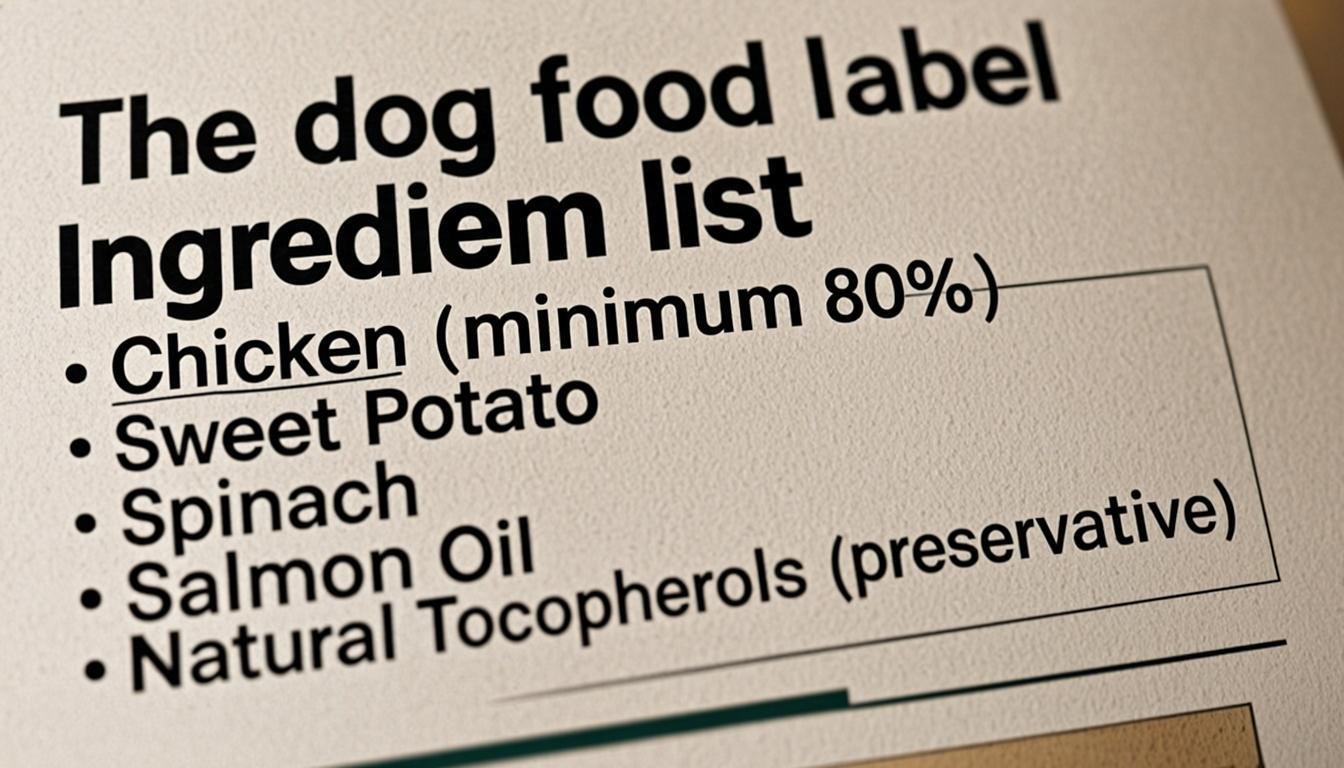
The ingredient list is your best early indicator of what the food contains. Ingredients are listed in order by weight at the time of mixing. That ordering can be counterintuitive because fresh meat has a lot of water weight; once dried or cooked into kibble, dried meat meals can provide more concentrated protein than fresh meat named earlier on the list. That is why the first five ingredients on a dog food label tell you more than the hero photo on the front of the bag.
Protein sources
Look for specifically named meat or meat meals: “chicken,” “chicken meal,” “beef,” “salmon meal.” A named meat meal (e.g., chicken meal) is a concentrated protein source. Generic terms like “meat” or “animal by-product” provide less transparency about the origin and composition. When a dog food label hides behind generic terms, you have no way to verify what your Shepherd is actually eating.
By-products and organ meats
By-products can include nutrient-dense organ meats such as liver and heart. These are not automatically bad, but they are less consistent in composition than named muscle meats. If you prefer specific sources, choose foods that list explicit ingredients. Organ meats are not a flaw on a dog food label; they often signal a nutrient-dense recipe.
Grains, starches, and alternatives
Grains such as rice, corn, and wheat, or alternatives like potatoes and peas, often appear high on lists because they are economical energy sources. For many dogs these are appropriate carbohydrates; for some dogs with individual sensitivities, a different formulation might be needed. Any change for suspected intolerance should be discussed with your veterinarian. If grains worry you, check where they actually sit on the dog food label before paying extra for a grain-free formula.
Fats, oils, and additives
Fats (chicken fat, fish oil) are essential for energy and skin/coat health. Vitamin and mineral premixes are typically near the end of the list. Look for clear listings rather than vague terms like “digest” or “natural flavors,” which don’t disclose the source. A dog food label that names every fat source is easier to trust than one that leans on catch-all wording.
Guaranteed Analysis: what the numbers mean
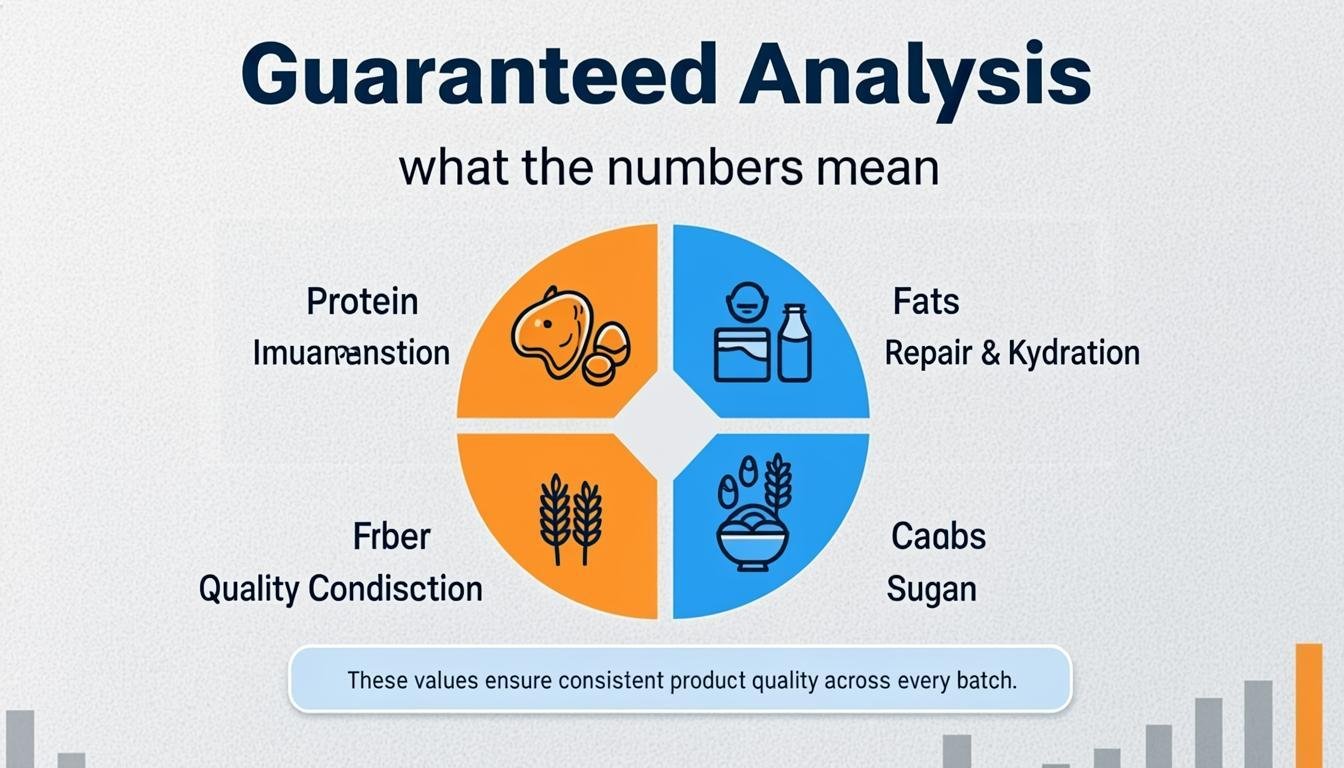
The Guaranteed Analysis lists minimum percentages for crude protein and crude fat and maximum percentages for crude fiber and moisture. These are helpful but limited: they don’t indicate digestibility or the bioavailability of nutrients. Treat the guaranteed analysis as the math section of the dog food label: small numbers with big consequences.
How to interpret typical entries
- Crude protein (% minimum): Indicates total protein, not quality. Protein from highly digestible sources is more useful to the dog than the same percentage from indigestible sources.
- Crude fat (% minimum): Important for energy. Active adult German Shepherds often do better with a moderate to higher fat content than sedentary dogs, but individual needs vary.
- Crude fiber (% maximum): Gives an idea about how much indigestible material is present—affects stool bulk and transit time.
- Moisture (% maximum): Helps you compare on an equal basis—canned foods have higher moisture and lower dry-matter nutrient concentrations.
For precise comparisons, convert to a dry matter basis (DMB) so moisture differences don’t skew protein and fat comparisons. That calculation is straightforward: divide the nutrient percentage by (100% − moisture%). For example, if a kibble lists 10% moisture and 25% crude protein, the DMB protein is 25 / (100 − 10) = 27.8%. Run this dry-matter math on any two dog food labels and the real protein gap between them often surprises owners.
Calories and energy density
Look for calories listed as kilocalories per kilogram (kcal/kg) or per cup. German Shepherds have large size and activity-related energy needs; two foods with the same guaranteed analysis may have different calorie densities, meaning portion sizes must be adjusted. Always use calories per serving to compare how much energy your dog will actually get. Calorie lines are the part of a dog food label most owners skip, yet they matter more than the ingredient photo.
AAFCO statements and feeding trials
In the U.S., many labels include an Association of American Feed Control Officials (AAFCO) statement that indicates whether the food is “formulated to meet” nutrient guidelines or “tested using AAFCO feeding trials.” A formulation statement means the nutrient profile meets AAFCO nutrient profiles on paper. A feeding-trial statement indicates the diet has been fed to dogs in trials and supports growth/maintenance claims based on observed results; methods and scope vary. When a dog food label mentions feeding trials, ask which life stage was tested and for how long.
Regulatory and scientific frameworks differ internationally. For general global guidance on selecting and evaluating pet food, the WSAVA Global Nutrition Guidelines and toolkit are useful resources: WSAVA: Global Nutrition Guidelines and the practical toolkit WSAVA: Selecting a Pet Food. These documents explain core concepts and encourage working with veterinary professionals on individual nutrition plans. Pair the WSAVA toolkit with what you now know about the dog food label and you will spot gap-filling fast.
Feeding guidelines on the bag: how to use them
Feeding charts are starting points, not prescriptions. They cannot account for your dog’s age, activity level, neuter status, health conditions, or metabolic rate. Use feeding guidelines as a baseline and adjust based on body condition scoring and guidance from your veterinarian. Think of the chart as the starting point printed on the dog food label, then adjust with body condition scoring every month.
Recommended gear for this stage:
- Digital kitchen scale (gram precision) (Amazon) — weighs portions exactly instead of relying on cup estimates.
- Airtight dog food storage containers (Amazon) — keeps kibble fresh so label nutrients stay intact.
Practical approach
- Weigh your dog and use body condition scoring (lean but healthy vs. overweight) to assess ideal feeding amount.
- Start at the feeding chart recommendation for your dog’s weight and life stage.
- Monitor weight and body condition over 2–4 weeks and adjust by 5–10% if needed.
- Consult your veterinarian for an individualized feeding plan if you see rapid weight changes, poor coat, or digestive issues.
Life stage, breed-size, and special formulas
Labels that specify life stage (puppy, adult, senior) and breed size (small, medium, large) indicate different nutrient balances. Large-breed puppy formulas often have controlled calcium and phosphorus to support steady bone growth and reduce the risk of developmental orthopedic problems—correct balance matters, and any concerns should be discussed with a veterinarian. Large-breed puppy formulas exist precisely because the dog food label numbers for calcium and phosphorus really do matter during growth.
If your German Shepherd has special needs (sensitive stomach, food allergy, orthopedic issues), labels for specialized diets exist, but an individual plan with a veterinarian or a certified veterinary nutritionist is appropriate prior to long-term use. Prescription and therapeutic diets carry their own dog food label conventions, which your vet can decode with you.
Red flags and what to watch for
- Vague ingredient names like “meat” or “animal fat” without species identification if you need specific protein sources for food-allergic dogs.
- Absence of an indication of life stage or nutritional adequacy statement—this may make comparing options harder.
- Unclear country of origin or manufacturer contact information—reputable companies provide traceability and a way to ask questions.
- Unfounded health claims asserting cures for medical conditions—these should be approached skeptically and discussed with a veterinarian.
Practical example: reading a dog food label line by line
Below is a fictional, generic breakdown of common label entries and how to interpret them. This is an illustrative example only.
Sample ingredient header (fictional)
“Chicken, chicken meal, brown rice, peas, chicken fat (preserved with mixed tocopherols), natural flavor, dried beet pulp, fish oil, vitamins and minerals.”
How to read it
- Chicken and chicken meal are the first two ingredients. Because fresh chicken contains water, chicken meal is a concentrated protein—both indicate chicken is a primary protein source.
- Brown rice and peas high on the list suggest carbohydrates/starches are major energy contributors.
- Chicken fat and fish oil supply important fats and omega fatty acids; fish oil is a demonstrable source of long-chain omega-3s for skin and coat support.
- Dried beet pulp provides fermentable fiber, which may help stool quality for some dogs but can affect dogs with specific sensitivities differently.
Now check the Guaranteed Analysis (fictional): crude protein 26% min, crude fat 14% min, crude fiber 4% max, moisture 10% max. Convert to dry-matter basis if comparing to a canned food. Check kcal per cup to set portion sizes. Confirm an AAFCO or national adequacy statement relevant to the life stage.
Transitioning foods and monitoring tolerance
When switching foods, transition over 7–10 days by gradually increasing the new food and decreasing the old. Watch for changes in stool quality, appetite, energy, skin/coat condition, and weight. If your dog develops severe diarrhea, vomiting, lethargy, or other concerning signs after a diet change, stop the new diet and contact your veterinarian. The same 7- to 10-day schedule applies whenever you switch brands, because every dog food label change alters fiber, fat, and moisture.
How to compare two dog food labels in 10 minutes
Side-by-side comparison is where dog food label reading becomes genuinely useful. Most owners compare foods by brand reputation or price per pound, which tells you almost nothing about nutrition. A structured ten-minute comparison of two dog food labels gives you a defensible answer instead of a feeling, and it works whether you are comparing a premium kibble against a supermarket house brand or two premium formulas against each other.
Here is the method. Grab two bags, a calculator, and a notepad. Work through the five steps below in order and write the numbers down for each product before you form an opinion. Numbers first, impressions second — that order matters, because packaging design exists to create impressions before you ever reach the panel.
- Normalize the moisture. Convert crude protein and crude fat to a dry-matter basis for both foods so the comparison is fair, especially if one is canned.
- Read the first five ingredients. Note how many are named animal ingredients and how many are plant proteins or starches.
- Find the calories. Write down kcal per cup and kcal per kilogram. The cup number drives portion sizes; the kilogram number drives cost per calorie.
- Locate the AAFCO or adequacy statement. Note the life stage claimed and whether it says formulated or feeding-trial tested.
- Check the company details. A full address, a phone number, and a named nutritionist on the dog food label are quiet signals of accountability.
For the official definitions behind each panel section, the AAFCO reading labels guide is the regulatory source of truth in the United States, and it pairs well with the practical checklist later in this article.
| Comparison point | Food A (example) | Food B (example) | What wins |
|---|---|---|---|
| DMB protein | 30.2% | 26.0% | Higher for active adults — but verify digestibility |
| DMB fat | 18.0% | 12.5% | Higher suits working dogs; lower suits easy keepers |
| kcal per cup | 410 | 355 | Lower lets you feed larger, slower portions |
| First ingredient | Chicken | Ground yellow corn | Named animal protein for most Shepherds |
| AAFCO statement | Feeding trial, all life stages | Formulated, adult maintenance | Feeding trials add real-world evidence |
Run this once and you will never look at a shelf the same way. Two dog food labels with nearly identical front-of-bag promises can differ by ten points of protein on a dry-matter basis, and the only way to see that gap is to do the math yourself. If your Shepherd has a sensitive stomach, add a sixth step: compare the fiber and fat lines, because those two numbers predict tolerance better than any ingredient story. For a broader view of where a new formula fits into the overall diet, our German Shepherd feeding and nutrition guide“>feeding and nutrition guide covers portioning and life-stage basics.
Marketing terms on the bag, decoded
Front-of-bag language is regulated loosely or not at all, which is why the same bag can say natural, premium, and scientifically formulated while telling you nothing verifiable. Learning the handful of terms that do have legal meaning is the fastest way to upgrade your dog food label literacy. Everything else on the front panel is marketing, and marketers are very good at their job.
The table below covers the terms owners ask about most. Note the pattern: terms tied to percentage rules have enforceable definitions, while feel-good adjectives generally do not. When a dog food label uses a percentage-based term, you can verify it; when it uses a vibe, you cannot.
| Term on the bag | What it legally means | How much to trust it |
|---|---|---|
| “With chicken” | Only a small minimum percentage of chicken required | Low — a garnish rule, not a formula statement |
| “Chicken dinner” or “recipe” | Roughly 25% of the product (the 25% rule), excluding water for dry foods | Moderate — real but easy to overestimate |
| “Chicken dog food” | About 70% total chicken including water weight | Moderate-high |
| “Natural” | No strict legal definition in pet food rules | Low — treat as decoration |
| “Human-grade” | Meaningful only if every ingredient AND the facility meet human-food standards | Conditional — verify the scope |
| “Premium” / “super-premium” | None — purely promotional | None |
| “Flavor” | Only requires the named flavor to be detectable, even from a meal | Very low |
| “Large-breed formula” | No standalone rule — check the AAFCO statement and calcium line | Moderate if backed by numbers |
Two practical habits follow from this table. First, never pay a premium for an undefined adjective; the same money buys a better guarantee elsewhere. Second, when a term does carry a percentage rule, remember that rules count water weight, so a wet food with beef may contain less dry-matter beef than you imagine. A disciplined read of the back panel beats a disciplined read of the front panel every single time, and our best food for German Shepherds roundup“>brand roundup applies exactly this filter to popular products.
Guaranteed analysis vs. ingredient list: which wins?
Owners often treat the ingredient list as the whole story, but ingredients and nutrients answer different questions. The ingredient list tells you what went into the bag; the guaranteed analysis tells you how much protein, fat, fiber, and moisture the finished product contains. A formula built from beautiful-sounding ingredients can still deliver mediocre nutrition, and a modest-looking ingredient list can support solid numbers. Mature dog food label reading means weighing both panels together rather than picking a favorite. For a veterinary-school perspective on evaluating foods, the Tufts pet nutrition team publishes the questions worth asking any manufacturer.
Here is a concrete example of the tension. Two kibbles both open with chicken, but one lists 24% crude protein and 14% fat while the other lists 30% and 18%. The first is a fine maintenance food for a moderately active pet; the second is closer to a performance formula. Same hero ingredient, very different diets. This is why a dog food label deserves at least as much attention on its numbers as on its storytelling.
Digestibility is the hidden third factor. Feeding-trial statements and manufacturer feeding research are the closest proxy available on the bag itself, and brands that invest in trials usually say so loudly. Beyond the bag, your dog provides the final audit: stool quality, coat condition, energy, and body weight over four to six weeks tell you whether the numbers on the dog food label translated into actual nutrition. If itching or chronic loose stools persist on a well-chosen formula, involve your vet, because diet trials for suspected reactions are a separate project — our guide to food allergy symptoms“>allergy symptoms explains the difference.
FAQ: dog food label questions owners ask most
Is the first ingredient on a dog food label always the main protein?
Usually, but not always in the way people think. Ingredients are listed by pre-cooking weight, so fresh chicken — heavy with water — can outrank a drier ingredient that ultimately contributes more protein. Read the first five entries together rather than worshiping the first line of the dog food label.
What percentage of protein should a German Shepherd’s food have?
On a dry-matter basis, most healthy adult Shepherds do well in the mid-to-high twenties for protein with moderate fat, while large-breed puppies need carefully controlled calcium rather than maximum protein. The right number depends on age, activity, and health, which is why the dog food label is a starting point for a conversation with your vet, not a prescription.
Do I need to avoid all by-products on a dog food label?
No. Named by-products like chicken liver are nutrient-dense and perfectly sound. The concern is unnamed generic entries like meat meal or animal fat, which hide the species. A transparent dog food label names its sources; an evasive one blurs them.
Are grain-free formulas better?
Grain-free is a marketing category more than a nutritional upgrade. Grains on a dog food label are economical, digestible energy for most dogs, and true grain allergy is uncommon. Discuss any grain-free plan with your veterinarian, especially long-term, and read our raw diet guide“>raw diet overview if you are considering bigger dietary philosophy changes.
Why does my bag list two different calorie numbers?
Because calories per kilogram describe energy density while calories per cup describe serving reality. Both matter: one tells you how rich the food is, the other tells you how much to scoop. When comparing any two dog food labels, use the per-cup number for portions and the per-kilogram number for cost math.
Three habits worth stealing from the pros
Breeders, veterinary nutritionists, and seasoned sport-dog owners read bags faster than the rest of us not because they know more words, but because they run the same three habits on every product they touch. Steal them and your own dog food label reviews will get quicker and sharper every month.
Habit one: the ten-second flip. Professionals ignore the front of the bag entirely and flip it first. Front panels are written by marketing; back panels are written by regulations. Starting at the ingredient list and guaranteed analysis means your first impression of any product is formed by data, not by a golden retriever photo and the word “ancestral.” Make the flip automatic — even in the grocery aisle — and half the shelf simply stops competing for your attention.
Habit two: the same five questions, every time. What is the first named fat? What is the DMB protein? What life stage does the adequacy statement claim? Who manufactures it, and where? Is there a customer contact worth calling? Asking identical questions turns every dog food label into a comparable scorecard, and comparison — not brand memory — is what exposes both bargains and pretenders. Keep the five questions in your phone notes; consistency beats genius here.
Habit three: the four-week audit after purchase. The pros do not stop at the bag; they audit the dog against it. Four weeks in, they score stool quality, coat shine, energy, and body condition on a simple one-to-five scale and decide accordingly. A bag that promised everything but delivers dull coat and loose stool gets replaced without sentiment, while a modest formula that produces firm stools and gleaming fur earns loyalty. That closing audit is the difference between reading a dog food label and actually using one — and it is the habit that makes every future choice easier, because you finally know what working nutrition looks like on your own dog.
Practical checklist: quick steps to compare labels
- Read the ingredient list top-to-bottom; note primary protein and carbohydrate sources.
- Convert Guaranteed Analysis to dry-matter basis when comparing wet and dry foods.
- Check kcal per cup (or per kg) to set correct portion sizes.
- Look for a life-stage statement and, if present, feeding-trial language or formulation details.
- Avoid making decisions based solely on marketing claims; probe the ingredient list instead.
- If your dog has specific health concerns, consult your veterinarian before changing foods.
Takeaway: what matters most
Diet selection for a German Shepherd is about matching nutrient density and ingredient quality to your dog’s age, activity, and health status. Labels provide vital clues—ingredient order, specific protein naming, guaranteed analysis, calorie density, and life-stage statements are the core elements to evaluate. Use the feeding chart only as a starting point and monitor your dog’s condition. For breed-specific feeding strategies and product comparisons, our a practical food-buying guide can help you narrow choices. Once the fundamentals click, a dog food label stops being noise and becomes a scorecard you can argue with.
Tip: When in doubt, take photos of the front and back of the bag and the feeding chart and bring them to your vet for a better-informed conversation.
Affiliate disclosure: As an Amazon Associate, German Shepherd Haven earns from qualifying purchases made through marked links on this page, at no extra cost to you.
Sources and Limits
This article summarizes label-reading principles and practical steps. For global, evidence-informed guidance on pet nutrition and selecting pet foods, consult the WSAVA resources: WSAVA: Global Nutrition Guidelines and the detailed toolkit WSAVA: Selecting a Pet Food. These sources stress the importance of individualized nutrition planning with veterinary professionals. Neither WSAVA nor AAFCO endorses products, so the dog food label still needs your judgment at the shelf.
Limitations: This article is educational and not a substitute for veterinary advice. It does not diagnose, treat, or recommend specific medical or therapeutic diets. For individualized feeding plans, allergy management, weight management, or clinical nutrition, consult a qualified veterinarian or a board-certified veterinary nutritionist. If your German Shepherd has a health condition that might be affected by diet, do not make long-term changes without professional guidance.
If you would like help interpreting a specific product label, you can bring the product details to your veterinarian or a qualified canine nutrition professional. Use the checklist above to prepare and make the conversation more efficient. Owners who can summarize a dog food label in three sentences usually get sharper advice from their vet.