
A careful dog food transition is the difference between an excited new bowl and a week of stomach upset. German Shepherds have sensitive digestive systems, and abrupt switches commonly trigger loose stools, gas, and appetite dips. This guide walks you through a proven dog food transition plan: why gradual change works, three ready-made schedules, the mixing math, and the warning signs that mean you should slow down. Follow the percentages, log what you see, and the whole switch can be boring — exactly what you want.
Affiliate disclosure: As an Amazon Associate, German Shepherd Haven earns from qualifying purchases made through marked links on this page, at no extra cost to you. See our full Affiliate Disclosure.
Why a gradual dog food transition matters
Dogs, including German Shepherds, have digestive systems adapted to a consistent diet. A sudden change in protein source, fat content, fiber, or type of food (dry to wet, kibble to raw) can alter gut motility and microbiome composition enough to cause loose stools, vomiting, decreased appetite, or gas. Gradual transitions give the gastrointestinal tract and microbiome time to adapt to new nutrients and textures. A dog food transition spread over 7 to 14 days protects that gut flora far better than a weekend swap.
Principles behind a slow switch
- Start small and increase the new food slowly so intestinal flora can adjust.
- Watch portions and feeding schedule: keep meal times and amounts consistent.
- Keep treats, supplements, and feeding routines steady to reduce other variables.
Signs your German Shepherd may need a different food
There are many reasons owners consider a food change. Common, non-diagnostic signs include:
- Recurrent digestive upset (soft stools, diarrhea, occasional vomiting)
- Chronic skin irritation, excessive scratching, or coat changes
- Poor body condition (weight loss or unwanted weight gain despite stable intake)
- Life-stage needs (puppy growth, active adult, senior)
- Picky eating or food refusal after gradual appetite changes
These signs don’t automatically mean a new diet is the solution. Always discuss persistent or severe signs with a veterinarian to rule out underlying medical problems before changing food. Once medical causes are excluded, a structured dog food transition answers whether the diet itself was the issue.
Choosing the new food: what to consider
Choosing a new diet depends on your dog’s age, activity level, body condition, known sensitivities, and your feeding goals. Use evidence-based guidance and professional advice when possible. For general principles on selecting a diet, refer to the WSAVA guidance linked in the Sources and Limits section and consult food-selection considerations for breed-specific context. Whatever formula you choose, the dog food transition schedule matters as much as the bag you buy.
Practical points when selecting a new food
- Check the guaranteed analysis for protein, fat, and fiber to understand how it compares to your current food.
- Consider protein source: switching from chicken to a novel protein may help if food sensitivity is suspected, but a vet-guided plan is best for allergies.
- Life-stage formulation: puppy, adult, or senior diets have different nutrient targets.
- If your dog is on medications or supplements, check compatibility with the new formula and keep supplement use consistent during transition.
- Refer to the broader feeding context in the broader feeding and nutrition guide for portioning and calorie considerations.
When to involve your veterinarian or a nutrition professional
If your German Shepherd has chronic vomiting, diarrhea, unexplained weight change, skin disease, or suspected food allergy, schedule a veterinary appointment before switching diets. A veterinarian can help exclude medical causes and, if appropriate, recommend an elimination trial or a prescription diet. If you want a professional nutritional assessment, a board-certified veterinary nutritionist can create a tailored plan. Professional input is especially valuable when a dog food transition involves prescription diets or known allergies.
Step-by-step dog food transition plans
Below are three commonly used transition timelines: a conservative 14-day plan, a moderate 10-day plan, and a quicker 7-day plan. Choose the schedule depending on your dog’s sensitivity and veterinary advice. Always use the same total daily calorie amount during the switch unless directed otherwise by a veterinarian. Write your dog food transition percentages on the calendar before day one; guessing mid-week is how switches stall.
14-day conservative plan (best for sensitive dogs)
- Days 1–3: 90% old food + 10% new food per meal.
- Days 4–6: 75% old + 25% new.
- Days 7–9: 50% old + 50% new.
- Days 10–12: 25% old + 75% new.
- Days 13–14: 100% new food.
10-day moderate plan
- Days 1–2: 75% old + 25% new.
- Days 3–4: 50% old + 50% new.
- Days 5–7: 25% old + 75% new.
- Days 8–10: 100% new food.
7-day quick plan (for dogs with no sensitivity)
- Day 1–2: 75% old + 25% new.
- Day 3–4: 50% old + 50% new.
- Day 5–6: 25% old + 75% new.
- Day 7: 100% new food.
How to mix foods practically and measure percentages
Mix foods in the bowl at mealtime rather than switching bowls mid-meal, as some dogs are texture-sensitive. If your dog receives two meals per day, calculate the percentage by weight, not by kibble pieces, because kibble density and size vary. Use a kitchen scale for accuracy, or measure by volume only if both foods have similar density. A kitchen scale turns a dog food transition from guesswork into arithmetic you can repeat every meal.
Recommended gear for this stage:
- Digital kitchen scale (gram precision) (Amazon) — makes day-by-day mixing percentages actually accurate.
- Slow-feeder bowls for large dogs (Amazon) — slows gulping during the switch and reduces bolted meals.
- Probiotic digestive chews (Amazon) — extra gut support many owners use during a transition.
Example: measuring by weight
If your dog normally eats 400 grams of food per day divided into two meals (200 g per meal):
- For a 25% new food meal: 50 g new + 150 g old = 200 g meal.
- For a 50% new food meal: 100 g new + 100 g old = 200 g meal.
This keeps the total calories consistent while changing the composition. Keeping calories flat during a dog food transition also keeps body weight flat, which protects joints and digestion.
Monitoring during the transition: what to watch for
Keep a close eye on appetite, stool quality, energy, and skin condition. Keep a simple daily log noting:
- Meal amounts and composition (percent new vs. old)
- Stool consistency and frequency
- Vomiting episodes, if any
- Changes in appetite or activity
- Any skin or ear changes
Minor, short-lived loose stools or a single soft bowel movement can occur during a switch and may resolve with a slower change. Ongoing diarrhea, repeated vomiting, lethargy, or substantial appetite loss warrant immediate veterinary advice. Most minor stool changes during a dog food transition resolve within two days of holding the current percentage steady.
Special cases: puppies, seniors, allergies, and raw/wet switches
Different life stages and feeding types need extra care during transitions.
Puppies
Puppies have higher caloric and nutrient needs. When switching puppy formulas, stick to a gradual plan and consult your veterinarian to ensure the new diet meets growth requirements. Never switch a rapidly growing puppy to adult maintenance food without veterinary guidance. A puppy dog food transition should also be timed around growth, with calcium levels discussed alongside your vet.
Seniors and dogs with medical conditions
Seniors or dogs with medical conditions (kidney disease, pancreatitis, diabetes) require veterinary-approved diets. Discuss transitions with your vet and follow any recommended timelines or prescription-switch protocols they provide. For seniors, stretch every stage of the dog food transition by two to three days and watch weight closely.
Suspected food allergy or intolerance
Food allergy diagnosis usually involves a veterinary-supervised elimination trial rather than a simple swap. Elimination diets and hydrolyzed prescription formulas require strict adherence and veterinary oversight. If you suspect an allergy, consult your veterinarian rather than attempting unsupervised rotations of commercial foods. Allergy workups and a dog food transition trial are different projects; running both at once muddies the results.
Switching between wet, dry, or raw diets
Texture and moisture changes can be disruptive. When moving from dry to wet or raw, add small amounts of the new form mixed into the old for longer than you might for kibble-to-kibble switches. Keep total daily calories consistent and watch for choking risk with whole pieces in some raw diets. Cross-type changes — kibble to wet, wet to raw — benefit from the slowest dog food transition timeline you can manage.
Managing picky eaters and refusal during a transition
Some German Shepherds are picky about texture or smell and may refuse a new food. Tips to improve acceptance without forcing a change:
- Warm wet food slightly to increase aroma (never hot).
- Top a small portion of the mixed bowl with a teaspoon of low-sodium broth or a small amount of the previous food to bridge taste.
- Keep mealtimes consistent and limit free-feeding so appetite is normal at mealtime.
- Avoid turning mealtime into a training session with excessive treats that undermine appetite for the new food.
If your dog refuses all meals for more than 24–48 hours, contact your veterinarian. A full 24-hour refusal during a dog food transition is a stop sign, not a standoff to win.
Common dog food transition mistakes to avoid
- Switching overnight: a sudden swap can cause gastrointestinal upset.
- Mixing by volume without measuring: different kibbles have different densities.
- Changing multiple things at once: treats, supplements, or feeding location changes can confound results.
- Ignoring persistent signs: ongoing diarrhea, vomiting, or lethargy require veterinary evaluation.
Practical sample schedules (three real-world examples)
Here are three sample situations showing how owners commonly apply the transition plans.
Example A: Adult German Shepherd, no known sensitivities (10-day plan)
Current daily amount: 500 g kibble (250 g per meal). New food is similar in calorie density. Notice how the percentages change while the total grams barely move — that is the signature of a smooth dog food transition.
- Days 1–2: 75% old + 25% new (187.5 g old + 62.5 g new per meal)
- Days 3–4: 50%/50% (125 g new + 125 g old per meal)
- Days 5–7: 25% old + 75% new (62.5 g old + 187.5 g new per meal)
- Days 8–10: 100% new (250 g per meal)
Example B: Senior German Shepherd with sensitive stomach (14-day conservative plan)
Follow the 14-day schedule and record stool quality daily. If soft stools develop, slow the transition by holding at the current ratio for 2–3 extra days before moving to the next step, and consult your veterinarian if there’s no improvement. Slowing down mid-plan is not failure; a dog food transition that takes 18 days still beats an upset gut in 10.
Example C: Switching from kibble to wet food for variety
Because wet food has higher moisture and sometimes different calories, reduce the dry amount slightly or follow the package feeding guide to keep calories steady. Mix a small spoonful of wet with dry for several days, increasing the wet proportion slowly over 10–14 days while adjusting the dry volume so total calories do not spike. Treat any cross-format change as its own dog food transition, not a simple brand swap.
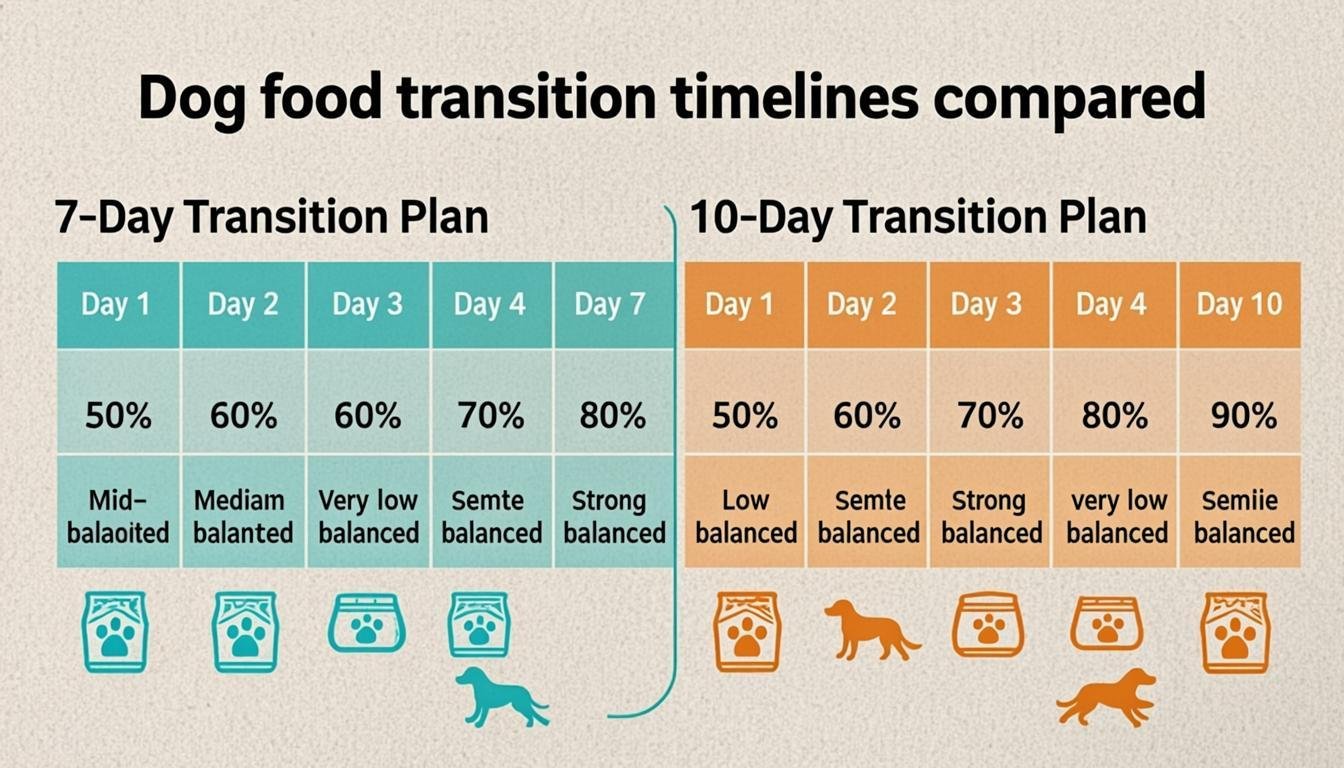
Dog food transition timelines compared: 7, 10, and 14 days at a glance
Choosing between the three standard schedules is easier when you see them side by side. A 14-day dog food transition suits sensitive stomachs, recent illness, or anxious dogs; the 10-day plan fits most healthy adults; the 7-day plan is for robust dogs with cast-iron digestion and no history of dietary upset. The right dog food transition is the slowest one your situation actually requires — faster is never better here.
| Day | 7-day plan | 10-day plan | 14-day plan |
|---|---|---|---|
| 1–2 | 75% old / 25% new | 75% old / 25% new | 90% old / 10% new |
| 3–4 | 50% / 50% | 50% / 50% | 75% old / 25% new |
| 5–6 | 25% old / 75% new | 25% old / 75% new | 60% old / 40% new |
| 7–9 | 100% new | 25% old / 75% new | 40% old / 60% new |
| 10–12 | — | 100% new | 25% old / 75% new |
| 13–14 | — | — | 100% new |
Three notes on using this table. First, percentages refer to the daily ration across all meals, not per bowl. Second, if stool quality softens for a single day, hold the current ratio for two extra days instead of stepping back a full stage — most dog food transition hiccups resolve with a pause rather than a reversal. Third, keep treats, table scraps, and supplements constant throughout, because changing two variables at once makes it impossible to know which one caused a reaction.
Owners sometimes ask whether a faster dog food transition is acceptable for young, healthy dogs. It can be, but the calculation includes more than the stomach: rapid switches change stool volume and frequency for a few days, and a large breed with an unsettled gut is more uncomfortable on long walks or in a crate during that window. Unless circumstances force your hand, let the calendar do the work.
What happens in the gut during a switch
The reason gradual schedules work is microscopic. Your Shepherd’s intestinal lining renews constantly, and the community of gut bacteria — the microbiome — adapts to whatever macronutrient profile arrives consistently. A sudden dog food transition floods that community with unfamiliar protein sources, fat levels, and fiber types before the bacteria that digest them well have multiplied. The result is fermentation imbalance, gas, osmotic water pull into the intestine, and loose stools.
Enzyme output matters too. Pancreatic enzymes are produced in response to diet composition, and their mix shifts over days rather than hours. During a staged dog food transition, enzyme production and bacterial populations move in step with each small increase, which is why each stage feels uneventful. Give the system three or four days per stage and it quietly reorganizes itself; force it in one day and it complains loudly.
This biology explains two practical rules that owners find counterintuitive. First, minor stool softening around a stage change is a signal to hold steady, not to panic or restart. Second, fiber differences between foods often cause more visible change than protein differences — a jump from moderate to high fiber changes stool volume within a day. When you understand the mechanism, a patient dog food transition stops feeling overly cautious and starts feeling like basic engineering. For the wider nutritional context behind these choices, our German Shepherd feeding and nutrition guide“>feeding guide covers the breed’s baseline needs.
Timing around boarding, travel, and big training weeks
Calendar placement does half the work of a smooth dog food transition. Starting a switch three days before boarding, a road trip, or a competition weekend stacks a new variable onto an already stressful event, and stress itself alters gut motility. Scan the next three weeks of your calendar before you open the new bag, and pick a window that is delightfully boring.
Ideal windows share three traits: the dog is home, the household routine is normal, and no veterinary procedures are scheduled. Avoid starting a dog food transition right after vaccination days, during heat cycles that make some dogs picky, or immediately before breeding or show events. If your dog is mid-way through a training block with high-value food rewards, keep the training treats identical and only change the meals — otherwise reward value shifts mid-course and confuses both of you.
Boarding deserves special mention. Most reputable boarders will run a staged dog food transition for you if you bring both bags and written percentages, but many prefer to keep a dog on its current food for the stay and finish the switch after pickup. Ask in advance, and if your dog is anxious about boarding at all, read our separation anxiety training plan“>separation anxiety guide — gut health and stress are more connected than most owners assume. Puppies have their own timing constraints; our German Shepherd puppy nutrition guide“>puppy nutrition guide explains why growth formulas should change gradually and only with a plan.
Warning signs the switch is moving too fast
The body sends clear signals when a dog food transition outruns the gut. Learning them turns you from a passive observer into an operator who can adjust the plan the same day. Watch for these markers, especially in the first half of the schedule.
- Stool score drop for two consecutive days. One soft stool is noise; a two-day trend means hold or step back.
- Mucus or visible urgency. The colon is irritated — pause at the current ratio and add a plain day.
- Loud gurgling and daytime gas. Fermentation imbalance; slow the schedule by a stage.
- Appetite dip or selective eating. Either palatability or nausea — check with small hand-fed portions.
- Vomiting more than once. Stop the advance, feed the previous ratio, and call your vet if it repeats.
- Lethargy beyond a normal quiet evening. Energy dips during a dog food transition deserve the same respect as digestive signs.
Two of these signs together — say soft stools plus an appetite dip — are a louder message than either alone. The correct response is almost always the same: freeze the current percentage for 48 hours, keep water plentiful, and resume stepping up only when stools firm up. If you complete a cautious dog food transition and problems continue at 100% new food for more than a week, the new formula itself may not agree with your dog, and it is time to review options with your veterinarian rather than push through.
FAQ: dog food transition questions, answered
Can I mix two complete dog foods long-term instead of finishing the switch?
Yes, many owners maintain a blended bowl deliberately, and a properly measured mix is nutritionally sound as long as both foods are complete and the total calories are right. If that is where your dog food transition has settled comfortably, there is no rule forcing you to reach 100% new food.
Should I add pumpkin or rice during the transition?
A spoonful of plain canned pumpkin can firm mild looseness, and small amounts are safe for most dogs. But treat it as a bandage: if a dog food transition needs daily pumpkin to hold together, the schedule is too fast or the food is wrong, and covering the symptom delays the real decision.
How long after a switch should I judge the new food?
Give it three to four weeks at 100% new food before a fair verdict on coat, energy, and stool quality. The dog food transition itself covers the adjustment; the following month shows you the steady state.
Do senior dogs really need slower switches?
Generally yes. Aging guts have less reserve, and many seniors take medications that interact with appetite or motility. A dog food transition for a senior is safer at 14 days than 7, with weight checks in between.
My dog loves the new food and refuses the old one — can I speed up?
Enthusiasm is not a medical green light. Digestive adaptation still takes days regardless of excitement. Keep the dog food transition schedule intact even if your dog would happily inhale the new bag on day one; the microbiome does not share the palate’s enthusiasm.
The pre-switch shopping checklist
A five-minute audit of what you buy before day one prevents most mid-transition surprises. The bag you chose is only half the decision; the other half is everything around it — sizes, tools, backups, and the small logistics that decide whether the dog food transition runs like a schedule or like improvisation. Run through this checklist before you open anything.
Buy the right quantity, not the biggest bag. Get enough new food for the full transition plus two weeks of evaluation, but resist the forty-pound bargain bag on a first purchase. Palatability and tolerance are unknowns until your dog has lived with the formula; a smaller bag that works beats a warehouse deal your dog refuses or fails. Note the best-by date while you are at it — food that expires mid-transition forces a restart, which defeats the whole gradual plan.
Check that both foods match calorie-wise. Compare kcal per cup on the old and new bags before setting the transition percentages. A new food with 15% more calories per cup, fed at identical volumes, quietly gains your dog weight during the switch. Recalculate portion sizes once, write them on the bag with a marker, and the whole dog food transition keeps weight neutral. If the calorie gap is large, transition volume first and percentages second — our feeding and nutrition guide“>nutrition guide has the arithmetic laid out.
Gather the measuring tools. A digital kitchen scale is the single best $20 a switcher can spend, because volume measuring is unreliable across kibble shapes. Add a dedicated airtight container for the new food, a scoop that lives inside it, and a roll of masking tape for day-labels on the containers. None of this is optional in a multi-dog household: labels prevent the classic disaster of two similar-looking bags feeding the wrong bowls, which resets a dog food transition to day zero with intestinal drama.
Plan the support kit. Plain canned pumpkin for mild stool softening, probiotics if your veterinarian recommends them, and your vet’s phone number saved in the favorites. Decide in advance what your personal stop-rule is — two consecutive soft stools, a single vomit, a skipped meal — so that mid-week decisions are made by your calm past self rather than your worried 6 a.m. self. The AVSAB position statement library and your own vet are the two references worth keeping on that same note, and the RSPCA behaviour guides cover the appetite-anxiety connection if refusal enters the picture.
Owners who run this checklist start their dog food transition with everything in place: right bag size, matched calories, clean tools, and pre-decided stop rules. That is why their switches read as uneventful — and uneventful is the goal. The puppy nutrition guide“>puppy nutrition guide covers the same checklist for growing dogs, whose transition windows are tighter and whose calcium arithmetic matters even more than calories.
One optional addition for multi-dog homes: a feeding order plan. If two or more dogs share a kitchen, decide before day one who eats where, who is crated during meals, and which bowl belongs to whom — switching foods is exactly when resource tensions surface, because both dogs can smell that something important has changed. Separate feeding stations, predictable order, and labeled containers keep the dog food transition calm for the whole pack, not just the switching dog. Ten minutes of planning here prevents the kind of mealtime chaos that makes owners abandon gradual schedules in frustration, and it protects the slower eater’s share of the precisely measured percentages you worked out above.
Checklist: quick reference before and during the switch
- Choose a new food appropriate for life stage and health — consult your vet if in doubt.
- Pick a transition timeline (7-, 10-, or 14-day) based on sensitivity.
- Measure by weight for accurate percentages.
- Keep treats, supplements, and feeding routine unchanged during the switch.
- Record appetite, stool quality, vomiting, energy, and skin condition daily.
- Slow the transition if minor loose stools occur; seek veterinary advice for ongoing issues.
- If you suspect food allergy or a medical issue, stop unsupervised changes and see a veterinarian.
Sources and Limits
Reliable, evidence-based guidance matters for canine nutrition. For general global nutrition guidance, see the World Small Animal Veterinary Association (WSAVA) Global Nutrition Guidelines and their toolkit on selecting a pet food. These resources explain nutrient requirements and practical selection steps and are helpful when considering a diet change: WSAVA: Global Nutrition Guidelines and WSAVA: Selecting a Pet Food.
For breed-specific feeding context, refer to the broader feeding and nutrition guide and consult our notes on food-selection considerations. A calm dog food transition also protects the work you put into choosing the right food in the first place.
Limits: This article gives practical, general advice but does not replace individualized veterinary diagnosis or treatment. Nutritional needs vary with age, activity, medical conditions, and individual sensitivities. If your German Shepherd has chronic digestive problems, suspected food allergy, or a medical condition (for example, pancreatitis, diabetes, kidney disease), an individualized plan developed with a veterinarian or a board-certified veterinary nutritionist is essential. If at any point your dog shows severe signs—persistent vomiting, bloody diarrhea, lethargy, or refusal to eat for more than 24–48 hours—contact your veterinarian promptly.
Changing your dog’s food can be straightforward when done methodically. A gradual, measured approach with close monitoring helps most German Shepherds adapt smoothly to a new diet while minimizing upset. When in doubt, professional guidance ensures the safest path for your companion. Give the dog food transition two quiet weeks and your Shepherd’s stool, coat, and appetite will tell you whether the choice was right.