
Choosing a dog ramp for a German Shepherd starts with your vehicle, your dog’s movement, and the space available to load safely. The right choice should fit the actual entry point, stay stable, and be manageable enough that you use it on every trip.
Quick answer: Measure the vehicle entry height before shopping, compare usable walking width and extended length, check the manufacturer’s load rating and installation instructions, and confirm that the folded ramp fits your car. A high weight rating alone does not establish that a ramp will suit your German Shepherd.
This guide is written for owners shopping in the United States, Canada, the United Kingdom, and Australia, with imperial and metric measurements. It is a buying framework, not a hands-on product ranking. This guide does not include independent hands-on testing.
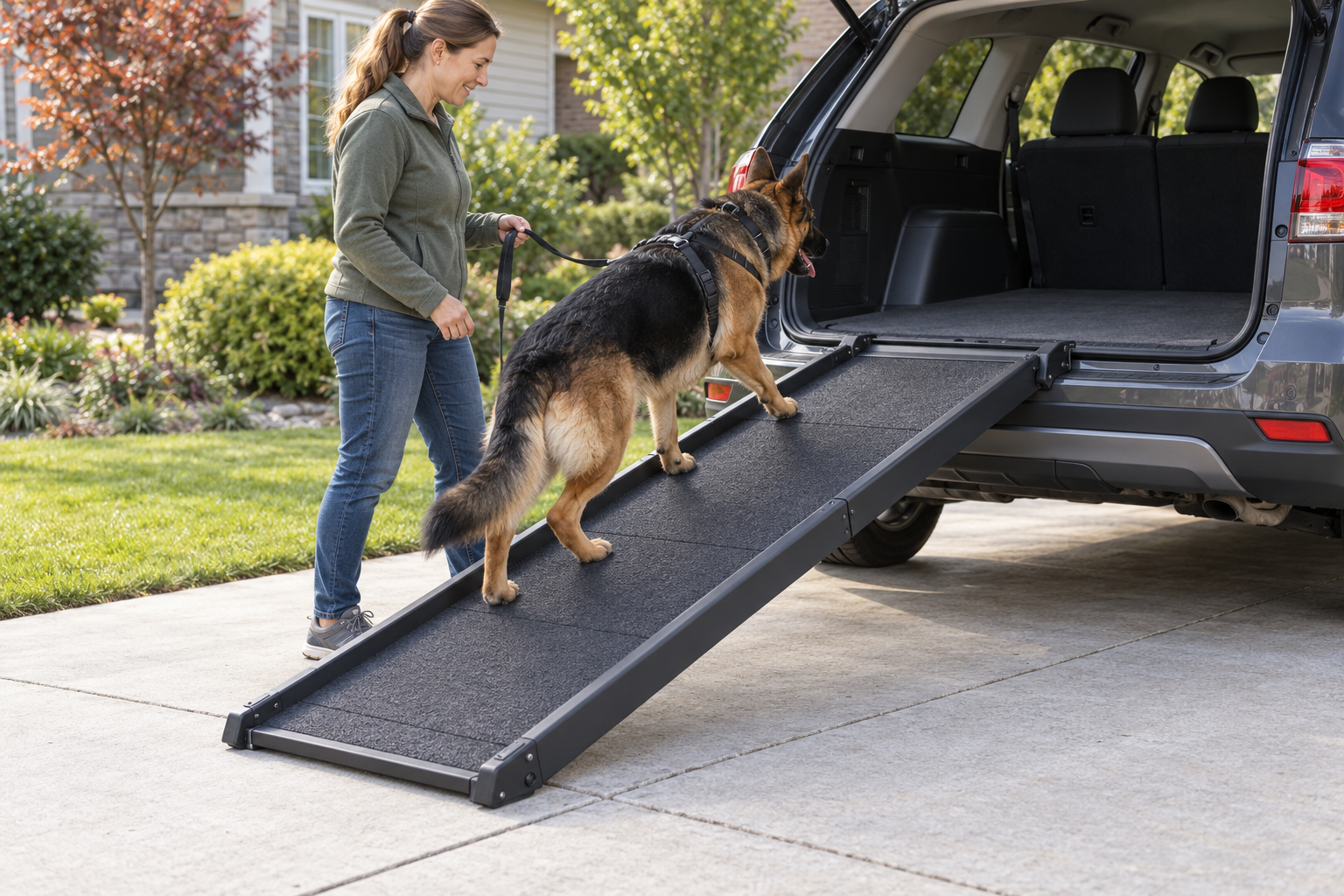
When does a German Shepherd need a car ramp?
A ramp can be worth considering when the vehicle entrance is high, your dog hesitates to jump, or lifting your dog is difficult. The American Kennel Club’s guide to ramps and stairs discusses their use for large dogs and dogs with mobility limitations, while emphasizing veterinary assessment when discomfort is involved.
Think of this purchase as solving a particular access problem. “My dog needs help entering the rear hatch of our SUV” is a useful brief. “I need the strongest ramp online” leaves out the details that decide whether the product will work.
If reluctance to enter the car is new, or your dog is limping or seems painful, arrange a veterinary assessment. A ramp does not diagnose or treat the cause. For background before that appointment, read our German Shepherd hip dysplasia guide. After surgery, use only the access arrangement approved by the treating veterinary team.
Dog ramp for a German Shepherd: 7 essential buying checks
1. Measure the exact vehicle entry point
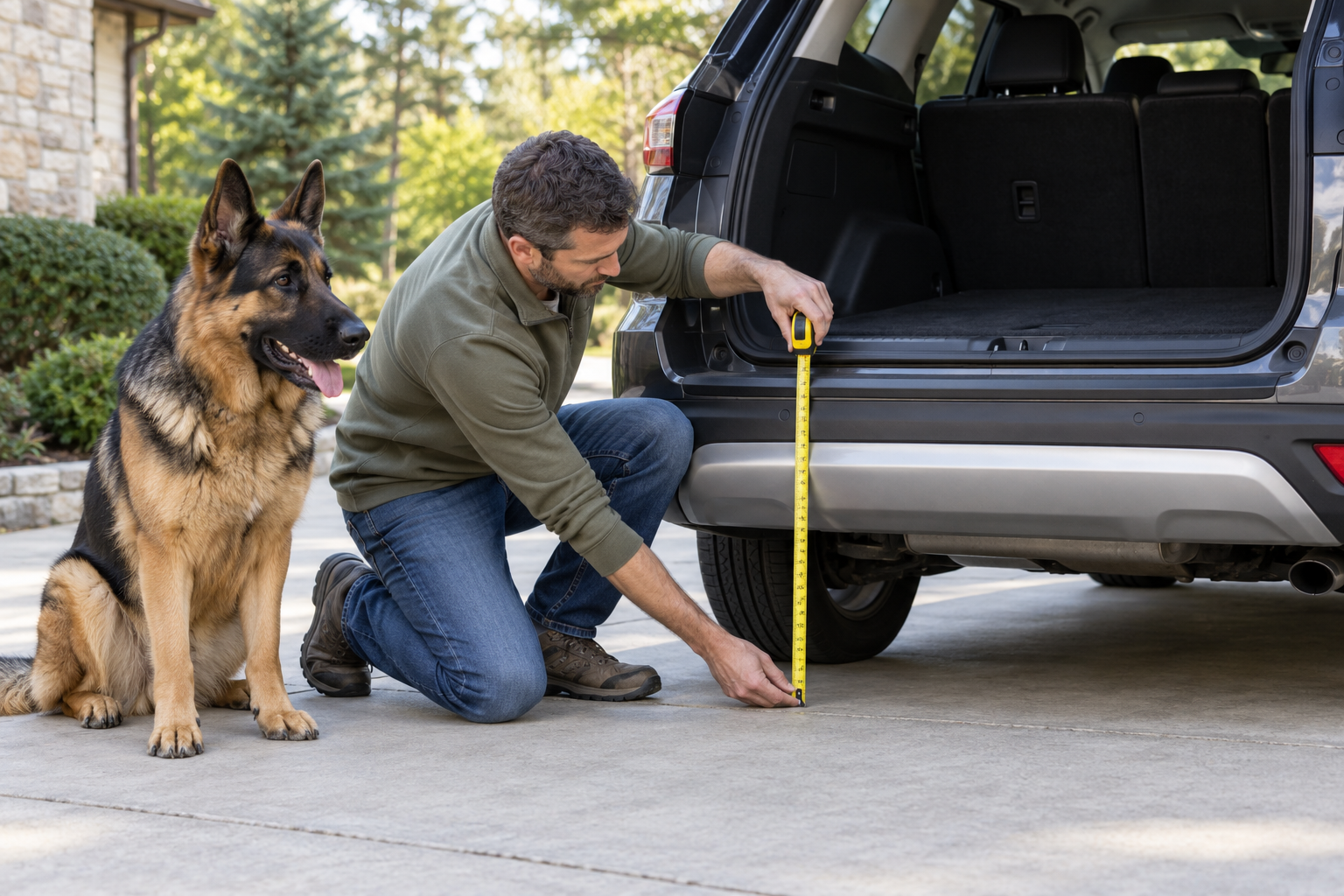
Park on level ground and identify where the ramp’s upper end would actually rest. Measure vertically from the ground to that support point. Do not substitute the height of the bumper if the ramp will land somewhere else.
Record a second set of details: the shape of the support edge, nearby plastic trim, the width of the opening, and whether a door obstructs the ramp. Take a side photograph and a close-up of the contact area. These give the manufacturer something concrete to assess if compatibility is unclear.
Rear-hatch and side-door access are different problems. A ramp that fits a wide cargo opening may not fit a rear passenger door. Check the intended installation in the manual, including any required adapter. Never assume that an improvised attachment is equivalent.
2. Compare extended length against available ground space
For a fixed entry height, a longer straight ramp produces a gentler incline but extends farther behind or beside the vehicle. You need room for both the ramp and your dog to approach it in a straight line.
Mark the likely footprint with tape or chalk before ordering. Include space for you to stand beside the dog. A ramp that works on a spacious driveway may be awkward in a narrow garage or a crowded parking bay.
Write down your most restrictive regular loading location. If you cannot deploy the ramp there, change the loading location or ask the manufacturer about a different setup. Buying extra length without checking space can simply exchange one problem for another.
3. Check usable walking width
Ask whether the listed width describes the whole frame or the surface between the side rails. Those measurements are not necessarily identical. The usable surface is the more relevant number when considering where your dog’s paws will land.
There is no single width that fits every German Shepherd. Body size, confidence, and movement differ. A dog that places its feet widely or needs assistance may require a different arrangement from a confident dog walking straight ahead.
Do not interpret a raised edge as a complete fall barrier. Look at the entire setup, including the landing space at the top and how you will supervise the descent.
4. Read the load rating and its conditions
Use your dog’s current measured weight, not a breed average. Check that the manufacturer’s rating covers that weight and that you understand any limits on extension, support, or intended use.
A quoted load capacity answers only one question. It does not tell you whether the ramp fits the car, whether the surface is suitable for the conditions, or whether the dog will accept it. Treat unusually vague claims such as “heavy duty for all large dogs” as a reason to request the manual.
Keep human use separate. For example, PetSafe’s telescoping ramp instructions specify pet use only. Do not climb onto a pet ramp to perform an informal strength test.
5. Inspect the surface and attachment system
The AKC recommends considering traction, width, height, and strength when selecting a mobility aid. For a car ramp, translate that advice into specific questions: how does the upper end engage with the vehicle, what stops the base moving, and what does the manual say about wet conditions?
Examine photographs of the walking surface close up. Ask whether replacement tread is available, how it is cleaned, and whether the hinges or sliding sections are accessible for inspection when the ramp is unoccupied. Avoid adding household carpet or other modifications unless the manufacturer approves them.
If a seller provides only lifestyle pictures, request photographs of the contact points and the opened locking mechanism. Those details are often more useful than a photograph of a dog standing beside the product.
6. Check what you must lift and store
The ramp’s own weight matters. Consider whether you can lift it from the boot or trunk, open it, position it, and put it away while managing your dog. Measure the folded dimensions against the actual storage space rather than relying on the word “compact.”
Make a simple cardboard rectangle matching the stored length and width. Try it in the intended location with the dog crate, luggage, or shopping already in place. This small check can expose an inconvenient fit before you pay for delivery.
Plan how to secure the ramp during travel according to the vehicle and equipment instructions. Loading equipment and travel restraints serve different functions. Our German Shepherd crate buying guide covers a separate part of the travel setup.
7. Check the return policy before the first trial
Your dog may need time to learn, but you also need a clear route for returning an unsuitable product. Find out whether an opened ramp can be returned, whether a supervised indoor trial is allowed, and who pays for shipping.
Save the exact model number, listing, instructions, and warranty terms. Similar names can refer to different sizes or regional versions. A screenshot of a retailer’s title is less useful than a model identifier when asking a manufacturer for help.
When choosing a ramp for your German Shepherd, prioritize documented fit over marketing adjectives. A clearly specified, returnable product is easier to assess than a premium-looking listing with missing measurements.
How long should a dog ramp be?
There is no universal ramp length or medically safe angle for every dog. The example below explains the geometry only. It is not a prescription for a puppy, senior dog, or dog recovering from treatment.
Imagine a vehicle support point 28 inches (71.1 cm) above level ground. For this simplified straight-ramp model, ramp length means the sloping distance between the ground contact and the upper support point. The angle is arcsin(entry height ÷ that sloping distance). Ground reach is the square root of that distance squared minus entry height squared. A product’s advertised overall length may include sections extending beyond the support points.
| Ramp length | Approximate incline | Approximate ground reach |
|---|---|---|
| 60 in / 152.4 cm | 27.8° | 53.1 in / 134.8 cm |
| 72 in / 182.9 cm | 22.9° | 66.3 in / 168.5 cm |
| 87 in / 221.0 cm | 18.8° | 82.4 in / 209.2 cm |
These are calculated examples, not product test results. They assume a straight ramp on level ground and do not account for the shape of the ends or the overlap needed at the vehicle. Follow the product’s installation limits even if a calculation appears favorable.
Notice the tradeoff: moving from a 60-inch to an 87-inch ramp reduces the angle in this example but adds roughly 29 inches (74 cm) of ground reach. You still need an approach area beyond the lower end. Measure that space separately.
A real specification example, without a product ranking
PetSafe’s published setup guide lists its standard Happy Ride Telescoping Ramp at 39–72 inches long and 17 inches wide, with a 13-pound (5.9 kg) ramp weight. The XL version is listed at 47–87 inches long and 20 inches wide, weighing 18 pounds (8.2 kg). These are manufacturer specifications, not our measurements.
The same guide lists vehicle-height limits of 28 inches for the standard version and 36 inches for the XL. Another PetSafe selection page gives different height ranges. Because those pages differ, verify the current manual for the exact model and market before purchase; do not choose the more permissive number automatically.
Which dog ramp design fits your routine?
| Design | Reason to consider it | Question to resolve |
|---|---|---|
| Telescoping | Adjustable deployed length | Which extension positions are permitted? |
| Folding | Defined open size and storage package | Do the folded dimensions fit your vehicle? |
| Fixed-length | No daily extending or unfolding | Can you transport and store its full length? |
| Vehicle steps | A different access layout to compare | Are the individual steps appropriate for your dog’s movement? |
This table compares design decisions, not safety rankings. Materials, construction, installation, and the individual dog matter more than the category name. For a dog with impaired mobility, ask the veterinary team which type of access is appropriate before choosing between steps and a ramp.
One useful shopping rule is to eliminate unsuitable options before comparing prices. A product that fails vehicle compatibility, usable width, or storage needs should not stay on the shortlist because it is discounted.
How to introduce your German Shepherd to a dog ramp
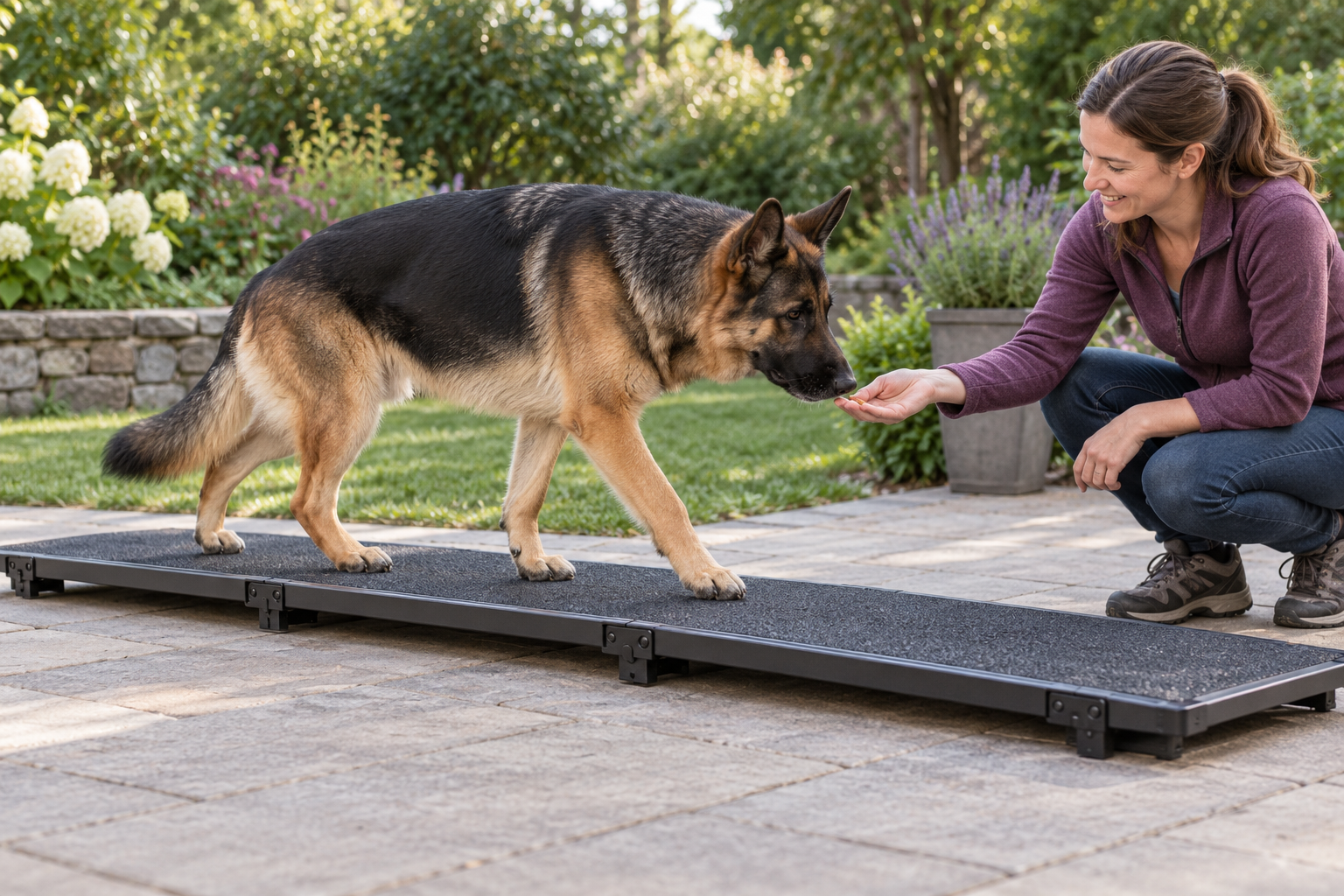
The AKC recommends short, positive sessions, allowing exploration, and avoiding pushing or pulling a reluctant dog. Start with the ramp flat on a stable surface if its instructions allow it, reward voluntary steps, and increase difficulty gradually. PetSafe’s guide also describes beginning on the ground before using the ramp at the vehicle.
Use the following as a progress record rather than a fixed timetable. Some dogs need more repetitions or professional help. For a dog with pain, weakness, or balance problems, get individual guidance before practicing.
- Exploration: Note whether your dog approaches voluntarily and can move away freely.
- Flat crossing: Record whether your dog walks across without rushing or stepping off the side.
- Approved low setup: If the manual permits one, note any change in confidence when the slope increases.
- Vehicle approach: Check whether the engine being off, a quieter location, or more space helps your dog remain comfortable.
- Controlled exit: Observe the descent separately. Confidence going up does not establish confidence going down.
Stop when the dog is uncomfortable. Return to an easier stage rather than increasing pressure. Avoid making the first lesson part of a rushed departure for an appointment; practice when you can end the session without needing to get anywhere.
Keep a brief note after each attempt: setup, surface condition, what went well, and why you stopped. “Walked halfway, then stepped off when the panel moved” gives you a clearer problem to address than “refuses ramps.”
What if your dog refuses the ramp?
Separate the possible issues. Is the dog reluctant to approach the equipment at all, comfortable on it flat but worried on an incline, or happy to walk up but unwilling to enter the car? Those observations can guide a conversation with a qualified reward-based trainer or veterinarian.
Do not assume refusal is stubbornness. If the ramp shifts or the fit is questionable, stop using that setup. If reluctance is new or accompanied by changes in movement, investigate discomfort before adding more training repetitions.
Buying in the US, Canada, UK, or Australia
The core buying checks are the same across these markets. The practical differences are often local stock, model versions, measurement units, delivery charges, and after-sales support. This guide does not assume that an item sold under a familiar brand name has identical specifications everywhere.
- United States: Record measurements in inches and pounds, then check the final delivered price and return-shipping terms.
- Canada: Confirm whether the seller ships domestically and whether the listed specifications use imperial or metric units.
- United Kingdom: Measure the boot opening and storage area in centimetres; convert any inch-based listing before comparing it.
- Australia: Confirm local stock, the relevant model manual, and availability of replacement parts before ordering an imported version.
For quick conversion, one inch equals 2.54 centimetres and one pound is approximately 0.454 kilograms. Keep both units in your notes so that comparing retailers does not become a mental-arithmetic exercise.
Do not compare only headline prices. Add delivery and any required approved adapter, then consider the practical cost of a return. We have not quoted live prices because they differ by seller, location, and date.
A copy-and-use shopping worksheet
- Dog’s measured weight: ______
- Intended vehicle and entry point: ______
- Vertical support height: ______
- Available ground space plus approach area: ______
- Required usable walking width: ______
- Maximum stored dimensions: ______
- Ramp weight I can comfortably handle: ______
- Exact model and manual checked: ______
- Vehicle compatibility confirmed by: ______
- Return deadline and return-shipping cost: ______
Send the completed measurements to the manufacturer if the fit remains uncertain. Ask for a written answer referencing your exact vehicle entry arrangement and model. Keep that response with the instructions.
Frequently asked questions
What is the best dog ramp for German Shepherd owners?
The best choice is the one that meets the dog’s needs and fits the intended vehicle installation. Use the seven checks above to build a shortlist. A universal winner would ignore entry height, storage, walking width, and the handler’s ability to move the ramp.
Is a 72-inch ramp long enough for an SUV?
Sometimes, but the label “SUV” does not answer the question. In the 28-inch-height example above, a 72-inch straight ramp produces an incline of approximately 22.9 degrees. That calculation does not establish suitability for your dog or override the manufacturer’s limits.
Can a ramp prevent hip dysplasia?
This guide does not claim that ramps prevent hip dysplasia. A ramp is an access aid. If you are concerned about your dog’s joints or movement, seek veterinary advice about the individual dog’s assessment and care.
Can I use the same ramp for a car and a bed?
Only if the manufacturer permits both installations and it fits each support point securely. Recheck height, contact surfaces, and available space. A product designed for a vehicle should not automatically be treated as indoor furniture equipment.
Should I buy a ramp before my dog becomes a senior?
You can consider one whenever vehicle access is inconvenient or you want to introduce the equipment calmly. There is no need to wait for a particular birthday. The decision should follow the dog’s needs and your actual loading setup.
Your next step
Before buying a dog ramp for your German Shepherd, measure the entry point and mark the footprint on the ground. Shortlist only models with clear instructions and a workable return policy. Once the fit is confirmed, introduce the equipment gradually and assess both entry and exit before relying on it for everyday trips.
Editorial note: This is a research-based buying guide with original illustrative calculations, not a veterinary assessment or hands-on product review. Manufacturer information was checked on October 28, 2026. Follow the current manual supplied with the exact product you buy.