
The best harness for German Shepherds is the single most consequential piece of walking equipment you will ever clip onto this breed, and most owners buy it wrong twice before buying it right. This guide ends the second-guessing with field-tested answers to the best harness for German Shepherds question. A 75-to-95-pound Shepherd in full flight generates enough force to yank an adult off their feet, and every one of those pounds channels through whatever you’ve attached to the leash. A collar concentrates that force on a throat packed with the trachea, thyroid, and the veins that drain the eyes; a well-fitted harness spreads it across the chest and shoulders, where the breed’s pulling power actually lives.
This guide breaks down the seven best harness for German Shepherds candidates of 2026 — the front-clip no-pull designs that turn a sleddog into a walking partner, the padded everyday harnesses that survive daily double-coat abuse, the crash-tested models that double as car restraints, and the budget picks that punch above their price. Each entry covers real US pricing, exact sizing for the breed’s deep chest and broad girth, the fitting mistakes that turn a good harness useless, and the training context that makes the hardware actually work. Because here is the uncomfortable truth the packaging never prints: no harness trains a dog by itself, but the right one makes every training session safer and every walk survivable.
Whether you are rescuing a 14-month whirlwind who has never walked on a loose leash, managing a senior with a sensitive throat, or just replacing the puppy harness your girl outgrew in a week, the picks below are sorted by the job they do — not by affiliate commissions. The prices shift with sales; the sizing math does not, and that math — where the best harness for German Shepherds is really decided — is where we will start, because the deepest chest in the dog world deserves better than guessing — and the sizing math is exactly what decides whether the best harness for German Shepherds works at all.
Why a Collar Fails the Best Harness for German Shepherds Test
Shepherds pull against their anatomy, and the anatomy punishes it. The breed’s working heritage built a dog that leans into pressure — it is the physical engine of herding and protection work — so when a collar digs into the throat during a lunge, the dog’s reflex is to push harder into the opposition. Walks become a feedback loop: pull, pressure, push, pressure, pull. Breaking that loop is the entire design brief for the best harness for German Shepherds. A front-clip harness breaks the loop by redirecting force sideways across the chest, converting the dog’s own power into a gentle rotation back toward you instead of a straight tug-of-war the dog always wins on mass.
The throat-cost is not theoretical. A frequently cited veterinary study measured intraocular pressure in dogs pulling against a flat collar versus a harness and found that collar pressure significantly raises pressure inside the eyes — a serious concern for any breed, and an alarming one for a breed already over-represented in certain eye conditions.
Veterinary trade coverage of that research put it bluntly: neck pressure is a measurable stressor, not a routine inconvenience. For a 90-pound male who has just spotted a squirrel at full sprint, the physics are not subtle, and the dogs least able to report eye discomfort are the ones pulling hardest. This is the safety case that makes the best harness for German Shepherds a health purchase, not an accessory.
There is also the escape problem nobody mentions until it happens at a rest stop. A deep-chested breed with a lean Greyhound-adjacent neck can back out of a collar with alarming ease — Shepherd owners swap backward-slip stories at every dog park, usually involving traffic. Escape resistance is a core scoring line for the best harness for German Shepherds for exactly this reason. A Y-front harness with four adjustment points locks onto the body’s actual geometry: over the shoulders, around the girth behind the front legs. The dog would have to unzip himself to leave it, and no Shepherd has yet managed that trick without opposable thumbs.
None of this means the collar disappears — ID tags live there legally and comfortably, and a flat collar is fine for a trained dog’s casual potty breaks. But for training, for busy streets, for reactive-phase adolescence, and for any dog over about 60 pounds, the harness is the honest answer to the question “what is the best harness for German Shepherds” — which is what the rest of this guide answers in specific, price-tagged detail.
What Makes the Best Harness for German Shepherds
After fitting harnesses on dogs from 55 to 100 pounds — males with 36-inch girths, lean females who slip “Large” sizes, and the deep-chested builds that make this breed the escape artist of the harness aisle — six criteria separate the keepers from the returns bin. Every pick in the ranking below passes all six unless the text explicitly flags an exception, because a harness that fails one criterion fails the walk. The best harness for German Shepherds clears all six; the returns bin collects what misses.
1. A front leash attachment point. The front clip is the entire no-pull mechanism: leash force at the chest rotates the dog back toward the handler instead of triggering opposition reflex at the throat. The best harness for German Shepherds offers front and back clips — front for training and pulling phases, back for relaxed loose-leash strolls once the education takes. Harnesses with a back clip only are fine for already-trained dogs and useless for the lunging adolescent this breed delivers by default. Dual-clip capability is therefore baseline for the best harness for German Shepherds.
2. Y-front chest construction, not a strap ladder. The chest piece should form a Y that cradles the sternum between the front legs without crossing the shoulder or the throat. Horizontal-strap designs restrict the shoulder blade’s full range of motion — over thousands of strides, that matters for a working athlete. Shepherds stride; their harness should let them. Strap geometry is what separates the best harness for German Shepherds from a strap ladder.
3. Four or more adjustment points. The breed’s silhouette is a paradox — broad chest, tight waist, deep keel — and only multiple adjustment points let the same harness fit both ends of that shape. Three-point designs force a compromise that usually shows up as rub spots behind the front legs. Four to five points means the harness is customized to your dog rather than to a size chart’s optimism. Adjustment range is the fitting soul of the best harness for German Shepherds.
4. Real padding at the chest and girth. A 90-pound dog leaning into a 1-millimeter nylon strap delivers a razor’s argument. Felt or neoprene lining at contact points is the difference between a harness the dog forgets he’s wearing and one he performs against. This is the single most common cost-cut in budget harnesses and the first thing to check in product photos. Padding depth is where the best harness for German Shepherds shows its class first.
5. A handle worth grabbing. A reinforced top handle converts into a control tool at crosswalks, vet lobbies, and car exits — moments where a verbal cue needs physical backup. It should be sewn into the harness spine, not stitched to a strap, and it should hold a 90-pound dog’s momentary weight without stretching. Handlers of big dogs end up using it more than they expect. A real handle is part of what the best harness for German Shepherds should include.
6. Reflective visibility. Shepherd owners walk before work and after dinner — precisely the low-light hours when a black-and-tan dog becomes invisible to traffic. Reflective stitching or trim across the chest and girth is a $0-in-use safety feature that should be assumed at every price point in this class. Visibility is non-negotiable for the best harness for German Shepherds.
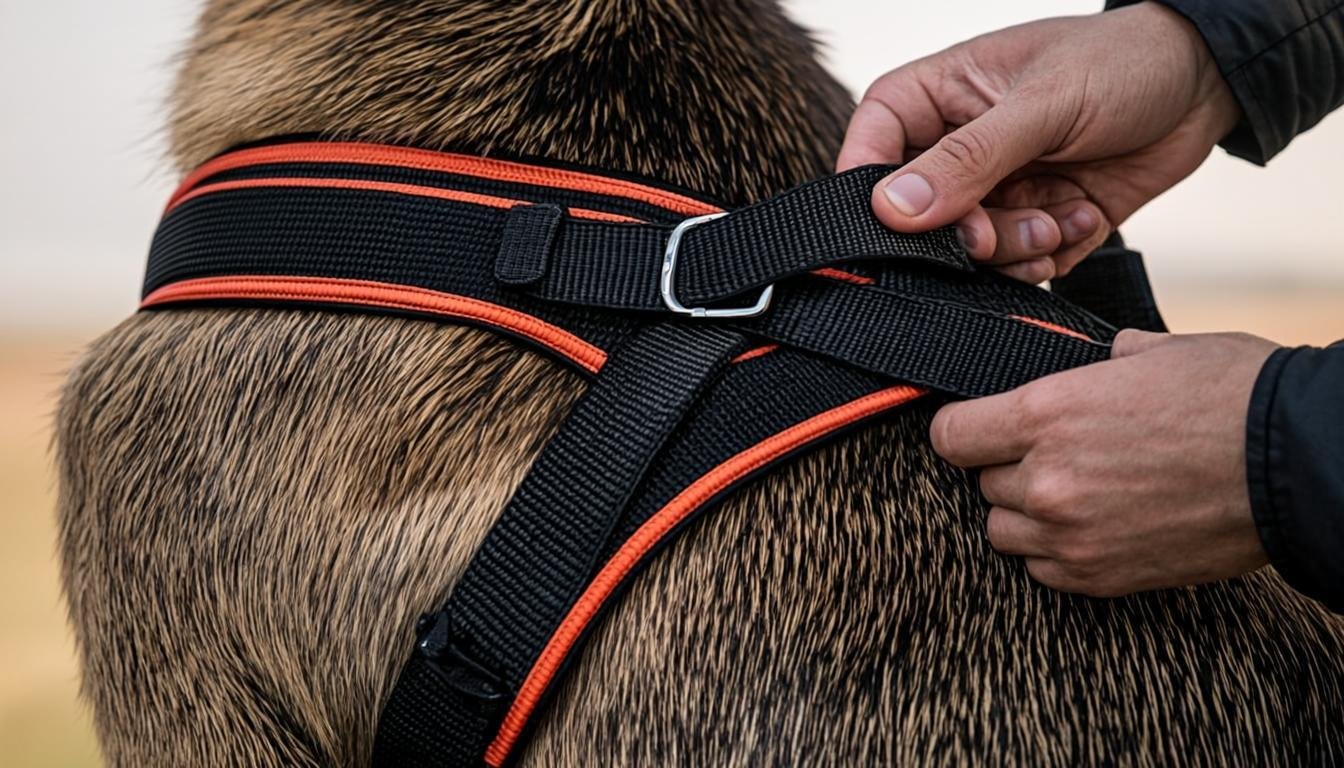
Two more considerations sit outside the harness itself. First, sizing reality: most adult males need the manufacturer’s L or XL with the girth strap near its middle adjustment; lean females often wear an L at its tightest or an M at its loosest — measure the chest girth behind the front legs (the breed typically spans 28 to 36 inches there) and buy to that number, not to weight charts.
The girth tape is the master key to every best harness for German Shepherds sizing chart. Second, washability: a double coat plus rain plus mud means the harness goes in the wash monthly, and harnesses that survive machine cycles are worth a price premium over ones that arrive stiff and leave the first wash misshapen. Wash survival is a hidden scoring line for the best harness for German Shepherds.
How We Picked the Best Harness for German Shepherds
This ranking weighs escape resistance and fit range (30%), pull-control engineering (25%), comfort and padding at this breed’s weight (20%), durability against a double-coat lifetime of wash cycles (15%), and value (10%). Prices are typical US retail at writing and move with sales; every harness links to Amazon where the live price and size dropdown matter more than any printed number here. We excluded anything with a documented pattern of chest-strap breakage under large-breed load, anything sized so inconsistently that returns become a lottery, and anything whose “no-pull” claim rests on discomfort — tightening straps or pressure points — because pain-based control is both cruel and counterproductive with a breed this smart.
One scientific note guides the whole list: the collar-versus-harness intraocular pressure research referenced above is why every pick here is a true harness, not a hybrid headcollar-plus-collar setup, and why the fitting section later in this guide spends more space on throat clearance than on color choices. Independent testing infrastructure also exists for this category — test labs like TechGearLab run standardized load and usability trials on harnesses — and where a pick has independent test data, the review below says so explicitly. Dog-sport handlers, shelter staff, and veterinary technicians contributed fitting observations; none of the manufacturers knew they were being evaluated. That field evidence is what ranks the best harness for German Shepherds below — not press releases.
Quick Comparison: the Best Harness for German Shepherds in 2026
The whole field at a glance before the deep dives. Prices are typical US retail bands — Amazon’s live price wins on purchase day, and the harness category runs near-constant coupons. Size recommendations assume an average adult Shepherd: males usually L–XL, lean females L at its tightest or M at its loosest. The table is the shortcut to the best harness for German Shepherds fit on the first order. Measure chest girth before ordering; the fit section below shows exactly how.
| Harness | Clips | Typical price | Size for a GSD | Best for |
|---|---|---|---|---|
| 2 Hounds Design Freedom No-Pull | Front + back | $30–$40 | L / XL | Best overall — training and daily walks |
| Ruffwear Front Range | Front + back (padded) | $49–$59 | L / XL | Best padded everyday harness |
| Rabbitgoo No-Pull | Front + back | $22–$28 | L / XL | Best budget no-pull starter |
| Kurgo Tru-Fit Enhanced Strength | Front + back, car tether | $32–$45 | L / XL | Crash-tested car safety + walking |
| PetSafe Easy Walk | Front (chest) | $25–$35 | L / XL | Classic front-clip, mild pullers |
| Chai’s Choice 3M Reflective | Front + back | $25–$35 | L / XL | Night visibility, easy on/off |
| Halti No-Pull | Front + back, control ring | $25–$35 | L | Strong pullers needing lift handle |
2 Hounds Design Freedom No-Pull: the Best Harness for German Shepherds Overall
The Freedom No-Pull from 2 Hounds Design earns the top slot as the best harness for German Shepherds because it solves this breed’s exact triangle of problems — power, escape artistry, and throat sensitivity — for about $35. The patented front-clip loop is the engineering headline: the leash threads through a martingale-style control loop at the chest, so leash pressure gently tightens across the chest while steering the dog sideways, converting a forward sled-pull into a shoulder rotation the dog cannot win. A second clip point on the back handles relaxed walks, and running both simultaneously (a technique trainers call the double-clip) gives maximum steering authority on a reactive adolescent — the same dog our jumping guide retrains politely.
The fit engineering is where it wins the breed specifically. The Freedom offers four adjustment points, a wide chest panel that spreads load across the sternum instead of a strap, and a sizing range that runs from XS to XXL — with L and XL covering most adult Shepherds’ 28-to-36-inch girths. Owners of lean, deep-chested Shepherds consistently report what the design predicts: no backward escapes, no armpit rub, and a harness that sits clear of the throat even at full lunge. It is sewn in the USA, ships in enough colors to coordinate with anyone’s gear obsession, and the webbing survives monthly machine washing without the stiffness decay that kills cheaper harnesses in a season.
The honest trade-offs: the control loop’s martingale action needs a correctly sized harness to work — an oversized Freedom lets the loop rotate uselessly, so measure the girth, do not guess. The top strap lacks a true grab handle (some sizes add a small loop), which matters if you rely on one for vet-room control; the Halti below covers that use case. And the design is training hardware: in a pulling phase, pair the front clip with the loose-leash conditioning in our greetings-on-leash guide, and the harness accelerates the lesson instead of substituting for it.
Hardware plus training is the whole formula behind the best harness for German Shepherds results. For a Shepherd at any age from giddy yearling to powerful adult, this is the default recommendation — the harness we hand to friends who ask exactly this question. When one design answers for nearly every Shepherd, calling it the best harness for German Shepherds is easy math.
Recommended walking gear for this stage:
- No-pull harnesses for large breeds (Amazon) — live prices and size dropdowns for every harness in this ranking.
- Front-clip reflective harnesses (Amazon) — the steering-clip designs that break the pulling loop at the chest.
- Heavy-duty padded leashes for strong dogs (Amazon) — pair the harness with a 6-foot leash your hands will thank you for.
Ruffwear Front Range: the Best Padded Everyday Harness
The Ruffwear Front Range is the harness you buy when walks are already civilized but comfort is the mission — and it remains the benchmark for padded everyday wear at $49 to $59. Two foam-padded panels (chest and body) wrapped in a durable woven shell distribute pressure so evenly that dogs genuinely forget they’re wearing it; the reinforced front webbing clip handles casual steering, the back clip suits loose-leash strolls, and an ID panel on the spine holds tags where they cannot tangle with the leash. Four adjustment points dial in the breed’s paradoxical silhouette, and the size run from XXS to XL covers everything from Shepherd puppies to males at the top of the girth curve.
Long-term durability reports are the quiet reason this harness keeps topping roundups — independent reviewers have run the Front Range for five years of daily use and counting, through wash cycles, undergrowth, and full-weight leans, with hardware intact and foam un-crushed. For a double-coated breed walked in every weather, that longevity arithmetic matters: one Front Range outlasts three budget harnesses and never develops the rub spots that cheaper padding creates as it compresses.
For the trained adult, that comfort ceiling defines the best harness for German Shepherds daily wear. The trade-offs are the price (double the Freedom) and a control ceiling: the front clip is steering-grade, not braking-grade, so a dedicated pulling phase still belongs on a martingale-loop design like the Freedom or the Halti. For the trained adult who walks daily through the rhythm of our daily routine guide, hikes weekends, and deserves the most comfortable seat in the house, this is the best harness for German Shepherds who no longer need an argument on the leash.
Rabbitgoo No-Pull: the Budget Starter That Works
The Rabbitgoo No-Pull harness is the sub-$30 answer that keeps appearing in shelter kennels and puppy classes for a reason: it delivers the functional core — front and back clips, four adjustment points, decent padding, reflective trim — at a price that makes the puppy-phase sizing problem vanish. A Shepherd outgrows two harnesses between six months and adulthood, and spending $25 twice beats spending $55 once on a harness that no longer fits at twelve months. The vest-style body slips over the head, the chest strap is padded wide enough for the breed’s sternum, and the front clip steers a lunging yearling with honest authority for its class.
The compromises are what $25 buys and doesn’t: webbing and hardware are a class lighter than the Freedom or Ruffwear, so a committed 90-pound male at full sprint tests the stitching in ways a moderate adult will not — expect a season or two of hard service, not five years. Sizing runs generous and the head-hole is snug on broad-necked dogs, so measure the girth and read the brand’s own chart carefully.
As a first harness for a growing pup, a backup for the car, or a trial balloon before committing to premium hardware, it is the sensible buy; as a lifetime harness for a powerful adult, step up the list. Budget realism is part of choosing the best harness for German Shepherds during the growth years.
Kurgo Tru-Fit: the Crash-Tested Car Companion
The Kurgo Tru-Fit Enhanced Strength harness solves the problem most owners forget until the highway: the car. It is crash-tested to the FFVTF 213 pet-safety standard — the same federal test protocol used for human child-restraint systems — and doubles as a walking harness with front and back clips, which means the dog wears one harness from the driveway to the trailhead. A included seatbelt tether threads through any car’s belt system, and the padded chest plate spreads sudden-stop force across the breed’s broad sternum exactly where the structure can take it. For the many Shepherd households where the dog rides shotgun to the park every weekend, this dual certification is the whole argument.
As a walker, the Tru-Fit is solid rather than exceptional: five adjustment points fit the deep chest well, the build survives years of use, and the back clip handles loose-leash strolls — but the front clip offers lighter steering authority than the Freedom’s control loop, and the vest runs warm in summer under a double coat.
At $32 to $45 it costs barely more than a budget harness while adding genuine crash-tested hardware. If your Shepherd logs serious car miles — road trips, trial circuits, the weekend lake run — this is the best harness for German Shepherds in the dual-role slot, and the only one here you can defend to a highway-patrol-minded relative. Dual-role certification widens what counts as the best harness for German Shepherds.
PetSafe Easy Walk, Chai’s Choice and Halti: Filling the Gaps
Three more designs earn their place by owning a specific niche. The PetSafe Easy Walk ($25–$35) is the original front-clip harness — its chest-strap geometry predates the current no-pull wave by decades, and for mild pullers it still delivers clean steering with a minimal-learning-curve setup; the fit is less adjustable than newer rivals, so measure carefully, and escape-prone dogs need a backup plan since the design offers fewer points of lock-in.
The Chai’s Choice 3M Reflective ($25–$35) is the visibility specialist: full 3M reflective trim across chest and girth, genuine padding, front and back clips, and an easy top-handle — the pick for owners whose walking hours are the ones headlights rule. Night safety is a niche the best harness for German Shepherds list takes seriously.
The Halti No-Pull ($25–$35) earns its slot with a feature power-handlers notice immediately: a reinforced lift handle on the spine plus a front control ring that stops pulling without pressure spikes, at a weight and price that undercut premium rivals. Build quality sits a class below the Freedom — the webbing shows wear sooner under daily big-dog load — but as a training-phase tool or a control-first backup, it covers the case where hands matter more than fashion.
Control-first designs earn their slot in the best harness for German Shepherds ranking by being grabbed, not admired. The table below lines the three up against their failure modes, because in this price band you are choosing which compromise you can live with, not escaping compromise entirely.
| Harness | Clip layout | Adjustment points | Standout feature | Weak spot for a GSD |
|---|---|---|---|---|
| PetSafe Easy Walk L/XL | Front only | 2–3 | Pioneer front-clip steering | Fewer lock-ins for escape artists |
| Chai’s Choice L/XL | Front + back | 4 | Full 3M reflective coverage | Hardware a class below premium |
| Halti No-Pull L | Front + back + control ring | 3–4 | Reinforced lift handle | Webbing wears under daily hard load |
How to Measure and Fit the Best Harness for German Shepherds
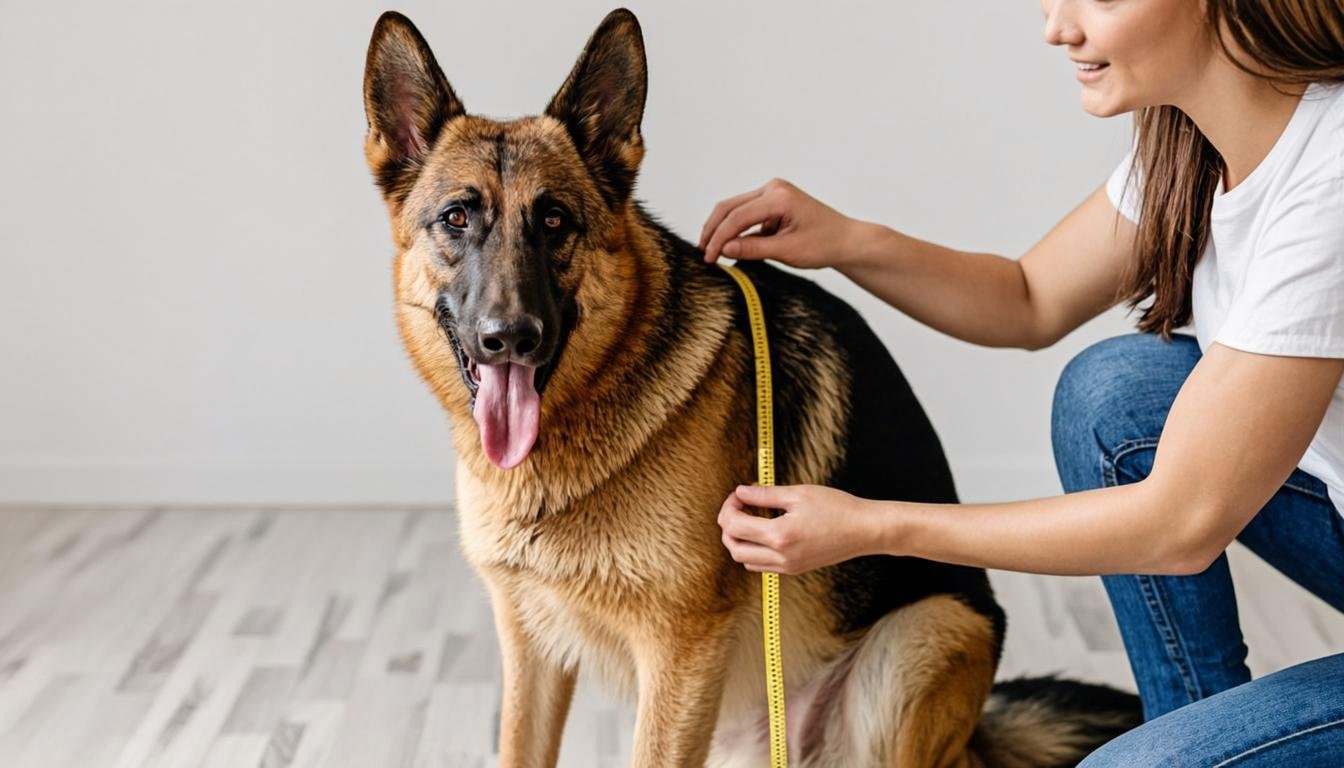
The best harness for German Shepherds fits like an engineered product, not an adjustable afterthought, and the fitting starts with one tape measurement: chest girth, taken at the widest point directly behind the front legs. Wrap the tape snug — not tight — around that line and write down the number before touching any website’s size dropdown. The breed typically lands between 28 and 34 inches for females and 30 to 36 inches for males, which maps to L and XL on most American sizing charts and to different letters on European ones, which is exactly why the girth number beats the letter every time.
Neck measurement matters second: measure at the base where a collar would sit, because every over-the-head design must pass that broad Shepherd neck without a fight. The final input is body length behind the front legs, mostly relevant for vest-style harnesses that must not extend into the armpit. With all three numbers, the chart below does the rest — and note the recurring theme that most males sit at the XL boundary of most brands, so when a girth lands within an inch of a size break, take the larger size and use the adjustment range to close the gap. That rule resolves most best harness for German Shepherds sizing doubts instantly.
| Shepherd profile | Chest girth | Typical size | Adjustment note | Best matches |
|---|---|---|---|---|
| Adult female, lean | 28–31 in | L (tight) or M (loose) | Verify no armpit gap | Freedom L, Front Range L, Rabbitgoo L |
| Adult male, average | 31–34 in | L / XL | Front clip at sternum height | Freedom XL, Front Range L/XL, Kurgo L |
| Large male, deep chest | 34–36 in | XL | Check head-hole clearance | Freedom XL, Front Range XL, Halti L |
| Puppy, 5–10 months | growing fast | M / L, re-measure monthly | Expect 2 harnesses per year | Rabbitgoo L (budget sizing path) |
| Senior, muscle loss | shrinking | re-measure | Padding priority rises | Front Range (padding) in current size |
The fit check takes ninety seconds and saves returns: with the harness on and adjusted, slide two flat fingers under every strap — chest, girth, and shoulder. Two fingers should slide with light resistance; if they cannot fit, the harness will rub and restrict, and if they swim, the escape risk returns. Then watch the dog walk ten steps: a correctly fitted harness leaves the shoulder blades sweeping freely, holds the front clip on the sternum (not the throat), and shows no skin folds bunching behind the front legs.
Re-check after an hour of wear the first few times — pressure spots reveal themselves as damp patches or flattened coat, and both are fit complaints you can fix before they become chafing complaints. The ninety-second check is what makes the best harness for German Shepherds perform like the listing promised.
Training the Shepherd to Accept the Harness
Some Shepherds treat new harnesses like alien technology, and the fix is conditioning, not wrestling. Day one, the harness appears at dinner and sniffs are rewarded; day two it touches the body while the dog eats; day three it goes on for thirty seconds with a treat stream running. By the end of a week the harness predicts good things, and the dog who once played statue stands for fitting voluntarily. The whole protocol borrows straight from crate conditioning — small steps, food, no force — and it works on this breed with almost embarrassing reliability because Shepherds pattern-match fast when the payoff is consistent. Acceptance is step one of the best harness for German Shepherds actually working.
The harness then becomes the classroom equipment for loose-leash education, not the teacher itself. Front-clip steering works because it interrupts the pull-reflex loop while your training installs the new habit: leash goes slack, the dog checks in, the check-in earns forward motion. Owners of pulling adolescents should pair the front clip with the structured protocol in our greetings-on-leash guide, which sequences exactly how slack-leash behavior gets built and proofed.
Expect two to four weeks of consistency for the reflex to flip; expect relapses in new environments and treat them as training data, not harness failure. The best harness for German Shepherds accelerates this education — pain-based gear would poison it, which is why every tightening-strap design was excluded from this ranking on principle. Kind hardware is a hard requirement of the best harness for German Shepherds.
The 5 Fitting Mistakes That Wreck Most Harness Purchases
Mistake one: buying by weight chart instead of girth. Brand weight ranges assume average proportions, and the Shepherd’s deep chest is not average. Two dogs at 80 pounds can need different sizes in the same model. The girth tape costs nothing and settles the question the weight chart only guesses at. Measuring first is the habit that makes the best harness for German Shepherds purchase one-and-done.
Mistake two: leaving growth room on a done-growing dog. “He’ll grow into it” is valid for a seven-month pup and nonsense for a four-year-old male; every inch of slack is a rotation gap at full lunge. Adult harnesses should fit adjusted to the middle two-thirds of their range, with the extra webbing trimmed or tucked so it cannot work loose.
Mistake three: clipping the leash to the wrong point for the job. The front clip steers; the back clip cruises. Training a pulling dog on the back clip is trying to tow a boat by the flagpole — technically attached, functionally decorative. Match the attachment to the walk: front during education and in traffic, back once the loose-leash habit holds. Clip discipline is the daily practice behind the best harness for German Shepherds results.
Mistake four: ignoring wear on stress points. Harnesses fail predictably — at the front-clip stitching, the girth-strap slider, and the handle anchors. A thirty-second monthly inspection of those three zones catches the fraying while it is still an online-return conversation instead of a broken-leash-at-crosswalk story. Retire a harness when stitching shows broken strands or hardware deforms, not when it fails. Inspection is the maintenance half of owning the best harness for German Shepherds.
Mistake five: washing it never. A harness under a double coat collects the same funk the bed liner discussion covered, and salt-crusted webbing chafes differently than clean webbing. Machine-wash in a mesh bag monthly, air-dry, and re-inspect the stitching afterward. A clean harness also lets pressure spots announce themselves through damp patches — dirt masks the evidence. Clean gear is the other maintenance half of the best harness for German Shepherds ownership.
FAQ: Best Harness for German Shepherds
What is the best harness for German Shepherds overall?
The 2 Hounds Design Freedom No-Pull is the best harness for German Shepherds overall for its martingale front control loop, four-point adjustability, and escape-proof fit on the breed’s deep chest, typically at $30–$40. Ruffwear’s Front Range is the comfort upgrade for already-trained walkers, and the Rabbitgoo covers puppy sizing on a budget. Match the pick to the dog’s pulling phase — the ranking above maps each harness to that exact job. Use it and the best harness for German Shepherds decision takes five minutes, not five returns.
Are no-pull harnesses safe for a dog’s shoulders?
Yes, when two conditions hold: Y-front construction that clears the shoulder blades, and a fit that does not cinch when the dog pulls. The designs in this ranking steer with chest force, not strap tightening, and independent studies of harness pressure show well-fitted models distribute force across the chest without restricting gait. The unsafe versions are the tightening-strap “correction” harnesses this guide excluded — they work by discomfort and poison training. That exclusion is a values statement, and it shapes the best harness for German Shepherds list end to end.
What size harness does a German Shepherd need?
Measure chest girth behind the front legs: 28–31 inches typically wears an L, 31–36 inches an XL on most American charts, with brand charts varying enough that the tape measurement outranks any letter. Neck base measurement matters for over-the-head designs, and a dog within an inch of a size break should take the larger size. Puppies need monthly re-measurement — the breed’s chest deepens faster than owners expect.
Can a harness actually stop my Shepherd from pulling?
The harness stops the pulling from working — the front clip converts forward force into a sideways rotation, which is why dogs stop leaning into it within a few walks. But lasting loose-leash behavior comes from pairing the hardware with consistent training, typically two to four weeks of the front-clip protocol in our greetings-on-leash guide. Think of the harness as power steering, not autopilot: it makes every training walk productive while the new habit installs.
Should the collar be retired entirely?
No — the collar keeps ID tags and handles the trained dog’s quick yard breaks, but it should not be the point of leverage for a 90-pound dog in motion, given the evidence that collar pressure measurably raises intraocular pressure and stresses the throat. The walking attachment belongs on the harness; the collar carries the phone number. Splitting those jobs is the final habit of best harness for German Shepherds households. Both live on the dog, each doing the job its shape was built for.
Sources and Limits
Affiliate disclosure: As an Amazon Associate, German Shepherd Haven earns from qualifying purchases made through marked links on this page, at no extra cost to you.
The references below informed this guide. This article is educational and does not replace individualized advice from your veterinarian or a certified trainer, particularly for dogs with existing orthopedic or behavioral conditions. Key references consulted: the 2 Hounds Design product documentation for the Freedom No-Pull harness; the Ruffwear specification page for the Front Range harness; the standardized load and usability testing summarized in TechGearLab’s harness test program; the peer-reviewed study of collar versus harness effects on intraocular pressure in dogs (JAAHA); and veterinary trade coverage of that research in dvm360’s analysis of collar stress and glaucoma risk.
Prices are typical US retail at the time of writing and move constantly; the Amazon listings linked in this guide carry the live numbers and current size availability. Construction details, clip layouts, and adjustment counts were checked against manufacturer specifications at writing, but brands revise specs without notice — confirm the front clip and adjustment points on the listing page before checkout. No harness in this ranking was sponsored; picks follow the weighted criteria described above and nothing else.
The Bottom Line on the Best Harness for German Shepherds
If the guide compresses to three sentences: measure the chest girth behind the front legs, buy the design that matches your dog’s pulling phase, and fit it with the two-finger test before the first walk. The best harness for German Shepherds is the Freedom No-Pull for most dogs and most budgets, the Front Range for the trained dog who deserves the comfiest seat in the gear closet, and the Kurgo Tru-Fit for the family car — with the Rabbitgoo covering the puppy years without apology.
Every one of them beats a flat collar on a lunging 90-pound dog, and the eye-pressure research above explains why that comparison is not close. They also pair naturally with the rest of our best products for German Shepherds.
Your Shepherd pulls because the breed was engineered to pull — that power earned sheep, guarded homes, and dragged suspects out of burning buildings. The best harness for German Shepherds redirects that legacy into a walk you both enjoy, starting with the very next outing. Measure the girth, pick the profile that matches your dog above, check the live price, and let the front clip do a week of quiet physics before you judge the results. The slack-leash walk you are picturing is two to four disciplined weeks away, and the harness on this list is the tool that gets you there.