
Quick Answer: A safe German Shepherd puppy feeding schedule follows four measured meals per day from 8 to 12 weeks, three meals from 3 to 6 months, and two meals from 6 months onward. Use a complete large-breed puppy growth formula (with controlled calcium capped at 1.8% dry matter) until roughly 18 months of age, adjusting portions every two weeks so your puppy stays lean rather than chasing rapid weight gain.
Setting up a consistent German Shepherd puppy feeding schedule is one of the highest-impact decisions you can make for your dog’s adult hips, elbows, and stomach. Because a GSD multiplies its birth weight dramatically over its first year, overfeeding calories or minerals during growth can push bone development faster than developing joints can safely support.
Why Large-Breed Puppy Geometry Changes How You Feed
German Shepherds are classified by veterinary nutritionists as a large working breed—dogs expected to reach or exceed 70 pounds (32 kg) at maturity. Unlike small-breed puppies that finish skeletal growth around 9 to 12 months, a Shepherd’s long-bone growth plates remain open until 15 to 18 months.
According to VCA Animal Hospitals’ large-breed nutrition guidelines, large-breed puppies should stay on an appropriate large-breed growth formula until about 18 months of age rather than switching early to adult maintenance food or standard all-breed puppy kibble.
Two nutritional guardrails matter more than marketing claims on the front of the bag:
- Controlled Calcium Ceiling: Puppies cannot down-regulate intestinal calcium absorption the way adult dogs do. As Whole Dog Journal notes, AAFCO caps calcium in large-breed puppy growth diets at 1.8% on a dry-matter basis (compared with up to 2.5% for smaller breeds), alongside an ideal calcium-to-phosphorus ratio of 1.1:1 to 1.4:1.
- Lean Growth Pace: Feeding excess calories does not make a puppy grow into a bigger adult—it simply accelerates growth speed, putting extra mechanical load on soft cartilage. Pair your feeding plan with an AAFCO-aligned diet from our best dog food for German Shepherds guide.
Stage-by-Stage German Shepherd Puppy Feeding Schedule
Because kibble calorie density varies widely between brands (typically 340 to 430 kcal per cup), always treat bag charts as a starting estimate and weigh portions on a gram scale when possible. Split the daily total evenly across the meals below.
| Puppy Age | Meals Per Day | Typical Sample Times | Formula Requirement | Key Focus at This Stage |
|---|---|---|---|---|
| 8–12 Weeks | 4 meals | 7:00 AM, 11:30 AM, 4:00 PM, 8:00 PM | AAFCO Large-Breed Puppy | Steady blood sugar, gentle hydration (warm water soak optional), stool monitoring |
| 3–6 Months | 3 meals | 7:00 AM, 1:00 PM, 7:00 PM | AAFCO Large-Breed Puppy | Rapid teething and height spurt; keep portions measured as appetite surges |
| 6–12 Months | 2 meals | 7:30 AM, 6:30 PM | AAFCO Large-Breed Puppy | Transition to adult meal rhythm; monitor lean waist closely after spay/neuter |
| 12–18 Months | 2 meals | 7:30 AM, 6:30 PM | Large-Breed Puppy → Adult (at ~15–18m) | Muscle fill-out phase; transition gradually over 7–10 days once growth plates close |
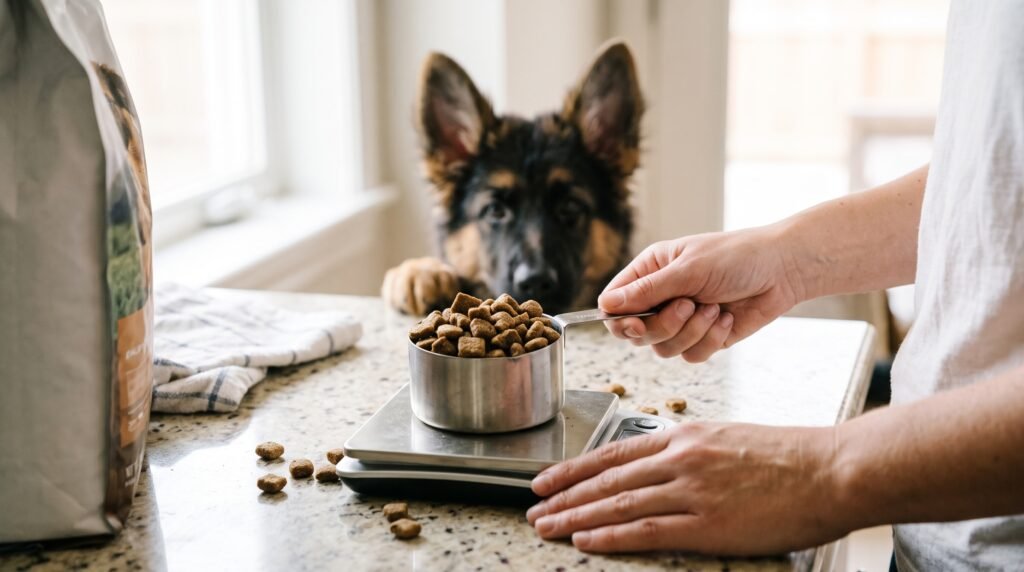
| Caption: Weighing daily kibble portions prevents accidental overfeeding during rapid adolescent growth spurts.]
How to Adjust Portions Using Body Condition (Not Just Bag Labels)
A reliable German Shepherd puppy feeding schedule adjusts to the dog standing in front of you, not a generic weight chart. Every two weeks, check your puppy against the 9-point WSAVA Body Condition Score Chart for Dogs, aiming for a 4 to 5 out of 9:
- Rib check: Run your flat palms lightly along the ribcage. You should feel each rib easily beneath a thin layer of skin without pressing hard, while the ribs remain invisible at rest.
- Overhead waist check: Looking down from above, your puppy should show a visible inward tuck behind the ribs before the hips.
- Side profile tuck: Viewed from the side, the belly should slope gently upward toward the hind legs rather than hanging flat.
If the ribs become hard to feel, cut the daily ration by 10% (and audit training treats so they stay under 10% of total daily calories) before re-checking in 14 days.
Five Common Feeding Mistakes That Hurt Growing Shepherds
- Free-feeding (leaving the bowl down all day): Free-choice feeding encourages overeating, masks early appetite loss if your puppy gets sick, and makes house-training schedules unpredictable. Pick the bowl up after 15 to 20 minutes.
- Adding extra calcium powder, cottage cheese, or bone meal: Never supplement calcium on top of a complete AAFCO large-breed puppy diet. Excess dietary calcium is linked to developmental orthopedic issues.
- Skipping post-meal rest: Deep-chested breeds like German Shepherds are predisposed to gastric dilatation-volvulus (GDV, or bloat) as they mature. Build a lifelong habit early: enforce 45 to 60 minutes of calm crate or mat rest after every meal before rough play or fetch.
- Changing foods abruptly: Sudden kibble switches commonly trigger loose stools in sensitive Shepherd guts. Transition over 7 to 10 days (25% new food for 3 days, 50% for 3 days, 75% for 3 days). If mild digestive upset persists during normal transitions, discuss gut support with your vet alongside our best probiotics for German Shepherds overview.
- Over-relying on joint pills instead of lean weight: No supplement can outwork excess body fat on growing hips. Keep your puppy lean first, and review evidence-based mobility support in our best joint supplements for German Shepherds guide only with veterinary guidance.
When to Call Your Veterinarian
Normal puppy hunger fluctuates slightly during teething or growth plateaus, but contact your veterinarian promptly if you notice any of the following red flags:
- Refusing two consecutive meals (or any meal refusal paired with lethargy in a puppy under 16 weeks).
- Repeated vomiting, watery or bloody diarrhea, or pale, greasy, unusually voluminous stools.
- Sudden limping, stiffness after resting, or reluctance to climb stairs during a growth spurt.
- Unproductive retching, restlessness, or a tight, distended abdomen after eating (treat as an immediate emergency).
Practical Takeaway
Stick to a structured German Shepherd puppy feeding schedule—four meals until 12 weeks, three until 6 months, and two thereafter—using an AAFCO large-breed growth formula until 18 months. Measure every cup or gram, skip extra calcium supplements, enforce calm post-meal rest, and let a lean WSAVA score of 4–5/9 guide every portion adjustment.
Frequently Asked Questions About a German Shepherd Puppy Feeding Schedule
How much should a 3-month-old German Shepherd puppy eat?
Most 12-week-old German Shepherd puppies eat between 2 and 3 cups of large-breed puppy kibble per day, split across three measured meals. Because calorie density varies by brand, check the kcal-per-cup line on your bag and confirm your puppy’s ribs remain easy to feel without excess fat.
When should I switch from puppy food to adult food?
Keep your dog on a large-breed puppy formula until 15 to 18 months of age, when long-bone growth plates finish closing. Transition gradually over 7 to 10 days to avoid digestive upset while keeping your German Shepherd puppy feeding schedule at two meals per day.
Should I use a raised bowl for my German Shepherd puppy?
Most veterinary guidelines advise against elevated bowls for deep-chested breeds unless a veterinarian specifically recommends one for a medical condition like megaesophagus. Feeding from a floor-level bowl—or a slow feeder if your puppy gulps kibble—paired with 45 to 60 minutes of post-meal rest is the safer habit.