
Why greetings on leash need training
Greetings on leash are where many walks go wrong: a friendly dog rushes over, leashes tangle, and suddenly two relaxed dogs are behaving like strangers. Calm, controlled greetings on leash are a trainable skill, and German Shepherds learn them well with the right structure. This guide covers body language, distance management, six core techniques, a step-by-step plan, and realistic scripts for the encounters you will actually meet on the sidewalk.
Why safe on-leash greetings matter
Leashes change how dogs communicate. A dog that would normally move away or shift body language when loose may feel trapped or frustrated on a leash. That restricted movement can increase stress, raise arousal, and sometimes cause tense or reactive behavior. Safer greetings reduce the chance of escalation, keep both dogs and people comfortable, and help you maintain control of the situation so your walk remains enjoyable. Polite greetings on leash are a learned skill, not a personality trait.
Reading German Shepherd body language
Before attempting any greeting, learn to read your dog’s signals. German Shepherds give subtle cues:
- Relaxed posture, loose mouth, normal panting — comfortable and approachable.
- Stiff body, closed mouth, intense stare, raised hair along the back — heightened arousal or possible discomfort.
- Turning head away, lip licking, yawning, moving backward — signs your dog may want more space.
Watching both dogs in a potential greeting is essential. If either dog shows signs of stress, increase distance or skip the interaction. Teaching your dog self-control and offering clear alternatives to direct greeting lowers risk. Learning to read these signals is half of what safe greetings on leash require.
Preparing before you head out
Preparation reduces surprises. Before a walk, consider these points:
Recommended gear for this stage:
- Front-clip no-pull harnesses (Amazon) — steering control without throat pressure.
- Clip-on treat pouches (Amazon) — rewards ready the moment your dog disengages.
- Hands-free leashes (Amazon) — stable leash position for parallel-walking drills.
- Leash and collar choice: Use a secure, comfortable collar or harness and a leash length that allows control without restricting movement. Avoid recommending force-based tools; choose gear that supports safe handling and reward-based training.
- Handler readiness: Practice calm body language, clear voice cues, and consistent reward timing. Your energy sets the tone.
- Treats and rewards: Bring high-value, small treats or a favorite toy for reinforcement. Timing matters — reward the behavior you want.
- Route planning: Choose less crowded paths if you expect your dog needs more distance to stay calm. Scanning ahead gives you options to change direction before an encounter becomes close.
For foundational skills that support safe on-leash behavior, review trusted training and behavior foundations before beginning focused greeting work. Solid basics make greetings on leash dramatically easier to teach.
Six core techniques for calmer greetings on leash
Several humane, evidence-based techniques reduce stress during encounters. Use them together rather than relying on a single trick.
Distance management (thresholds)
Most dogs improve if they can observe another dog or person from a comfortable distance where they remain calm. Identify your dog’s threshold — the distance where noticing another dog causes minimal reaction — and keep the approach at or beyond that point. Gradually and consistently decrease distance only as long as your dog stays calm. Distance is your best tool for keeping greetings on leash positive.
Focus and attention cues
Teach a reliable attention cue such as “watch me” or a hand target so your dog can look to you for guidance instead of escalating toward the other dog. Reward focus immediately with high-value treats, then release and allow relaxed exploration if appropriate. Attention cues are the steering wheel of greetings on leash.
Counterconditioning and desensitization
Counterconditioning pairs the appearance of a person or dog with something pleasant (treats, praise) so your dog learns to expect good things instead of reacting. Desensitization slowly increases exposure from safe distances over many short, positive sessions. Pairing this with calm greetings on leash builds better associations than forcing contact ever could.
Redirection and alternative behaviors
Train and reward alternative, incompatible behaviors such as a sit, loose-leash walk, or a recall to replace forward lunging. Rewards for the calm alternative make it more attractive than the rush to greet. Alternative behaviors give your dog a script for greetings on leash that does not involve lunging.
Parallel walking and neutral greetings
Instead of face-to-face approaches, practice parallel walking: two dogs walk side-by-side at a comfortable distance for a short period, then move apart. If you try a brief face-to-face greeting later, keep it calm, short, and optional for both dogs. Parallel walking is the lowest-pressure way to practice greetings on leash.
Step-by-step training plan for on-leash greetings
Below is a progressive, sample plan for practicing safer greetings. Adapt timing, distances, and rewards to your dog’s comfort level.
Step 1: Build focus in low-distraction settings
Start indoors or in a quiet yard. Teach “watch me” or a look cue using treats. Reward immediately when your dog makes eye contact. Short sessions (5–10 minutes) repeated daily work best. Focus first; greetings on leash fail when attention is optional.
Step 2: Add movement and mild distractions
Practice the focus cue while walking in low-traffic areas. Reinforce loose-leash walking and add brief sits or “look” moments when a passerby appears. Keep rewards frequent and high-value. Movement plus mild distraction is where greetings on leash start feeling real.
Step 3: Introduce distance-controlled exposure
Find a calm dog or a cooperating friend with their dog at a distance beyond your dog’s threshold. Reward your dog for staying calm while they notice the other dog. Slowly reduce the gap across multiple sessions, never forcing proximity. This staged exposure is what keeps greetings on leash safe for both dogs.
Step 4: Practice brief, voluntary greetings
When both dogs show relaxed body language at a comfortable distance, allow a short, controlled greeting. Keep throws of praise and then separate to reinforce voluntary, calm interactions. If either dog becomes tense, end and increase distance for the next trial. Brief and boring wins; greetings on leash should never feel like an event.
Step 5: Generalize to real walks
Gradually apply these skills during regular walks. Use distance management and attention cues before passersby approach too closely. If you struggle to progress, slow down and return to the previous step until your dog is consistently calm. Generalization is the final exam for greetings on leash.
Managing reactive or tense encounters
Even with training, some encounters will become tense. Prepare for those moments with safety-first responses: Even well-trained greetings on leash need an exit plan.
- Prioritize distance: Move away or change direction calmly to increase space before tension escalates.
- Use management tools: A short, non-restrictive leash hold or stepping in front to create body blocking can add safety without force. Avoid recommending punitive tools or harsh corrections.
- Keep the encounter brief: Short, calm recoveries are better than prolonged standoffs that increase arousal.
- De-escalation cue: Teach a reliable recall or a “let’s go” cue so you can exit quickly when needed.
For dogs showing strong leash reactivity — persistent lunging, barking, or aggressive signals — consult resources developed for professionals and handlers. The ASPCA’s guidance on managing and training leash-reactive dogs is a useful, practical reference for humane strategies and safety planning: ASPCApro: Managing and Training Leash-Reactive Dogs.
When controlled greetings are appropriate
Not every dog or situation is suitable for a face-to-face greeting. Controlled greetings may be appropriate when:
- Both dogs show relaxed, loose body language and voluntary interest.
- Handlers are calm, prepared, and able to manage distance and rewards.
- The environment is neutral, not one dog’s territory or near high-value resources.
If one or both dogs are uncertain, fearful, or over-aroused, skip the greeting and opt for parallel walking or a friendly wave from distance. Keeping greetings optional and under the dogs’ control prevents forced interactions that can create lasting negative associations. Voluntary contact is the gold standard for greetings on leash.
Working with professionals and walkers
Some situations call for outside help. If your German Shepherd struggles with on-leash greetings despite consistent, reward-based practice, seek a certified behavior professional who uses positive reinforcement. A qualified trainer can build a personalized plan, troubleshoot setbacks, and guide safe real-world practice. Ask walkers directly how they handle greetings on leash before hiring.
If you hire a dog walker or use a walking service, communicate your dog’s greeting preferences and management plan clearly. Consider professional help for regular walks if you need consistent, experienced support; local options can help maintain training and safety during daily outings. For those who want assistance with walks and behavior management, look into professional walking support that understands humane management and training methods.
Professional organizations provide position statements and handouts on ethical, science-based approaches to animal behavior and training. These resources can help you evaluate trainers and methods: AVSAB: Position Statements and Handouts.
Real-world greetings on leash: examples and scripts
Below are three brief, practical scripts you can adapt for common walk situations.
Scenario 1: Passing a friendly dog at distance
- Spot the other dog while still far away and prepare by holding treats.
- Ask for a brief “watch me” and reward calm eye contact as the other dog approaches.
- Maintain a comfortable distance; praise and treat intermittently as you pass.
- If your dog stays calm, release with an enthusiastic marker and continue walking.
Scenario 2: Another dog approaches suddenly
- Turn your body slightly away to avoid direct face contact and step calmly to increase space.
- Use a recall or “let’s go” cue to move your dog away while rewarding calm movement.
- Once at a safe distance, allow your dog to re-engage with focus training before resuming the walk.
Scenario 3: A calm, controlled greeting opportunity
- Confirm both dogs are relaxed and handlers agree on a short greeting.
- Approach parallel at a comfortable distance, reward calm walking, and slowly close to a brief sniff. Count-to-three contact is the sweet spot for greetings on leash: long enough to be real, short enough to stay safe.
- Limit the greeting to a few seconds, then guide both dogs apart with a positive cue and treat for calm behavior.
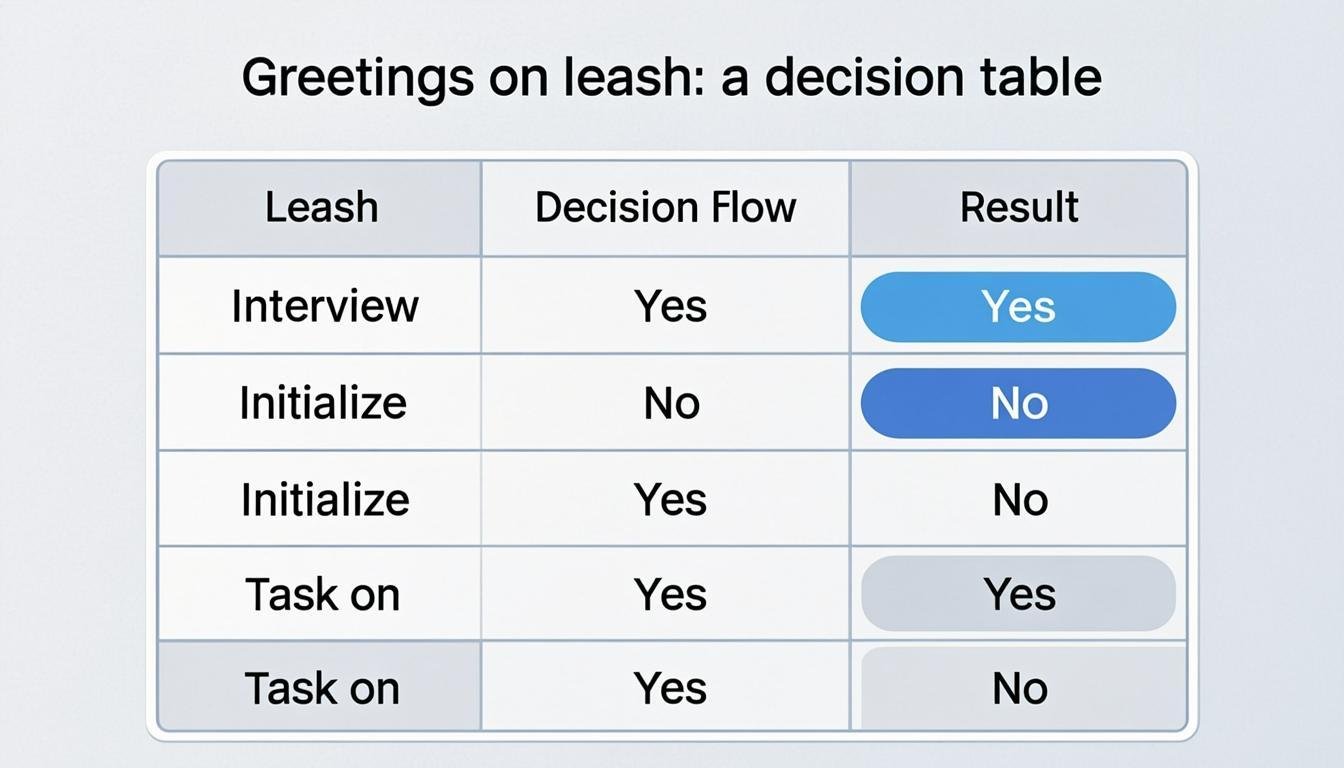
Greetings on leash: a decision table for common scenarios
Every sidewalk encounter asks the same question — greet or pass? — and answering it in the moment is hard when a dog is bouncing at the end of a leash. This decision table turns greetings on leash into a repeatable checklist. Read it before walks until the flow becomes instinct, and share it with whoever else walks your Shepherd, because greetings on leash only stay safe when every handler applies the same rules.
| Scenario | Green lights (greet) | Red lights (pass) | How to pass smoothly |
|---|---|---|---|
| Calm dog, aware handler | Loose bodies, curved approach, both handlers agree | Any stiffness, staring, or hesitation | Arc widely, reward focus, keep moving |
| Excited puppy rushing over | Rarely a true green light | Uncontrolled approach, tangled risk | Step off-line, ask for sit, let puppy pass |
| Leashed dog dragging handler | Almost never | No handle on the other end | Create distance fast, use “let’s go” cue |
| Loose dog approaching | Never on a first meeting | No leash, no handler control | Block, toss treats past, leave the path |
| Reactive dog across the street | No contact needed | Visible stress at distance | Cross early, reward calm noticing |
| Familiar play partner | Both dogs settled, space allows parallel start | Either dog frustrated or jumping | Parallel walk first, then brief contact |
The table’s pattern is worth noticing: most greetings on leash fail not because dogs are unfriendly but because control is missing somewhere in the picture. Control can be absent on either end — a dragging handler is as risky as a bouncy Shepherd. When in doubt, passing is always a win; there is no quota for greetings on leash, and a dog that happily passes twenty dogs to greet two well-chosen ones is a dog having excellent walks.
Use the pass column as actively as the greet column. Practicing smooth passes with reward chains builds exactly the disengagement muscle that greetings on leash depend on, so even the no-contact walks are training. Owners who master the pass often find their dogs become calmer greeters too, because every walk carries the same message: you do not need every dog, and that is a relief, not a loss.
Teaching kids and guests the sidewalk rules
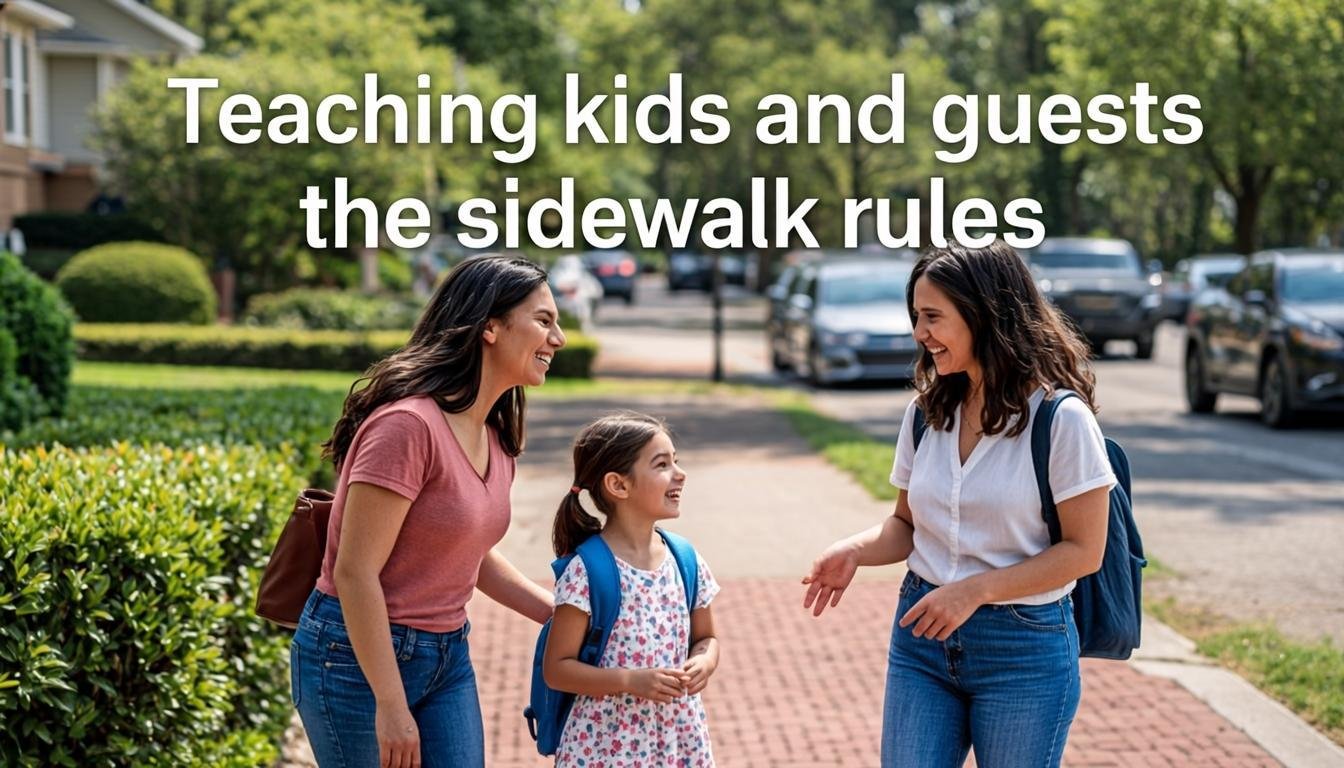
Family members are part of the training environment whether you plan for them or not, so a household briefing multiplies your progress with greetings on leash. Children especially need clear, rehearsed rules, because a child running toward a leashed dog can flip a calm encounter into chaos in seconds. The rules are short enough for a fridge poster and strict enough to matter.
- Ask the handler, then the dog. No one touches a dog on leash — even a familiar one — without both permissions. This single rule prevents most greeting accidents with kids.
- No running toward, squealing at, or hugging. Calm sideways approaches and brief strokes under the chin are the safe pattern; hugs are for pillows, and greetings on leash stay brief by design.
- Feet stay still while the dog approaches. Children stand like trees with hands relaxed. A moving child triggers chase and herding instincts in exactly the dogs that most want to greet politely.
- Guests skip greetings entirely at first. Your dog’s manners rehearse cleaner when visitors simply ignore the dog for the first minutes; excitement is the enemy of good greetings on leash.
Rehearse the rules as a game. Children who earn a small reward for spotting “green light” dogs on walks become spotters instead of improvisers, and their judgment about greetings on leash improves shockingly fast. Our guide on German Shepherds and children“>German Shepherds with children expands on the household side of dog-child safety, and the scripts below give every family member the same words to use.
Consistency across humans is the hidden variable in all of this. A Shepherd who hears “go say hi” from one person, “leave it” from another, and nothing from a third is being trained by committee into confusion. Pick your cues for greetings on leash, write them down, and let every walker and family member use exactly those words in exactly those moments — the dog’s clarity is built from your household’s uniformity.
Sidewalk greetings vs. off-leash play: what actually changes
Owners often notice their dog greets beautifully at the park but turns into a freight train on the sidewalk, or vice versa, and the difference confuses everyone. The mechanics differ in three ways, and understanding them fixes the mystery. Greetings on leash happen in tight space, with tension physics, and under social contract; off-leash play happens with escape routes, slack, and self-selection. Each difference changes the dog’s options — and your job.
Leash tension is the biggest factor. A taut leash transmits your micro-tensions down six feet of nylon and removes the arc-and-approach body language dogs use to signal good intentions, so two friendly dogs can misread each other purely because of hardware. That is why the techniques in this guide favor slack lines, curved paths, and parallel starts: they restore the missing vocabulary. Greetings on leash done this way look nothing like the face-to-face collision most owners grew up believing was normal.
Space and choice come next. Off-leash dogs can leave; leashed dogs cannot, which is why a cornered-feeling dog can escalate faster than the same dog in a field. Keeping greetings on leash in open sightlines, with handlers standing at angles rather than blocking the path, preserves the sense of exit that keeps everyone polite. Duration completes the picture: a park acquaintance lasts minutes, while sidewalk greetings on leash should last seconds. Short, sweet, and finished while both dogs still want more is the formula that keeps tomorrow’s greeting easy.
If your dog handles playdates but struggles specifically on leash, the issue is rarely sociability — it is arousal plus restraint. Train the sidewalk as its own skill using the step-by-step plan above, and treat our German Shepherd aggression training guide“>aggression guide as reference reading only if true reactivity appears. Most Shepherds convert quickly once the leash stops distorting the conversation, and our broader German Shepherd training and behavior guide“>training guide supplies every foundation these lessons assume.
FAQ: greetings on leash
Should my dog greet every dog we meet?
No — and wanting to is itself a training target. Selective greetings on leash with smooth passes build better walk skills than a contact-everything policy, and they keep your dog’s play standards high.
How long should greetings on leash last?
Two to five seconds of contact, then move apart and re-engage your dog. If both dogs re-approach willingly, a second brief exchange is fine. Endings matter more than beginnings in greetings on leash.
My dog is friendly but screams when refused a greeting. What do I do?
That is frustration-based reactivity, and the fix is rehearsing passes with heavy rewards at increasing distances. Greetings on leash become optional rather than mandatory in your dog’s mind, and the vocal protests fade as passes get paid.
Are retractable leashes okay for greetings?
They are the worst tool for the job: constant tension, line burn risk, and no quick control. Standard 6-foot leashes make greetings on leash predictable, and predictability is the whole game.
Can two dogs on leash learn to walk together?
Yes — parallel walking is the best-kept secret of greetings on leash. Start ten feet apart in the same direction, shrink the gap only if both dogs stay loose, and finish with a brief face sniff if everyone is still relaxed.
Equipment and setup choices that make greetings easier
The right gear does not train your dog, but the wrong gear reliably sabotages greetings on leash. Before the next training cycle, audit your walking kit against the list below — every item either buys you control in the two seconds that matter or quietly removes it. None of this requires spending much; it requires matching equipment to the job you are asking it to do.
The leash. A standard six-foot leather or biothane leash is the gold standard for greeting work. Retractables fail twice — constant tension teaches pulling, and the thin cord offers no steering — so park them for training walks. Check the clip: a stiff carabiner that takes two hands to operate costs you reaction time at exactly the wrong moment. Shorter five-foot leashes give even tighter control for reactive phases, and many trainers drop to four feet for the first month of dedicated greeting work.
The attachment point. A flat collar works for dogs with loose-leash skills; a well-fitted front-clip harness buys steering for the rest. Front clips turn chest pressure into a gentle pivot, which changes the geometry of an encounter — your dog physically rotates toward you instead of torpedoing forward. Avoid head halters for greeting practice unless already conditioned; they restrict the natural body language both dogs need to read, which can make two friendly dogs misread each other purely through hardware.
The treat delivery. Rewards arrive within a second or they reward the wrong thing, so carry them somewhere one hand can reach without fishing. A magnetized waist pouch beats a pocket, and soft pea-sized pieces beat crunchies that scatter and stall attention. Some owners pre-load a handful before every walk; others keep a jar by the leash hook. The specific system matters less than the consistency — greetings on leash improve fastest when the payment infrastructure never fails. Freeze-dried liver, cheese cubes, and chicken are the classics for a reason.
The environment choices. Setup extends beyond equipment to routes. For the first month of training, favor wide paths, visible sightlines, and the quieter hours your neighborhood offers, because every avoided ambush is a kept streak of calm encounters. Where you meet confident, leashed demo-dogs — a training class, a friend’s settled adult — stage the structured greetings from the step-by-step plan rather than trusting luck. The RSPCA dog behaviour library reinforces the same principle: control the environment first, train the skill second.
One last habit worth building: the pre-walk checklist. Thirty seconds before leaving — leash checked, pouch loaded, route chosen, cues rehearsed in your head — measurably improves how the first encounter of the walk goes, because the first encounter sets the tone for the rest. Handlers who start walks organized give their dogs a model of steadiness to copy; handlers who burst out the door inherit whatever energy spills into the street. Greetings on leash are a team performance, and teams warm up.
Budget note for skeptical beginners: the entire upgrade path here costs less than one pair of premium walking shoes. A six-foot biothane leash, a front-clip harness in the correct size, and a waist pouch together usually run under sixty dollars, and each item earns its keep from the first walk. What you should not buy yet is anything punitive or gimmicky — no spray collars, no yanking gadgets, no vibration remotes — because greeting problems are communication problems, and communication tools that frighten cannot help.
If a trainer ever recommends a tool that works by surprising or hurting your dog during an already stressful moment, that is your cue to keep interviewing. The best equipment for greetings on leash is boring, humane, and already in most households’ cupboards; the investment that actually changes outcomes is the practice hours, and those are free.
Checklist and takeaway
Use this concise checklist before and during walks to keep greetings safe and positive:
- Prepare: collar/harness, short leash, high-value rewards, plan route.
- Observe: read both dogs’ body language; prioritize space if either dog is tense.
- Control: use attention cues, recalls, and alternative behaviors to redirect interest.
- Manage distance: work at your dog’s threshold and only decrease when calm.
- Keep greetings optional: brief, voluntary, and under clear handler control.
- Seek help: contact a certified, reward-based professional for persistent reactivity.
Calmer, safer walks take time and consistent practice. Small, daily training sessions and proactive management make on-leash greetings more predictable and pleasant for everyone involved. Practice beats luck; greetings on leash improve with every calm repetition.
Affiliate disclosure: As an Amazon Associate, German Shepherd Haven earns from qualifying purchases made through marked links on this page, at no extra cost to you.
Sources and Limits
This article references humane training and behavior principles and points readers to professional resources. For specific, individualized behavior problems or health concerns, consult a qualified veterinarian or a certified behavior professional who uses reward-based methods. For practical, professional guidance on leash reactivity, see the ASPCA resource on managing and training leash-reactive dogs: ASPCApro: Managing and Training Leash-Reactive Dogs. For information on ethical, science-based training practices that can help you evaluate trainers and programs, see the AVSAB position statements and handouts: AVSAB: Position Statements and Handouts.
Internal resources you may find helpful include our training and behavior foundations guide and recommendations for professional walking support. This content is educational and not a substitute for individualized professional advice.